If you’ve ever taught a teen or adult beginner and thought, I wish there were another option besides putting them straight into a traditional beginner method, this one is for you.
Over the past couple of years, I’ve spent a lot of time looking at piano methods for older beginners. I’ve compared methods, tried different approaches with students, and paid attention to what works really well…and what still feels like it’s missing.
And eventually, I made the method I had been looking for.
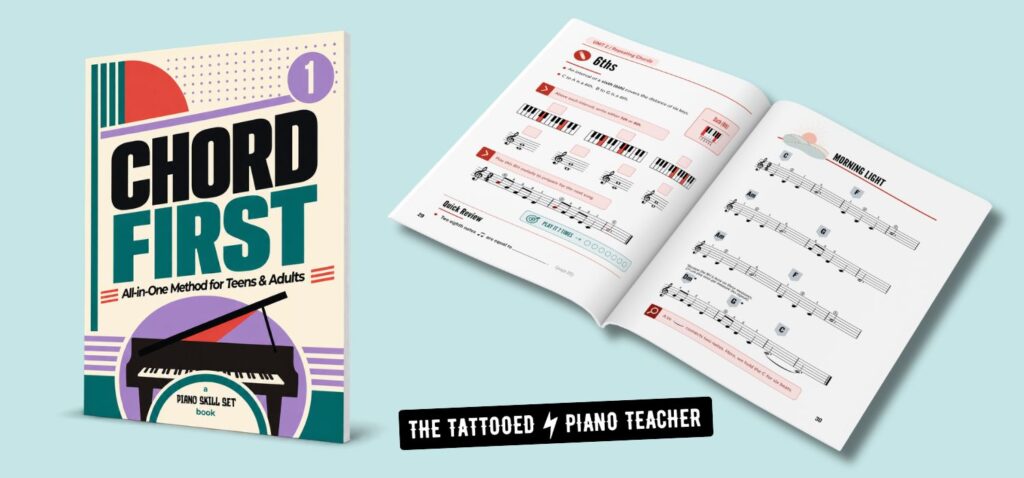
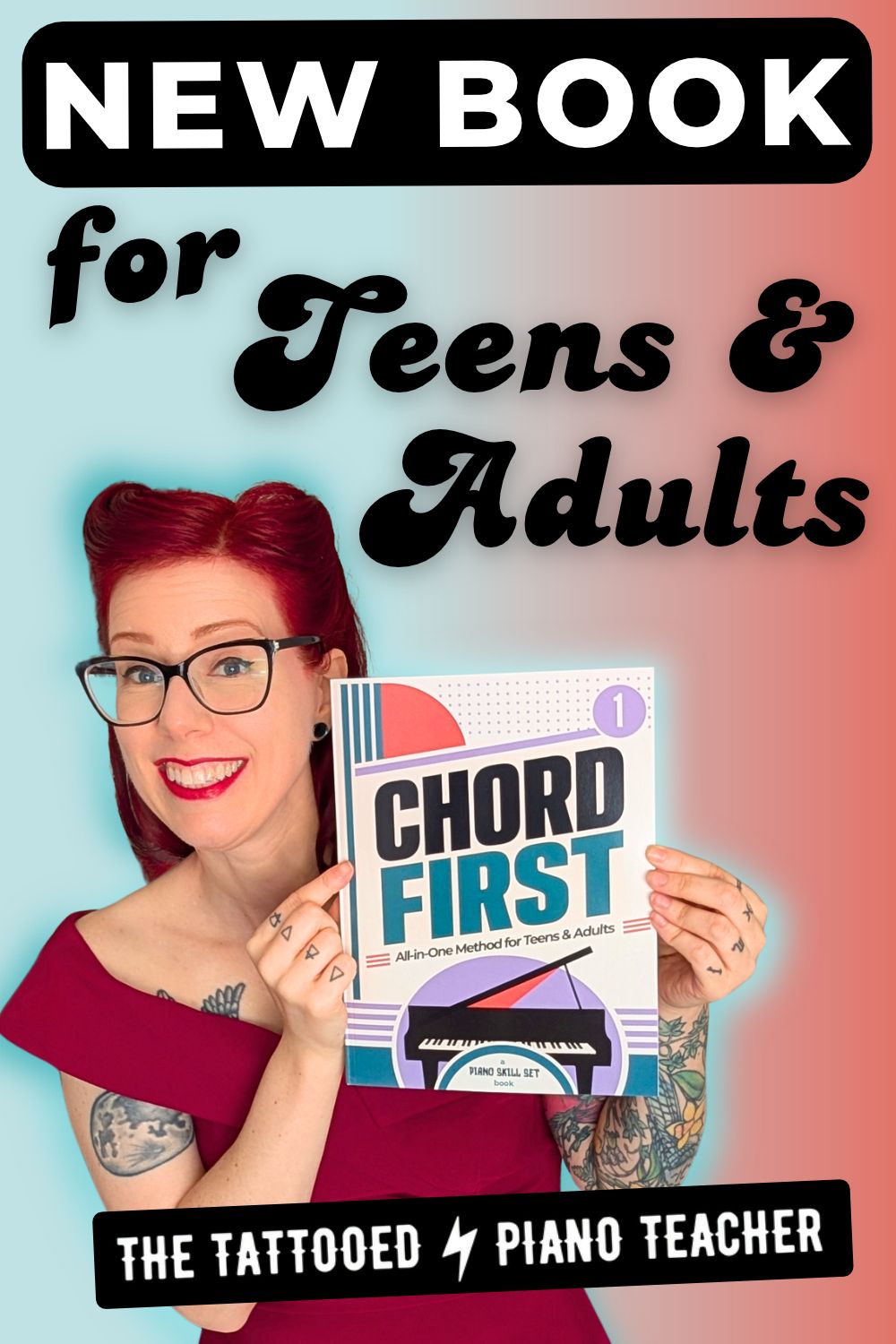
Chord First is an all-in-one piano method series designed specifically for teen and adult beginners. It combines lead sheet playing, chords, theory, technique, improvisation, composition, and traditional note reading into one accelerated method.
The goal is pretty simple:
Get older beginners playing music that actually sounds satisfying as quickly as possible, without skipping the skills they’ll need later.
Why I Wanted a Different Method for Older Beginners
There are some really great piano methods out there for teens and adults.
But I kept running into the same problem.
A lot of traditional methods begin by keeping students in a very limited five-finger position while they slowly build note-reading skills. Pedagogically, there are reasons for that. But for an older beginner who has been listening to music for 15, 25, or 50 years?
Those first pieces can feel…a little underwhelming.
Older beginners often want to play music that sounds like music right away.
They want chords. They want recognizable patterns. They want to understand why the music works. They want to move around the piano. And many of them are interested in pop, jazz, lead sheets, improvisation, or accompanying themselves and others.
So instead of treating those skills as something we introduce later, Chord First begins there.
What Does “Chord First” Actually Mean?
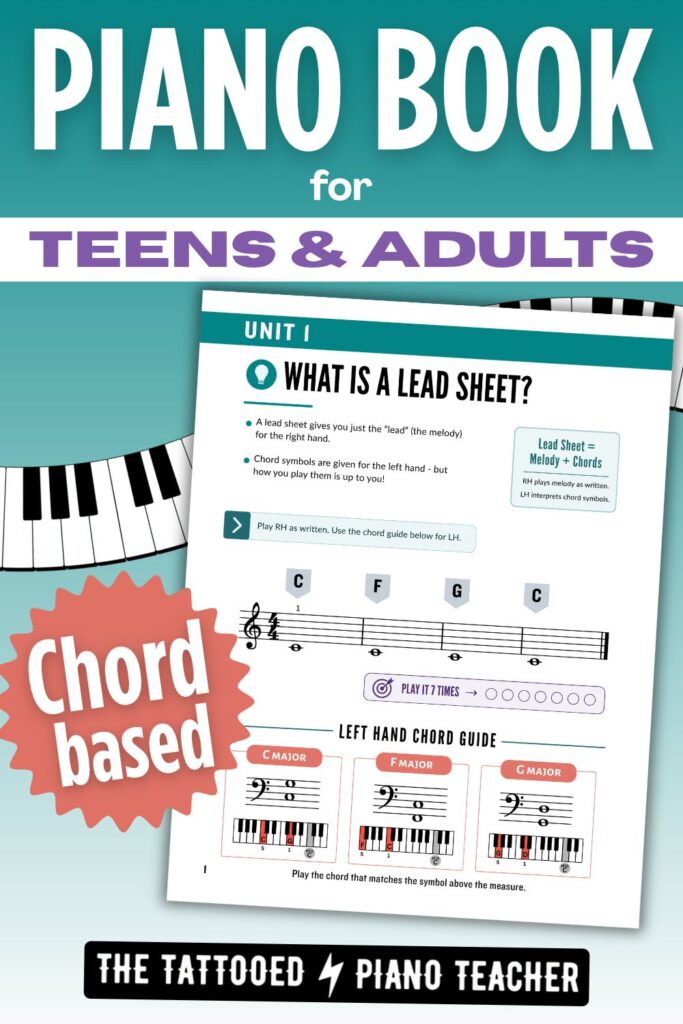
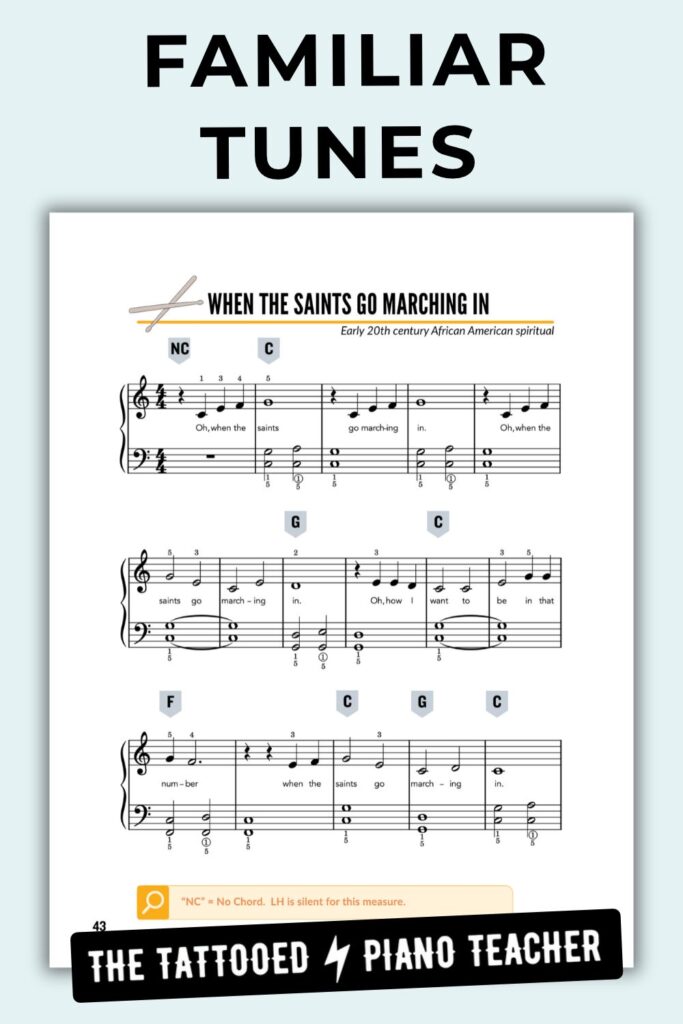
Students begin by learning to read chord symbols with the left hand while reading a simple melody on the treble staff with the right hand.
In Book 1, the left hand initially plays chords as open fifths.
So instead of asking a brand-new student to immediately read two staves at once, they can focus on reading the melody while learning how chords work underneath it.
And suddenly, beginner music sounds much fuller.
From there, the method gradually expands.
Students learn more chords, inversions and slash chords, broken chord patterns, blues patterns, rhythmic variations, improvisation, composition, and eventually more traditional bass clef reading as well.
It’s not a lead sheet book pretending to be a method book.
And it’s not a traditional method book with a couple chord symbols thrown in.
It’s a hybrid.
Can Chord First Replace a Traditional Piano Method?
Yes.
Chord First can absolutely be used as a standalone method.
But it’s important to understand that it does not follow the exact same progression as a traditional method book.
Students are still learning to read music, but the method does not spend as much time drilling two-staff reading from the beginning.
Instead, there is more emphasis on:
- Chord fluency
- Lead sheet reading
- Harmonic understanding
- Moving comfortably around the keyboard
- Improvisation
- Composition
- Contemporary playing patterns
- Theory
- Technique
For some students, that is exactly what I want.
For others, I may use Chord First alongside another method.
It can also work really well as a supplemental book for later-elementary students who already read music but have had very little experience with chords or lead sheets.
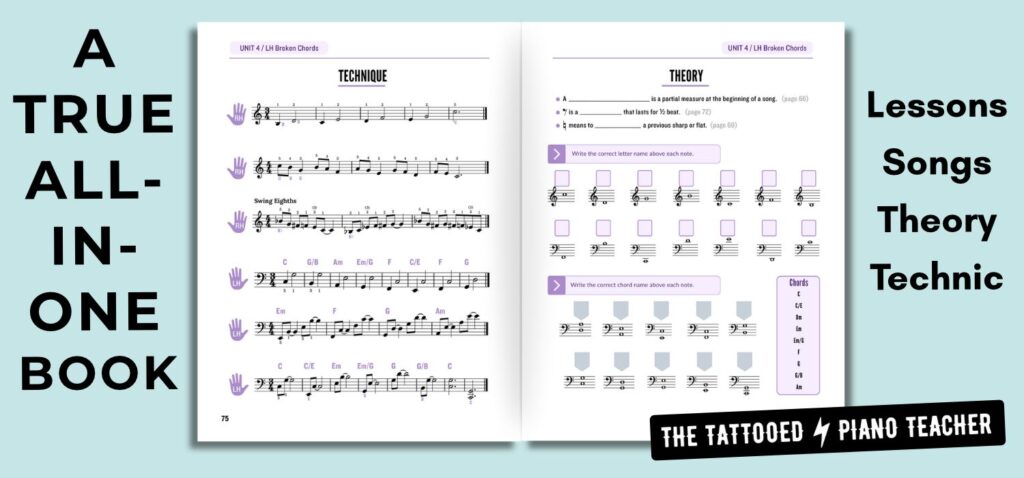
What Students Learn in Chord First Book 1
Book 1 contains four units, with each unit building on the chord and reading skills introduced before it.
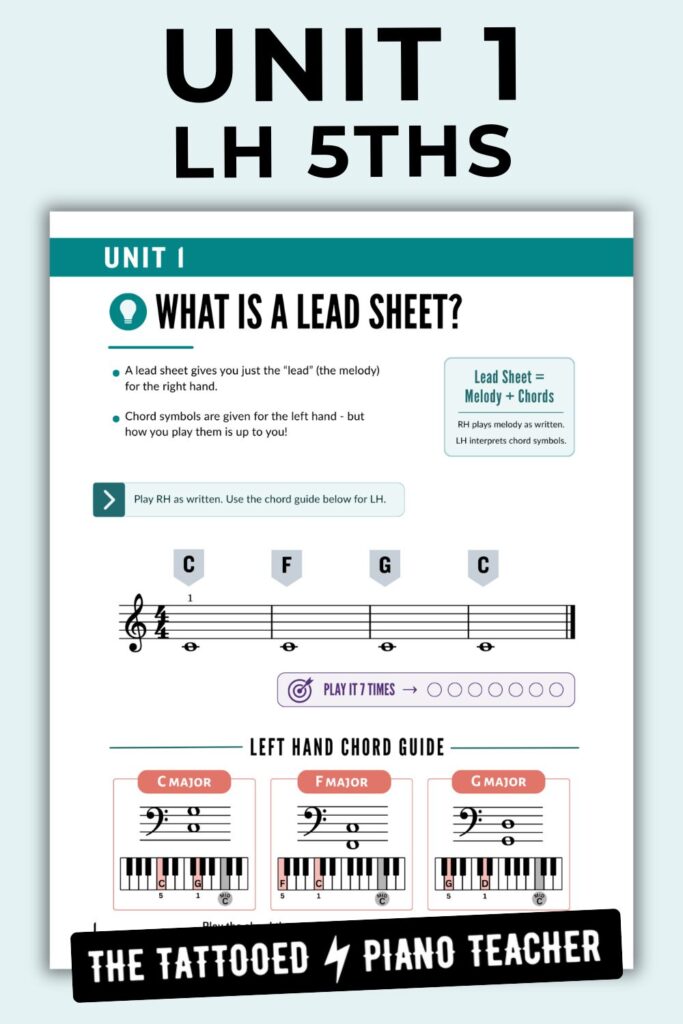
Unit 1: I-IV-V Chords + Basic Melody Reading
Students begin with three chords in C Major:
C, F, and G
The left hand plays these as open fifths.
Meanwhile, the right hand begins reading C through G on the treble staff using simple rhythms including quarter notes, half notes, and whole notes.
This means students can begin playing hands together without trying to decode two full staves of music at once.
Familiar pieces in this unit include Au Clair de la Lune and Ode to Joy, both selected because they work beautifully using only I, IV, and V chords.
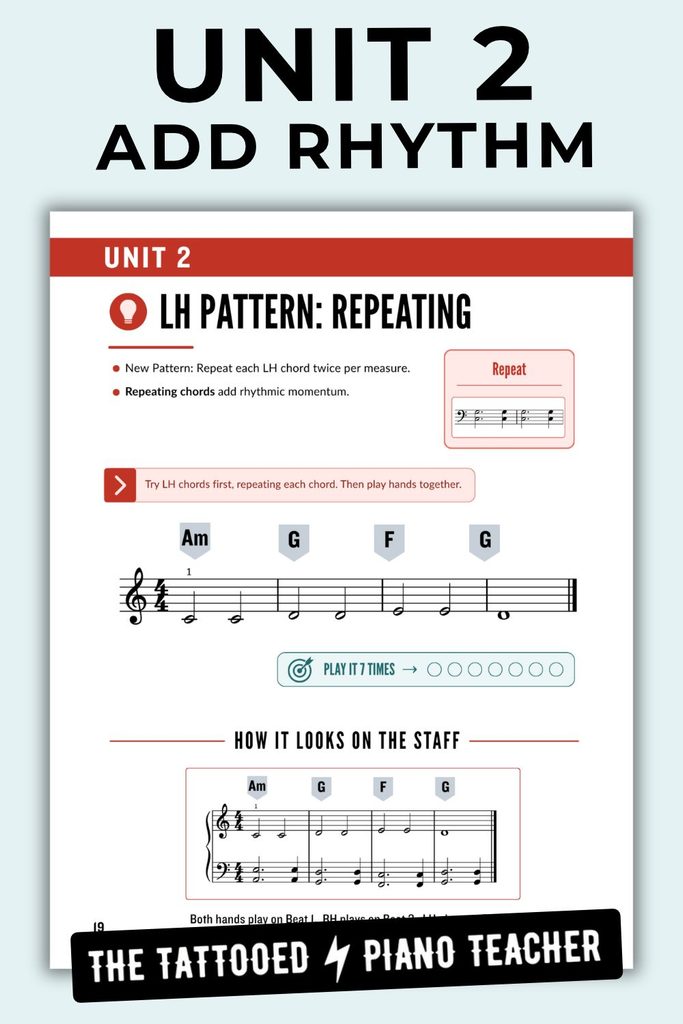
Unit 2: Expanding the Chord Vocabulary
Next, students add:
E minor, A minor, and D minor
They also begin repeating chords rhythmically instead of holding one long chord underneath the melody.
The right hand expands beyond the original five-note range, introducing larger intervals and a wider section of the keyboard.
Students also learn a simplified version of Pachelbel’s Canon, transposed to C Major.
This is where the music really starts to feel less like “beginner piano music” and more like actual piano playing.
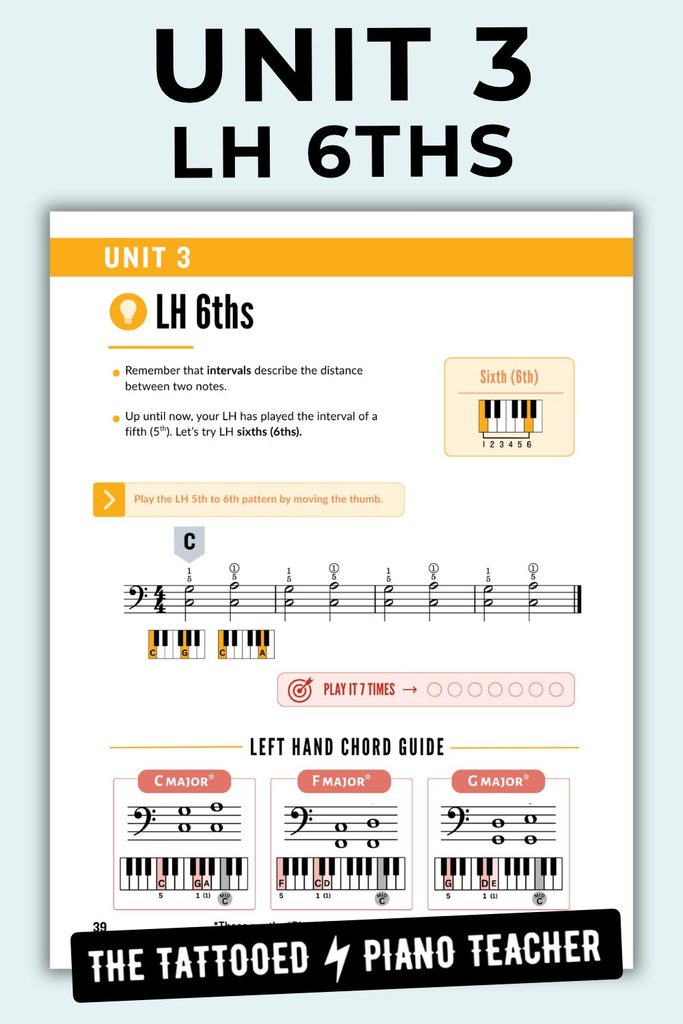
Unit 3: Slash Chords, Blues, and Swing
In Unit 3, students expand some left-hand shapes from fifths to sixths.
That opens up two especially fun possibilities.
First, students can begin experimenting with simple boogie-woogie and blues bass patterns.
Second, they can begin playing slash chords and inversions.
For example:
C → G/B → Am
That little bit of bass movement creates a much more sophisticated sound without requiring difficult technique.
The right hand begins exploring sharps, flats, swing eighth notes, and blues-based melodies.
This unit includes pieces like When the Saints Go Marching In, along with several original blues and swing pieces.
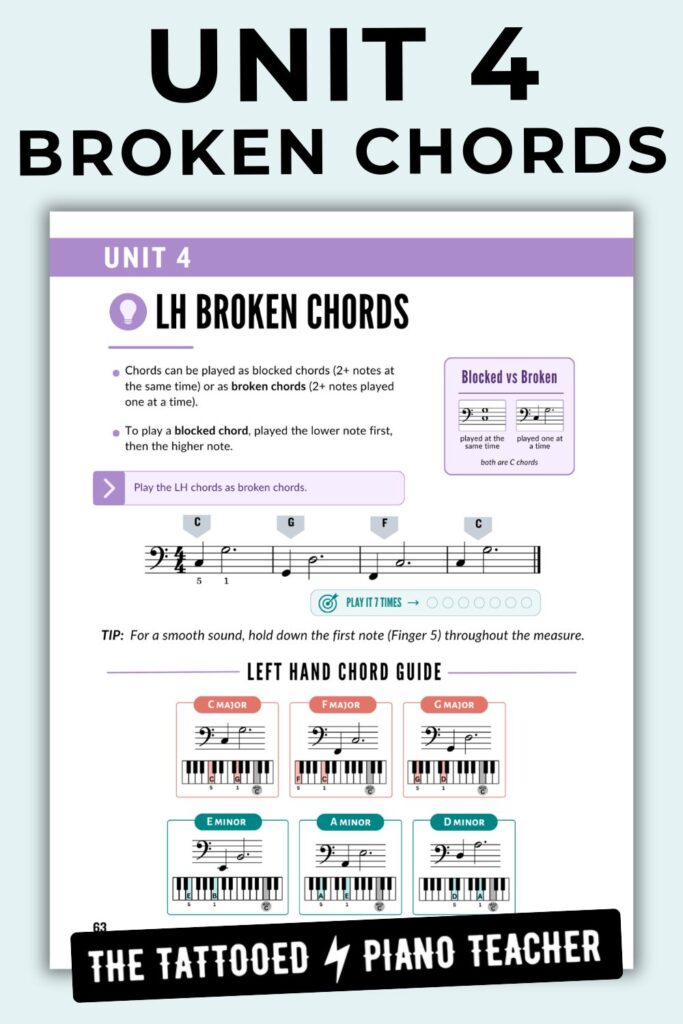
Unit 4: Broken Chords (2-note Arpeggios)
The final unit introduces broken chord patterns.
Since students are still working primarily with simple two-note left-hand shapes, the broken chords stay very manageable.
For example, a C chord might simply become:
C → G
And an A minor chord:
A → E
That one change introduces a completely different texture and requires a new level of coordination between the hands.
Students also begin exploring the blues scale and more jazz-influenced sounds.
The familiar piece in this unit is Brahms’ Lullaby.
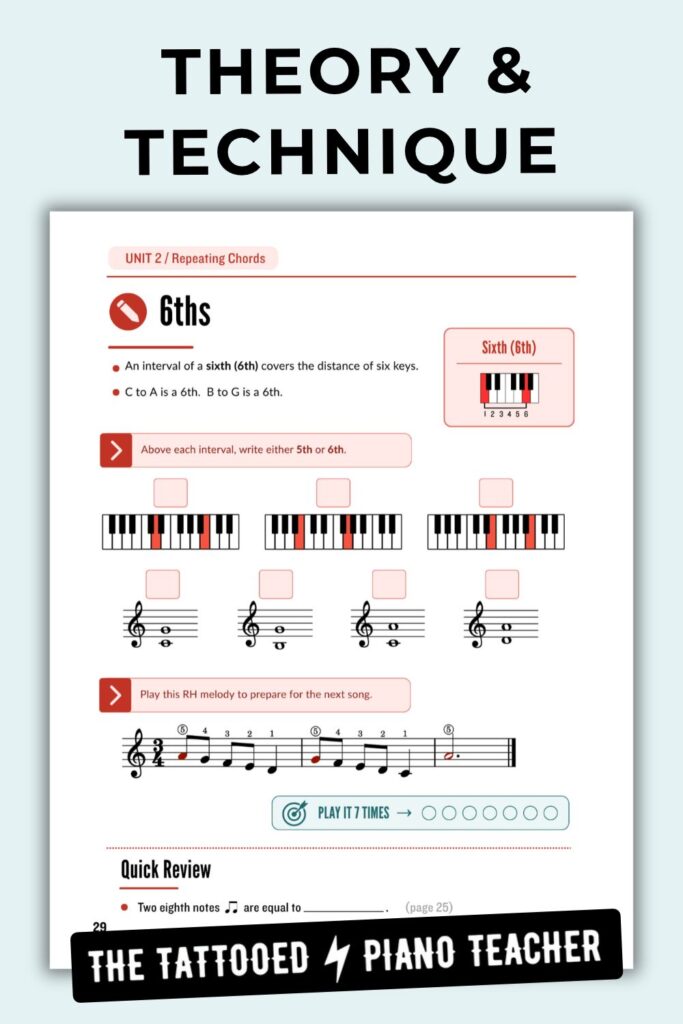
Theory and Technique Are Still Part of the Method
One thing that was really important to me when creating Chord First was making sure that a modern approach didn’t mean throwing traditional piano skills out the window.
Students still need technique.
They still need theory.
They still need to understand intervals, rhythms, scales, chords, accidentals, and how music is organized.
So those concepts are built directly into the method.
Throughout each unit, students encounter technique exercises and short theory assignments connected to whatever concept they are currently learning.
At the end of every unit, students also receive:
- A dedicated theory review
- A technique or warm-up page
- A comprehensive unit checklist
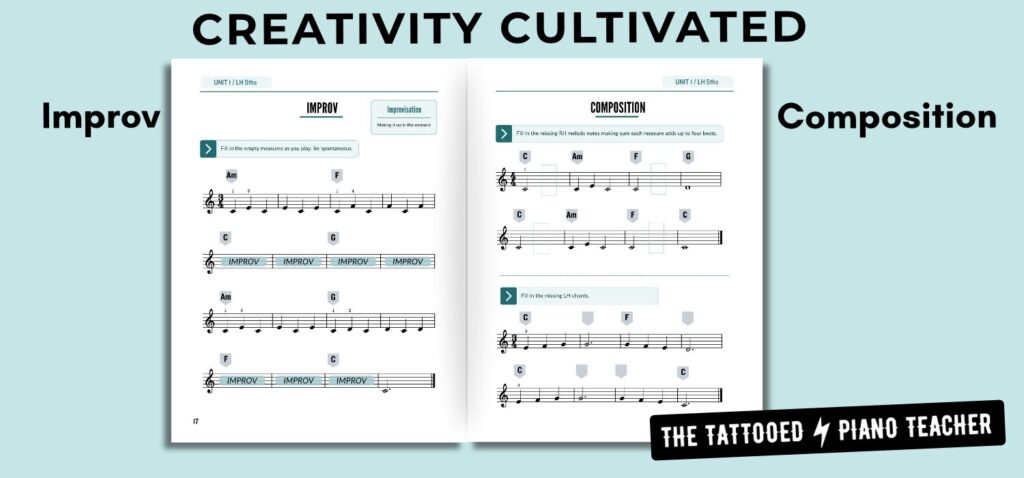
- An improvisation project
- A composition project
The improv projects combine written music with sections students create on the spot.
The composition projects give them a partially completed piece and ask them to fill in certain measures themselves.
So improvising and composing aren’t treated as advanced skills reserved for “creative students.”
They’re simply part of learning piano.
Why Start Older Beginners With Lead Sheets?
This is probably the biggest philosophical difference between Chord First and a traditional beginner method.
Lead sheets allow students to do a lot very early.
They can move their hands around the keyboard.
They can learn how chords function.
They can experiment with different accompaniment patterns.
They can improvise.
And they can play music that sounds full and satisfying before their note-reading skills have completely caught up.
That does not mean we stop teaching students to read music.
It means we don’t make advanced-looking music dependent on advanced reading skills.
Those two abilities can grow alongside one another.
And for a lot of older beginners, I think that creates a much more motivating learning experience.
Familiar Music + Original Pieces
Chord First includes a mixture of public-domain familiar pieces and original music.
In Book 1, students will encounter familiar pieces including:
- Au Clair de la Lune
- Ode to Joy
- Pachelbel’s Canon
- When the Saints Go Marching In
- Brahms’ Lullaby
The original pieces cover contemporary, traditional, blues, jazz, and other styles.
I wanted students to experience a variety of sounds instead of feeling like every beginner piece belongs to the exact same musical world.
You can hear all of the songs in Books 1-3 as audio recordings at ChordFirst.com/Listen or as video demos below:
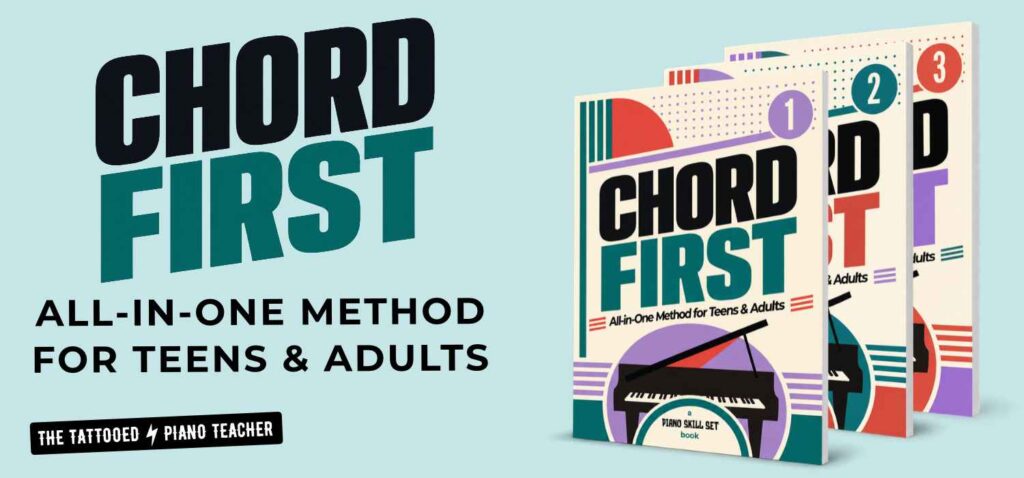
Chord First Has Grown Into a Full Series
When I originally introduced Chord First, only Book 1 existed.
That has changed.
Chord First Books 1, 2, and 3 are now available.
Each book has its own page at ChordFirst.com, where you can learn more about the level, see what is included, and listen to recordings of the music.
All of the recordings for the published books are now available on the website as well.
Book 4 is currently in progress and will be published before the end of 2026.
Books 5 and 6 are planned for 2027.
I’m also slowly building a collection of video tutorials for Book 1. The link to those tutorials is included inside the front cover of the books so students can access additional help at home.
Eventually, I want Chord First to be more than a stack of method books.
I want it to be a complete learning system that works equally well for students studying with a teacher and motivated adults working independently.
Which Students Would I Use Chord First With?
I’d consider Chord First for:
- Teen beginners
- Adult beginners
- Older beginners who want a faster-moving method
- Students interested in pop, jazz, chords, or lead sheets
- Students who enjoy improvisation and composition
- Transfer students with decent reading skills but weak chord knowledge
- Later-elementary students who need more experience playing from chord symbols
- Students who are bored by traditional beginner repertoire
It will not be the perfect method for every student.
No method is.
But if you’ve been wishing there were another option for older beginners, especially one that gets them playing chords and more satisfying music right from the beginning, Chord First may fill that gap.
Take a Look at Chord First
If this sounds like an approach that would work for some of your teen or adult students, you can explore the complete series at ChordFirst.com.
You’ll find individual pages for Books 1, 2, and 3, information about what students learn at each level, recordings from the books, and links to order your own copies through Amazon.
Visit ChordFirst.com to explore the series and see whether Chord First belongs on your piano teacher bookshelf.