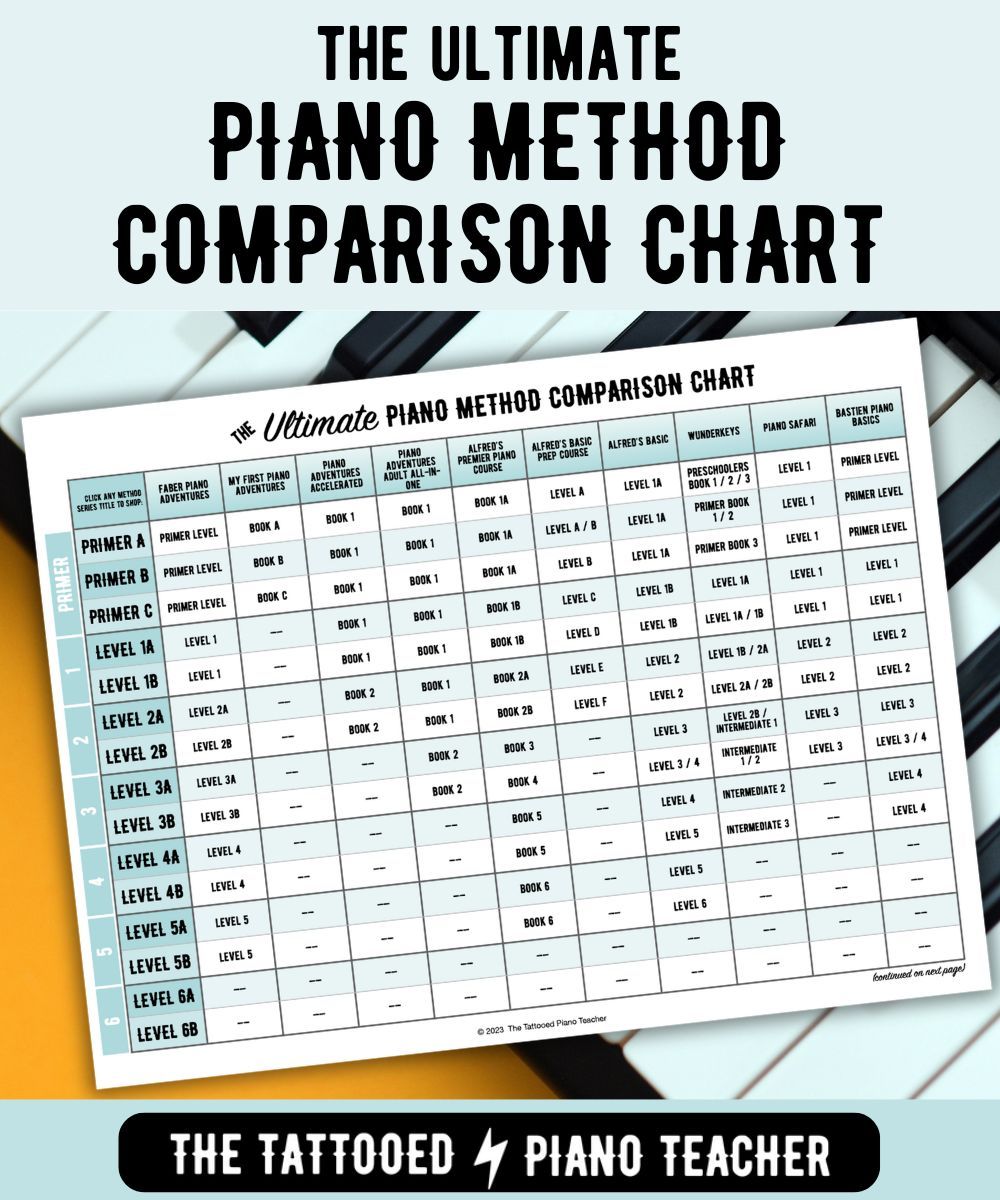
Finding the right piano method for older beginners can be tricky. Tweens, teens, and adult beginners are often ready to move at a faster pace than younger students, but they still need a solid foundation in note reading, rhythm, technique, and theory. And, of course, they want to play music that actually sounds good!
That’s where WunderKeys Pop Staff Piano for Older Beginners takes a unique approach.
Rather than relying entirely on traditional grand staff notation, this three-book series introduces a special Pop Staff that allows students to play contemporary-style accompaniments while learning to read music.
But does this unconventional approach actually work? And can these books provide a well-rounded piano education?
In this WunderKeys Pop Staff review, I’ll take you inside Books 1–3 to explore the pacing, notation, hand positions, theory, technique, and repertoire. I’ll also compare the series to other popular piano methods for older beginners and share how I’ve started incorporating these books into my own piano studio.
What Is WunderKeys Pop Staff Piano for Older Beginners?
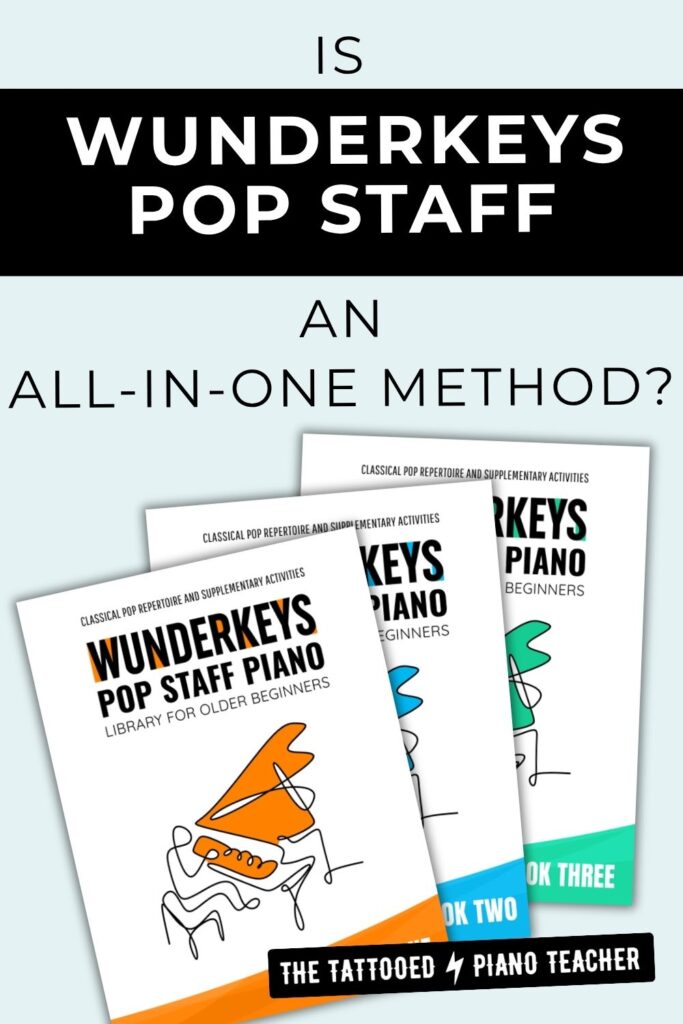
The WunderKeys Pop Staff Piano Library for Older Beginners is a three-book series by Andrea Dow, designed for students ages 11 through adult.
The series includes:
- WunderKeys Pop Staff Piano for Older Beginners, Book 1
- WunderKeys Pop Staff Piano for Older Beginners, Book 2
- WunderKeys Pop Staff Piano for Older Beginners, Book 3
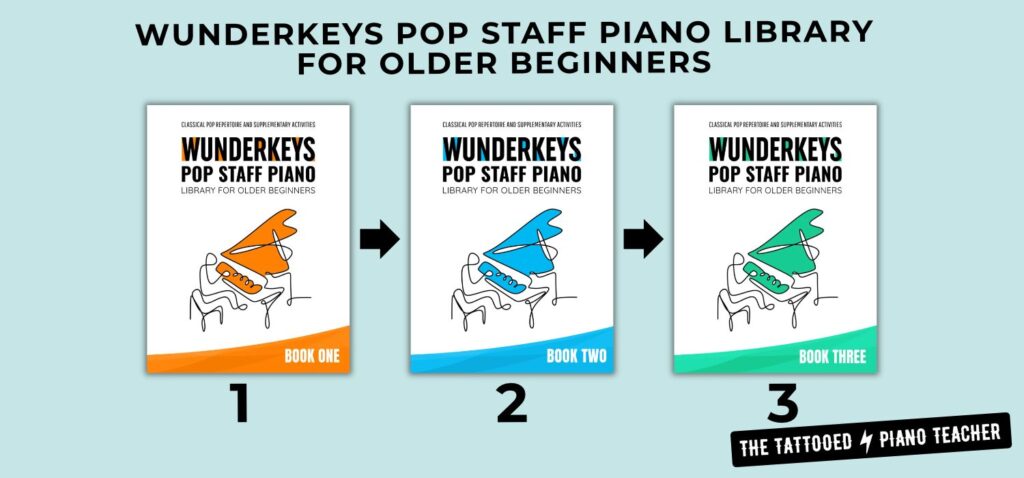
Book 1 is designed for students who are brand new to the piano. By the end of Book 3, students may be ready to transition into the WunderKeys intermediate-level materials.
What makes this series different from other older beginner piano methods is its approach to notation. Instead of requiring students to read every note on the grand staff from the beginning, Pop Staff combines traditional note reading with a simplified, chord-based notation system.
This allows students to play contemporary-sounding music with surprisingly full accompaniments, even while their note-reading skills are still developing.
But how does that approach affect the overall learning experience?
Pacing: How Quickly Do Students Progress?
Older beginner piano methods tend to move at an accelerated pace compared to traditional children’s methods. After all, an 11-year-old beginner and a 5-year-old beginner have very different learning capabilities!
Compared to other older beginner methods, I would describe the pacing of WunderKeys Pop Staff as slow to moderate, although there’s an important distinction to make.
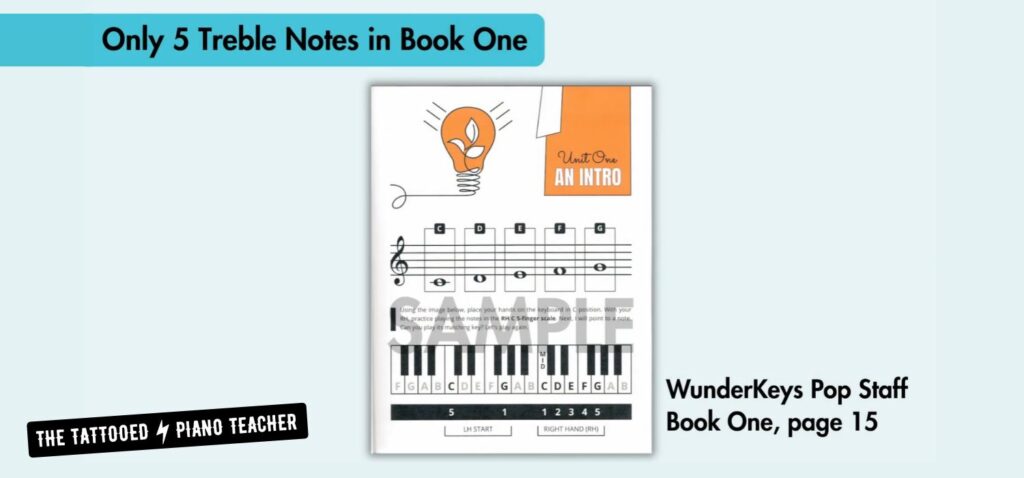
When it comes to note reading, the progression is quite gradual.
Students spend a considerable amount of time learning just a handful of notes on the staff before expanding into additional five-finger positions. Compared to Faber’s Accelerated Piano Adventures, for example, Pop Staff introduces new notes at a slower pace.
However, when it comes to physical coordination and movement around the keyboard, the opposite is true!
Pop Staff students are asked to move their left hands between different chord shapes almost immediately. This is something that more traditional methods might not introduce until considerably later.
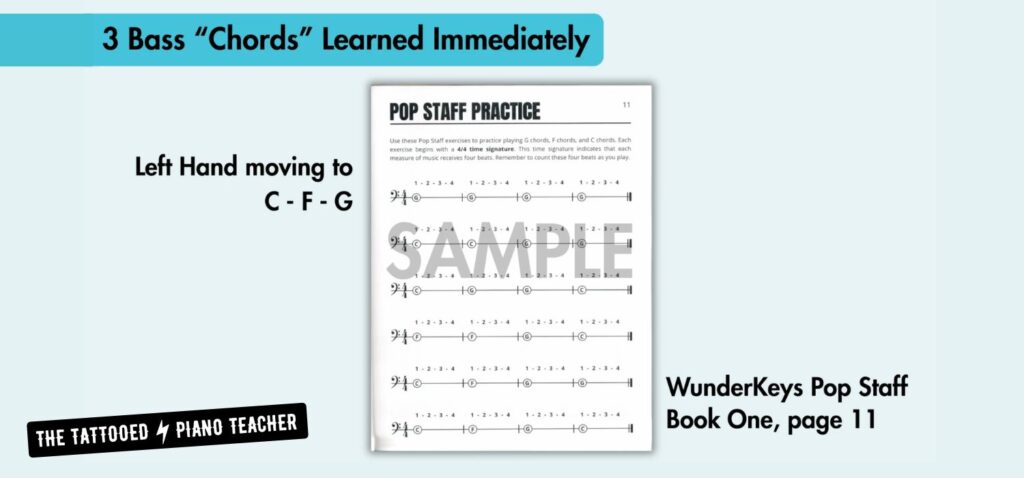
So, while students are progressing slowly through the fundamentals of note reading, they’re simultaneously developing skills that we typically associate with more advanced playing.
My takeaway: Pop Staff isn’t necessarily a slow method all around, nor is it an accelerated method. It simply prioritizes different skills at different stages of the learning process.
The Pop Staff: A Unique Approach to Piano Notation
This is where things get really interesting!
The defining feature of the series is something Andrea Dow calls the Pop Staff.
Essentially, this is a simplified lead sheet format that combines traditional treble clef notation with chord-based instructions for the left hand.
Here’s how it works.
Right Hand: Traditional Note Reading
The right hand reads notes on the treble staff, just as it would in a traditional piano method.
Students begin with a limited number of notes and gradually expand their reading skills as they progress through the books.
Left Hand: Pop Staff Chords
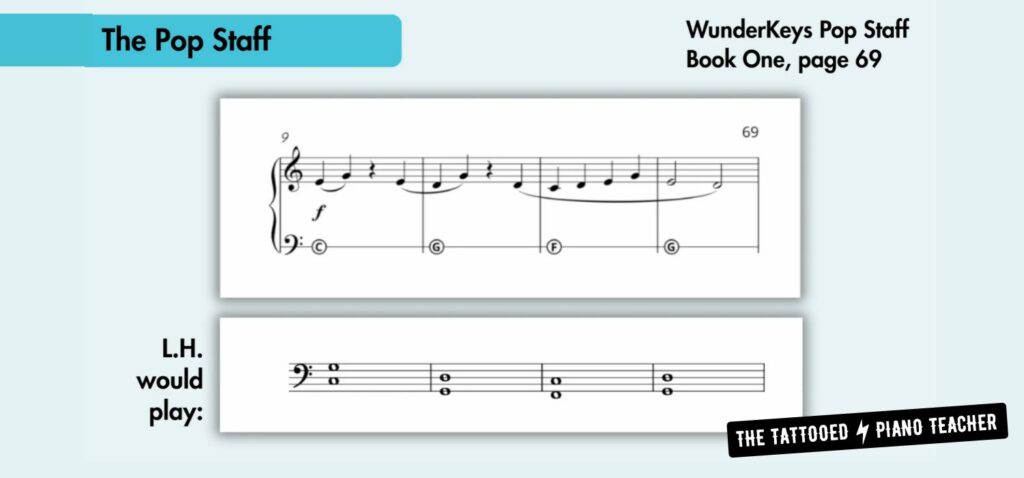
Instead of reading every left-hand note on the bass staff, students are introduced to circled letter names that indicate which open fifth to play.
For example, a student might encounter a C chord symbol and play the notes C and G together in the left hand.
By moving between these open fifths, students can create full-sounding pop accompaniments without needing to read complicated bass clef notation.
And this is what makes the series so unique!
A student might be playing a right-hand melody consisting of just three or four notes, but the changing left-hand harmonies make the piece sound much more sophisticated.
But Do Students Learn Bass Clef?
Yes!
One concern teachers might have about this approach is whether students will eventually learn to read traditional grand staff notation.
Fortunately, Pop Staff doesn’t abandon the bass clef.
Throughout the series, students encounter three different types of notation:
- Pieces using Pop Staff chord notation for the left hand
- Pieces written entirely in traditional grand staff notation
- Pieces that combine traditional bass clef notation with Pop Staff chord symbols
This hybrid approach allows students to develop traditional reading skills while continuing to enjoy the contemporary accompaniments that make these books distinctive.
I particularly like the possibilities this creates for students who have only experienced traditional piano methods.
Even if a student is already comfortable reading the grand staff, Pop Staff can introduce them to a different way of interpreting written music.
And that’s a valuable skill!
Hand Positions: Restrictive or Expansive?
If you’re familiar with WunderKeys method books, you probably know that the series tends to rely heavily on five-finger positions.
Students learn the notes within one position, become comfortable reading and playing those notes, and then move into a new position.
The Pop Staff series follows this same general philosophy.
However, there’s an interesting twist.
Five-Finger Positions in Books 1–3
Book 1: Students focus on reading the notes of the C five-finger scale in both hands, while also learning to play left-hand Pop Staff chords.
Book 2: The series continues developing reading skills within the C five-finger position, alternating between traditional notation and Pop Staff accompaniments.
Book 3: Students expand into G and D five-finger positions, including new notes and black key patterns. Left hand Pop Staff chords also become more varied, introducing shapes that incorporate black keys.
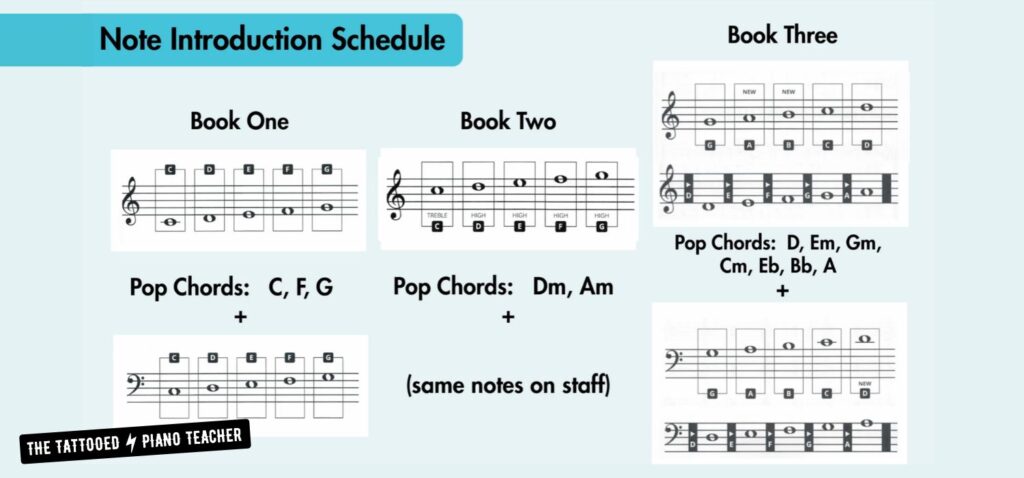
So, from a note-reading perspective, the books are fairly restrictive.
Students spend a significant amount of time within a limited range of notes before moving on.
But physically, the left hand is anything but stationary!
Because students are moving between open fifths, they’re exploring different areas of the keyboard from the very beginning.
This creates an interesting combination of positional reading and keyboard exploration.
Students have the security of a familiar five-finger position when reading traditional notation, while their left hand develops confidence moving around the keyboard.
I think this is one of the strongest pedagogical features of the series.
Does WunderKeys Pop Staff Include Music Theory?
Yes, but perhaps not in the way you might expect.
There is no separate theory workbook designed specifically to accompany the Pop Staff series.
Instead, theory activities are incorporated directly into the lesson books.
These include:
- Note naming activities
- Rhythm exercises
- Sight-reading activities
- Simple improvisation opportunities
One thing WunderKeys does particularly well is reinforcing note recognition and rhythm.
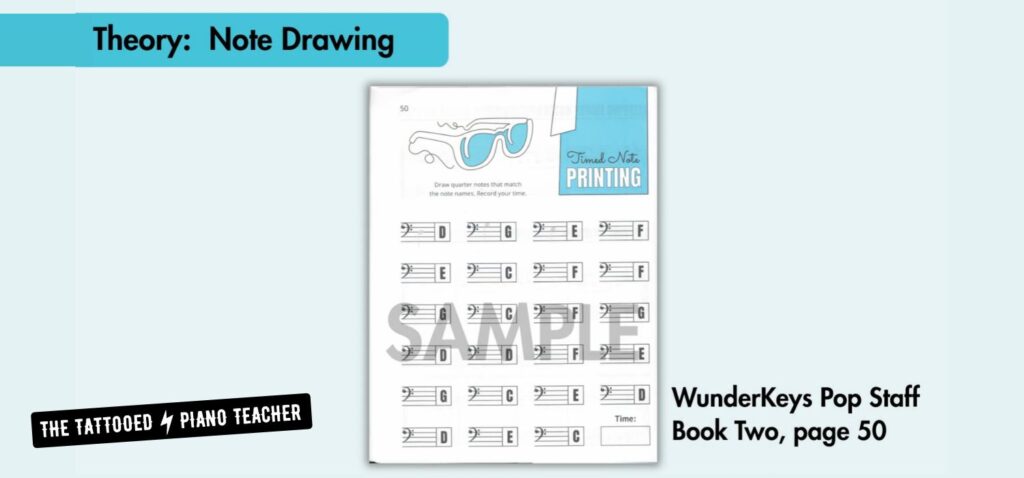
There are plenty of opportunities for students to practice identifying notes and working with rhythmic patterns, and I appreciate that these activities are built directly into the books.
I also love seeing improvisation included!
It’s not something we find in every traditional piano method, and it fits nicely with the contemporary, chord-based approach of Pop Staff.
Where I Think the Theory Falls Short
Although theory is included, I wouldn’t describe it as a comprehensive theory curriculum.
Concepts such as dynamics, musical terminology, and note values are introduced, but they don’t always receive the kind of repeated written reinforcement that you might find in a dedicated theory workbook.
Instead, WunderKeys takes what I would describe as a project-based approach to theory.
Students learn the concepts they need to understand and perform the music in front of them.
And for certain students, especially older beginners who are eager to play actual songs, that might be exactly what they need!
However, if your goal is a comprehensive music education that includes a strong foundation in written theory, I would consider supplementing these books with additional theory activities.
How Does Pop Staff Approach Piano Technique?
Like theory, technique is incorporated directly into the Pop Staff lesson books rather than presented in a separate companion book.
Students encounter scales as new five-finger positions are introduced, along with short technical exercises designed to reinforce specific playing skills.
These exercises are generally brief, often just a single line of music.
The idea is that students will practice and repeat these exercises over the course of a week or two to develop the necessary skills.
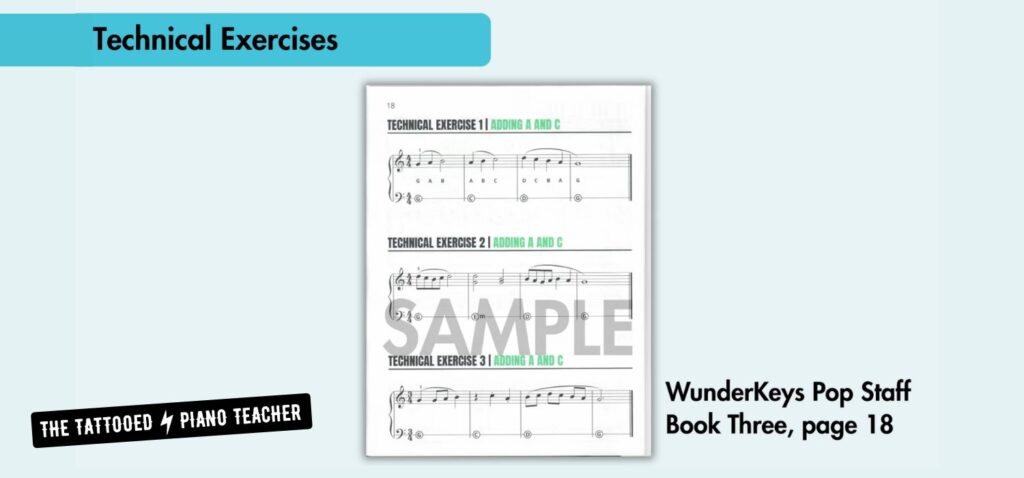
However, I have a personal observation about this style of technical exercise.
In my own teaching experience, these short exercises sometimes end up functioning more like sight-reading assignments than dedicated technique practice.
A student reads through the exercise, plays it successfully, and moves on.
That doesn’t necessarily mean they’ve developed the technical fluency the exercise was intended to build!
Would I Supplement Technique?
For most students, yes.
Although Pop Staff introduces technical concepts, it doesn’t provide a particularly structured routine for reviewing scales and developing technical fluency over time.
For example, students learn new five-finger scales as they progress, but there isn’t necessarily an expectation built into the books that they continue practicing previously learned scales every day.
That responsibility falls on the teacher.
Again, I think this comes back to the project-based philosophy of the series.
The emphasis is on learning the skills necessary to play the music successfully.
And for an older beginner who is primarily interested in playing contemporary music for enjoyment, this approach could be a great fit!
But for students interested in classical repertoire, more advanced jazz, or a comprehensive technical foundation, I would absolutely consider adding a dedicated technique routine.
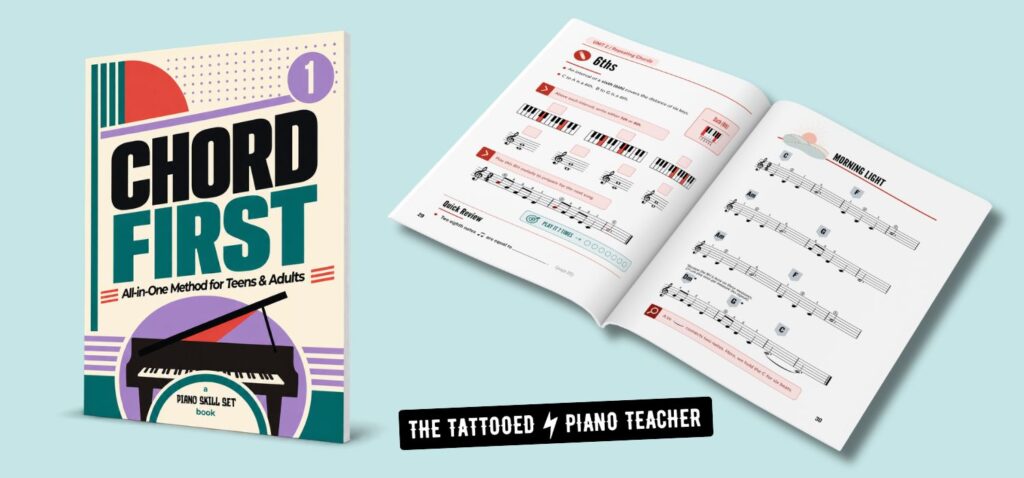
Love the Lead Sheet Approach? Meet CHORD FIRST!
If you love the idea of teaching older beginners through lead sheets but want a more comprehensive approach to music theory and technique, I’d love to introduce you to my own piano method series!
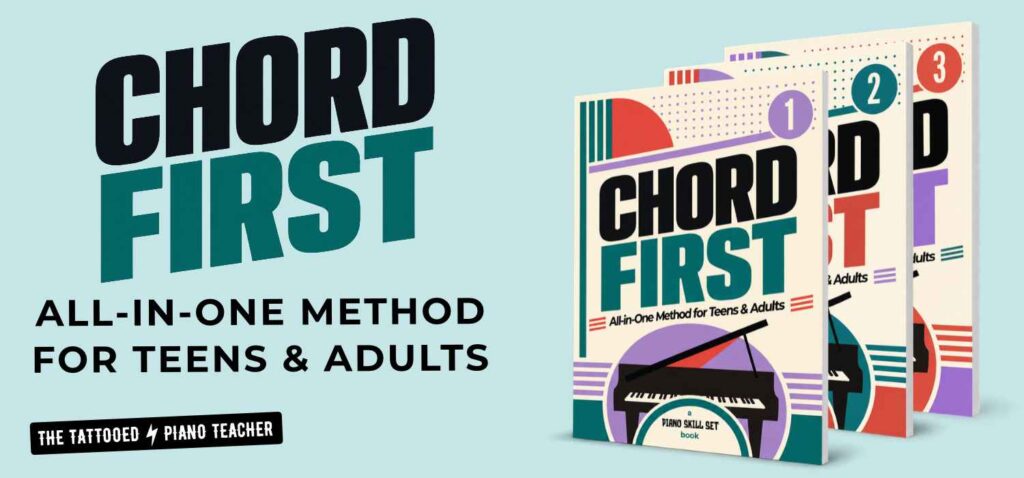
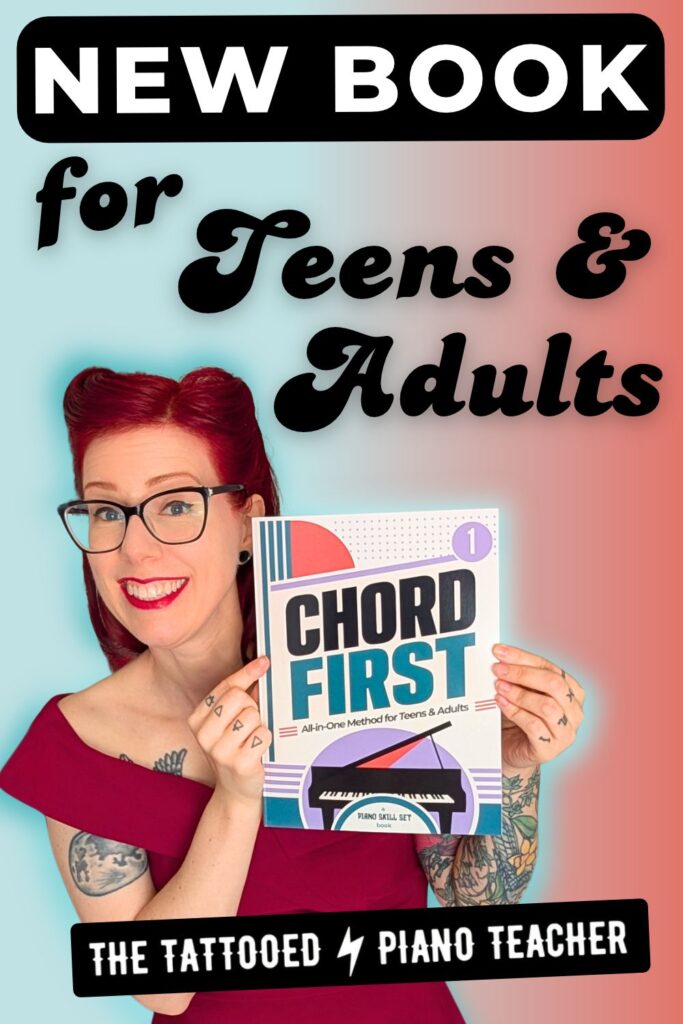
CHORD FIRST: All-in-One Piano Method for Teens & Adults shares some similarities with WunderKeys Pop Staff. Both methods introduce students to reading melodies on the treble staff while using simple left-hand fifths to create full-sounding accompaniments.
But CHORD FIRST takes a more structured approach to developing those skills.
Throughout the series, students gradually expand their chord vocabulary while working through dedicated theory exercises, technical warm-ups, and unit reviews. Improvisation and composition are also incorporated into every unit, encouraging students to understand and experiment with the music they’re playing.
The goal is to help older beginners develop strong note-reading, chord-playing, theory, and technique skills, all within a single method book.
Books 1–3 are currently available, with additional levels on the way!
Explore CHORD FIRST Books 1–3 and listen to the recordings at ChordFirst.com
Book Design and Aesthetics
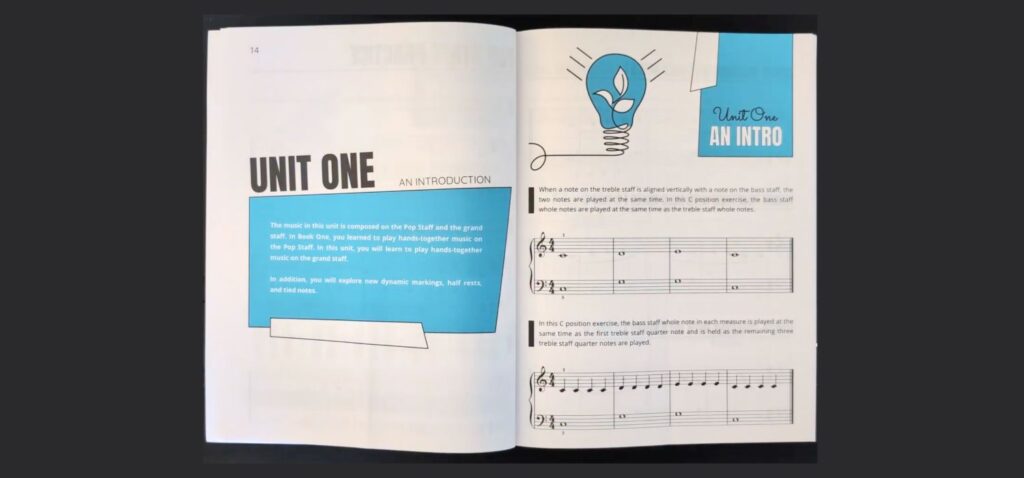
The Pop Staff pages have a clean, modern appearance, using mostly black and white with a single accent color. The note charts and chord diagrams are particularly well done, with simple, easy-to-understand layouts that allow students to quickly find the information they need.
This is especially important when introducing an unfamiliar notation system, since we don’t want the page design to create additional confusion. I also appreciate that the books manage to look age-appropriate without becoming boring.
They don’t have the colorful, cartoon-heavy appearance of many children’s method books, but they aren’t overly serious or intimidating either. I could see these books appealing to an 11-year-old, a teenager, or an adult beginner.
The line-art illustrations are a little unusual, and I’m still not entirely sure how I feel about them! They’re modern, a little quirky, and certainly not childish, so they do fit the overall aesthetic.
Overall, I think WunderKeys did an excellent job creating a visually appealing series that works for such a wide age range.
Song Selection: Classical Themes Meet Contemporary Pop
The Pop Staff books describe their repertoire as classical pop, but what does that actually mean?
Many of the pieces are inspired by themes from classical compositions, although those themes are often transformed so significantly that students may not recognize the original melodies.
Sometimes you’ll hear a familiar classical idea, while other pieces borrow just a small fragment of a classical theme before developing it into something entirely new.
So, despite the word classical appearing on the covers, I would describe most of the repertoire as contemporary-style music that sounds largely original.
Why the Music Sounds So Good
I think the repertoire is where Andrea Dow’s strengths as a contemporary composer really shine.
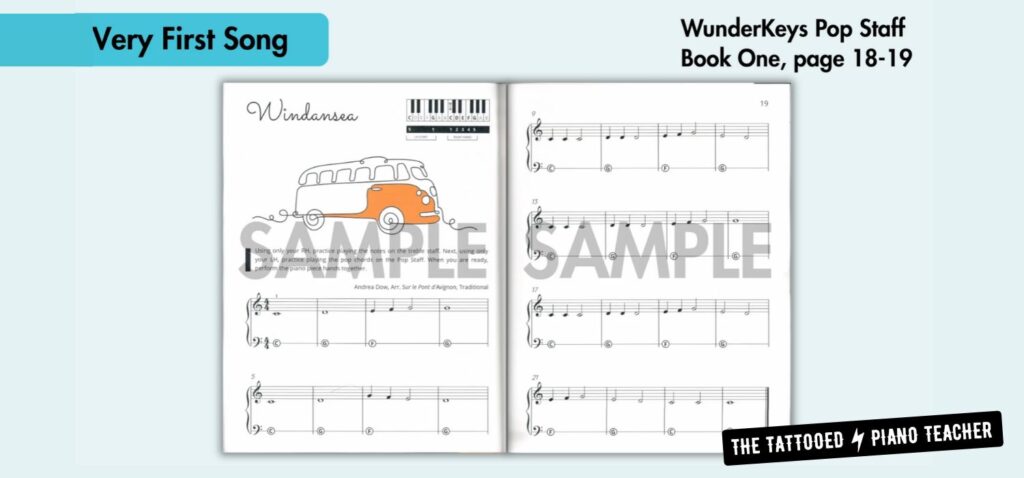
Although the right-hand melodies are relatively simple due to the limited five-finger positions, the changing left-hand harmonies make even the simplest pieces sound surprisingly full and engaging.
Students get to experience satisfying pop-style chord progressions without needing advanced note-reading skills. Compared to many traditional beginner methods, this can make the music feel more rewarding early on, especially for older beginners eager to play something impressive!
The trade-off is a lack of variety in musical styles. Teachers wanting to introduce classical, folk, jazz, and other genres will likely need to supplement the repertoire. But for students who love contemporary music, Pop Staff has a lot to offer.
This is where adding a book like Chord First will branch out to more diverse styles!
Pricing and Availability
At the time of my review, each WunderKeys Pop Staff book was priced at approximately $15.
The books are printed through Amazon and are available for purchase there.
Considering that each book includes lesson material, repertoire, written activities, and some technical exercises, I think the price is reasonable.
And since there aren’t multiple required companion books for each level, teachers and families aren’t necessarily purchasing an entire stack of materials at once.
However, that brings us to an important question.
Is WunderKeys Pop Staff an All-in-One Piano Method?
Andrea Dow describes Pop Staff as a hybrid teaching tool, and I think that’s an appropriate description.
Each book incorporates several components that would traditionally be spread across multiple books in a piano method series.
There’s lesson material introducing new concepts, written theory activities, sight-reading and rhythm exercises, technical studies, and full-length repertoire pieces.
In that sense, Pop Staff theoretically functions as an all-in-one method.
But does it provide everything a student needs for a well-rounded piano education?
That depends on the student.
If you’re working with an older beginner who is primarily interested in learning contemporary-style music, developing basic reading skills, and enjoying the process of playing piano, these books could serve as an excellent foundation.
However, for students who want a more traditional or comprehensive piano education, I think there are some areas that would benefit from supplementation.
What Would I Add to Pop Staff?
One of the things I love about teaching piano is that we don’t have to rely on a single method book to provide absolutely everything.
We can build a curriculum around the individual student’s needs!
Here are a few resources I would consider pairing with Pop Staff.
1. A Traditional Piano Method Book
For students who need a stronger emphasis on traditional grand staff reading and a broader progression of musical concepts, I might pair Pop Staff with an appropriate level of Piano Adventures.
This would allow students to experience both approaches simultaneously.
2. A Dedicated Theory Book
For more comprehensive theory instruction, I would consider adding a written theory workbook.
My own Piano Skill Set series includes writing books that can be used independently of a specific piano method.
I’ve also reviewed the Essential Elements theory books, which offer another option worth exploring for older beginners.
3. A Dedicated Technique Book
If you want a more structured approach to scales, finger patterns, and technical development, a separate technique book could be helpful.
Again, the Piano Skill Set technique books are one option.
You might also consider technique materials from Piano Safari, depending on your student’s needs and learning style.
4. Supplemental Repertoire
For students who would benefit from exploring different musical styles, I would add occasional pieces from another repertoire collection.
Faber’s Piano Adventures library includes a wide variety of supplemental books, including the PlayTime, ShowTime, and FunTime collections.
These can provide opportunities to explore different styles while continuing to develop reading skills.
And if you simply want more music that complements the WunderKeys approach, Andrea Dow’s Rock Repertoire for Teens books are another possibility.
These provide additional contemporary-style repertoire in traditional notation.
The important thing is to choose supplements based on what your student actually needs, rather than automatically adding more books just for the sake of having them.
5. A Hybrid Method
For students who are thriving in the chord/lead sheet approach, but just need more reinforcement…perhaps a more comprehensive method with theory and technique built in,
Consider CHORD FIRST! This is my own method book series written for teens and adults as an accelerated all-in-one method series for older beginners.
How I’m Using Pop Staff in My Own Piano Studio
After exploring all three books, I think WunderKeys Pop Staff books could work very well for a teen or adult beginner who is motivated by contemporary music and prefers a project-based learning experience.
However, I don’t think it’s the perfect primary method for most older beginners, at least as a standalone method book.
And that’s okay!
Using Pop Staff as Supplemental Material
This is how I’ve been using the books with some of my current students.
For students who are following a more traditional method and have developed some confidence reading the grand staff, I’ve been introducing Pop Staff as supplemental repertoire.
It’s a fun way to expose them to a different notation format and encourage them to think about music beyond individual notes on the staff.
I’ve also found myself pulling these books off the shelf for sight-reading activities in a lead-sheet-style format.
For students who have become very dependent on traditional notation, this can be a great opportunity to explore chord-based playing and develop a little more flexibility at the keyboard.
Final Thoughts: Would I Recommend WunderKeys Pop Staff?
Overall, I’m very happy to have the WunderKeys Pop Staff series in my collection of piano teaching resources. The unique notation system offers something genuinely different from traditional older beginner methods.
I love how the books allow students to create contemporary-sounding music early in their learning journey, and I appreciate the thoughtful visual design and gradual approach to note reading.
The biggest strengths, in my opinion, are the…
- Accessible note-reading progression
- Early left-hand mobility
- Engaging contemporary-style repertoire.
The biggest limitations are the…
- Relatively narrow range of reading positions
- Less comprehensive approach to theory and technique
- Specificity of the style of literature.
But those limitations don’t necessarily make Pop Staff a poor choice. They simply mean that teachers need to understand what the series prioritizes and decide whether those priorities align with their students’ goals.
For a project-based learner who loves pop music, this could be an excellent fit. For a student pursuing a more traditional path, it might work best as supplemental repertoire alongside another method.
Either way, I think Pop Staff brings something valuable to the world of older beginner piano methods.
Watch My Complete WunderKeys Pop Staff Review
Want to see inside the books and hear examples of the music?
Watch my complete video review on The Tattooed Piano Teacher YouTube channel, where I walk through Books 1–3 and share a closer look at the notation, repertoire, and teaching approach.
Watch the WunderKeys Pop Staff Review on YouTube
And now I’d love to hear from you!
Have you used WunderKeys Pop Staff in your piano studio? Do you use it as your primary method, or do you pair it with other teaching materials?
Share your experience in the comments! I’d love to hear what has worked for you and your students.
Check Out Chord First All-in-One Method for Teens & Adults
And if you want to explore a similar, but more comprehensive alternative, please check out my new books: Chord First!
You can learn more about these books in an article I wrote all about Chord First Book 1 here,
Or preview and listen to the songs from all three Chord First books on the official website.