As piano teachers, we often talk about finding the “right” curriculum, method book, pacing, or teaching style.
But lately, I’ve been thinking about something different:
What if great teaching has less to do with finding the perfect system… and more to do with learning how to truly respond to the student sitting in front of us?
For me, student-led piano lessons don’t mean abandoning structure or letting students completely run the show. It means recognizing that every student experiences music differently, learns differently, communicates differently, and connects with lessons differently.
And honestly? I think this kind of teaching is actually more work for the teacher, not less.
What Are Student-Led Piano Lessons?
Student-led piano lessons focus on adapting instruction around the individual student rather than forcing every child through the exact same musical path.
This does not mean:
- letting students avoid challenges
- removing structure from lessons
- eliminating technique or theory
- abandoning educational goals
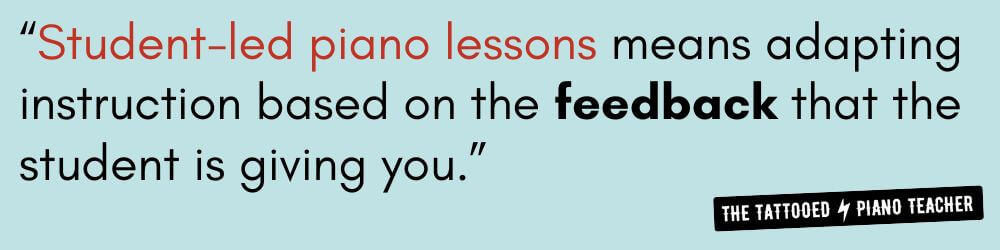
Instead, it means the teacher is constantly observing how the student responds to different teaching approaches, repertoire choices, activities, pacing styles, and lesson environments.
A student-led teacher asks questions like:
- Does this student enjoy this repertoire?
- Are they emotionally connecting with this method book?
- Do they seem energized or discouraged during lessons?
- What types of music naturally spark curiosity?
- What learning style helps this student feel successful?
Sometimes the answer is continuing forward.
Sometimes the answer is changing direction entirely.
Why Student-Led Teaching Is More Work for Piano Teachers
Traditional teacher-led lessons often follow a predictable structure:
- Assign pages
- Correct mistakes
- Move through the curriculum
- Prepare for the next level
Student-led teaching requires something much more complex.
The teacher has to:
- prepare multiple pathways
- recognize subtle emotional feedback
- adapt in real time
- notice engagement patterns
- balance structure with flexibility
- evaluate whether the current approach is truly working
And the hardest part?
Many students will never directly tell you when something feels wrong.
Especially younger children.
Especially shy children.
Especially students who are naturally people-pleasers.
That means piano teachers have to become highly observant.
How Students Give Feedback Without Saying Anything
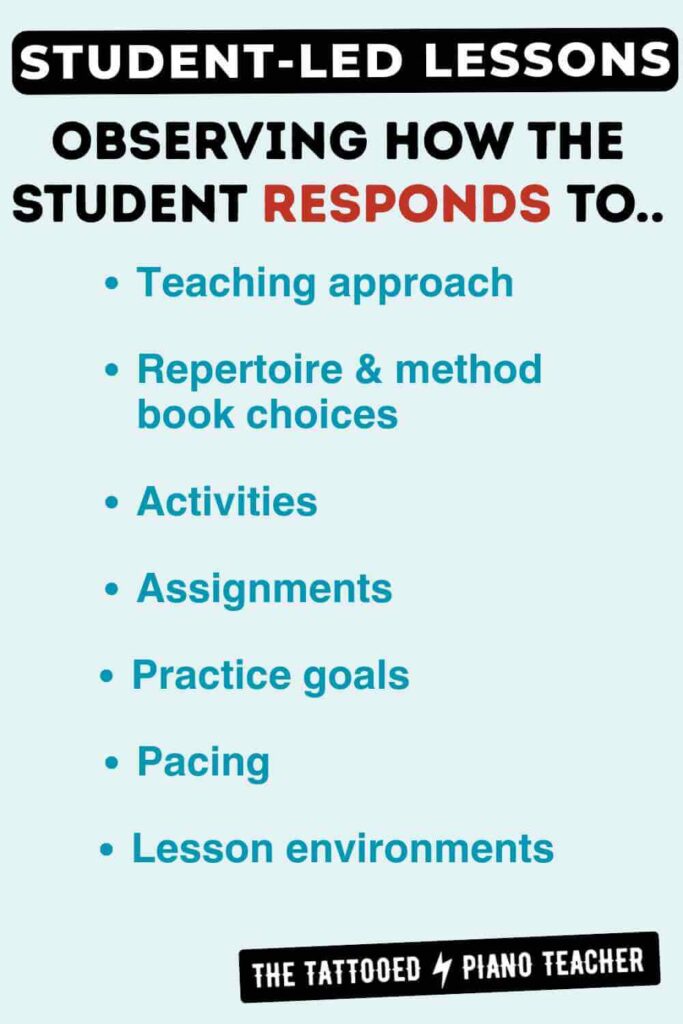
One of the biggest mindset shifts in student-led teaching is realizing that everything in a lesson is feedback.
Sometimes students communicate clearly.
But often, they communicate indirectly.
For example:
- A student suddenly becomes more engaged during improvisation activities.
- A child lights up when lessons include pop music.
- A student avoids eye contact during theory work.
- A student willingly plays by ear but shuts down during note reading.
- A student repeatedly talks during certain activities but focuses deeply during others.
These are not random behaviors.
They are information.
And sometimes that information should influence the direction of lessons.
Being Willing to Change Piano Curriculum Midway
This is the part many teachers struggle with.
We often feel pressure to “finish the book.”
But sometimes finishing the book is not actually serving the student.
Student-led teaching may require saying:
- “We’re switching method books.”
- “Let’s try a different style of repertoire.”
- “This pacing isn’t working.”
- “This student needs more creativity.”
- “This student needs more structure.”
- “This approach isn’t creating connection.”
That flexibility can feel uncomfortable because teachers naturally become attached to systems, routines, and philosophies that have worked well in the past.
But students are not identical.
And piano education shouldn’t assume they are.
Quiet Students vs. Talkative Students in Piano Lessons
Student-led teaching also applies to personality differences.
Some students sit silently through entire lessons. They barely react, barely speak, and barely express emotion outwardly.
Those students require teachers to become incredibly observant. Over time, you begin noticing subtle cues:
- leaning forward during favorite activities
- replaying songs after the lesson technically ended
- asking one small question after weeks of silence
- showing increased focus during certain styles of music
Other students are the complete opposite.
They talk constantly.
And many piano teachers immediately feel pressure to redirect:
“We only have 30 minutes.”
“We need to stay on task.”
“The parents are paying for this.”
Now obviously, lessons cannot become 30-minute social visits about pet iguanas.
But sometimes conversation is part of how a child regulates themselves enough to participate in learning.
Sometimes relationship-building is not separate from teaching.
Sometimes it is the teaching.
The Goal of Piano Lessons Is Not Creating Identical Musicians
Not every piano student is trying to become the same kind of musician.
Some students will pursue advanced classical repertoire.
Others may eventually gravitate toward:
- composing
- songwriting
- jazz
- improvisation
- worship music
- accompaniment
- arranging
- playing by ear
And some students may never become advanced performers at all, but will still develop a lifelong relationship with music because someone allowed lessons to feel personal instead of performative.
That matters.
Because the goal of piano lessons should not simply be producing students who can complete curriculum levels.
The goal should be helping students develop a meaningful and lasting connection with music.
Final Thoughts on Student-Led Piano Teaching
Student-led piano lessons do not mean lowering standards.
They mean paying closer attention.
They require teachers to observe more carefully, adapt more intentionally, and remain flexible enough to recognize when a student needs something different.
And honestly, I think the best piano teachers are often the ones paying attention not just to what they are teaching…
…but to who they are teaching.