Many piano students spend years learning to play exactly what’s written on the page, but real-world musicians often do much more than that. They improvise, accompany singers, play by ear, and create their own arrangements.
Lead sheets are a fantastic tool for developing these skills.
By combining a simple melody with chord symbols, lead sheets encourage students to think beyond note-reading and become more independent, creative musicians. In this guide, we’ll explore when to introduce lead sheets, how to teach them, and ways to help students build confidence playing from chord symbols.
What Is a Lead Sheet?
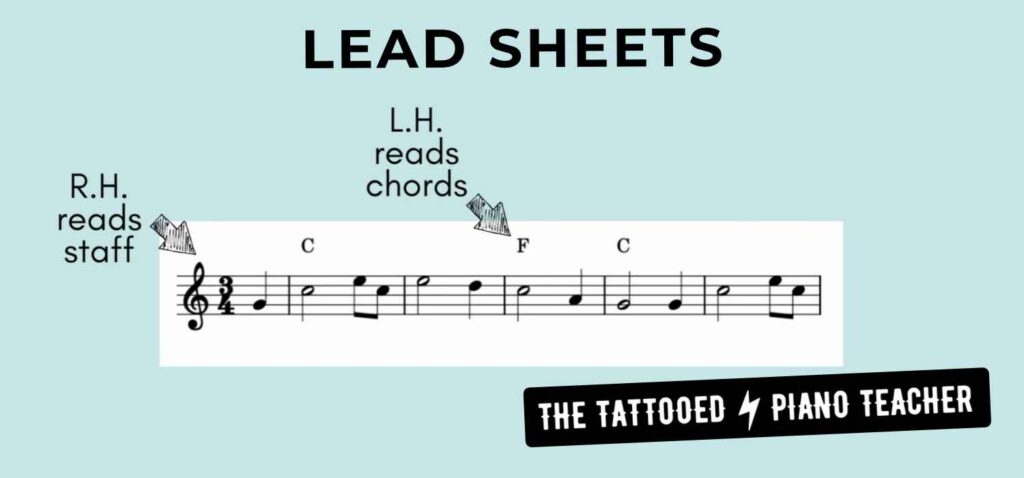
A lead sheet is music showing just the “lead” (melody) with chord symbols.
Chord symbols tell the left hand what chord to play by using a series of abbreviations:
- C = C major triad
- Cm = C minor triad
- C7 = C dominant (major-minor) 7th chord
- CMaj7 = C major 7th chord
- Cm7 = C minor 7th chord
- C2 = C major triad with an added 2nd above the root
And so on.
Why Teach Lead Sheets to Piano Students?
Lead sheets help students develop skills that traditional sheet music often doesn’t. Instead of relying on fully written-out arrangements, students learn to make musical decisions for themselves. They must interpret chord symbols, choose accompaniment patterns, and think about how harmony supports the melody.
The first thing you’ll notice when bringing the wide world of lead sheets into your teaching studio is that simple lead sheets help beginning students sound polished way before reading note-by-note staff music does! Especially for older beginners who want to sound like those people on YouTube on Day 1…a lead sheet using 5ths in the left hand can sound full and professional with little reading needed!
This process strengthens their understanding of music theory in a practical, hands-on way. Chords, inversions, and harmonic progressions stop being abstract concepts and become tools students actively use while playing.
Lead sheets also prepare students for real-world music making. Whether they want to accompany themselves while singing, play in a worship band, jam with friends, perform pop songs, or simply play music for fun, lead sheet skills are incredibly valuable. Outside of piano lessons, musicians are often expected to work from chord charts rather than fully notated scores.
Perhaps most importantly, lead sheets encourage creativity and independence. Students begin to realize that there isn’t always one “correct” way to play a song. They gain confidence experimenting with different accompaniment styles, creating their own arrangements, and making music that reflects their personal tastes and interests.
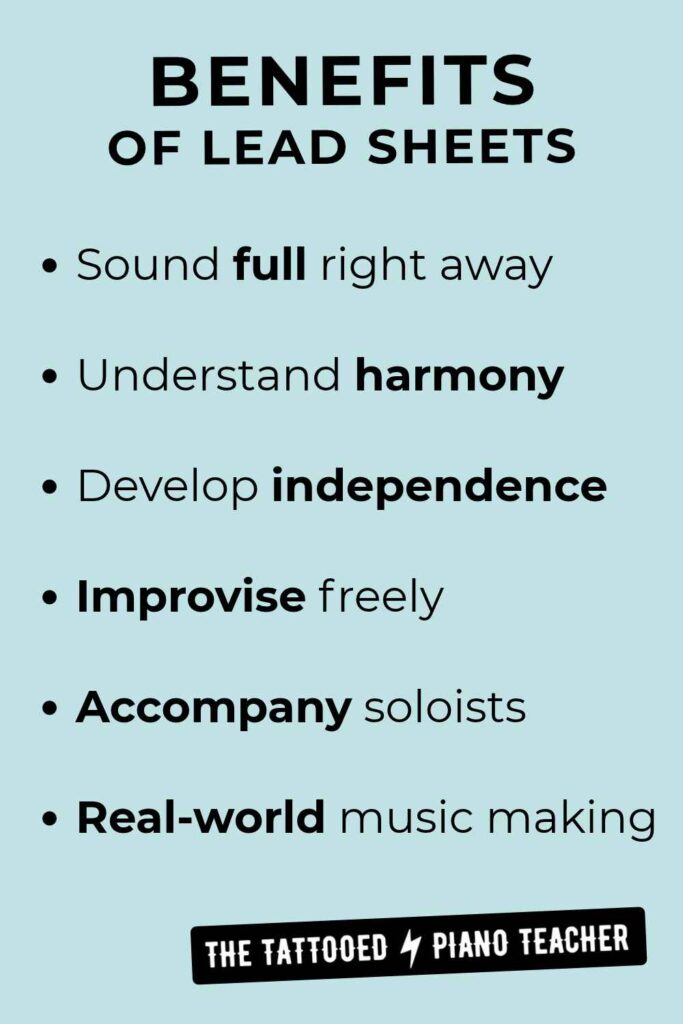
So, to sum up those benefits, lead sheets help students…
- Sound full before staff reading is developed
- Understand harmony
- Develop independence
- Improvise freely
- Accompany singers and other musicians
- Prepare for real-world music making
When Are Students Ready for Lead Sheets?
The truth is, piano students are ready to start learning about lead sheets way earlier than you might think!
As seasoned musicians, we think lead sheet and picture the most complicated voicings from a jazz standard fake book changing every beat.
Lead sheets can start very simply, before students are playing triads!
Don’t just equate lead sheet learning with your advancing teen or adult students. You’ll see far more ease and success introducing simple lead sheet examples early on and building as their coordination, chord technique, and music theory knowledge grows year after year.
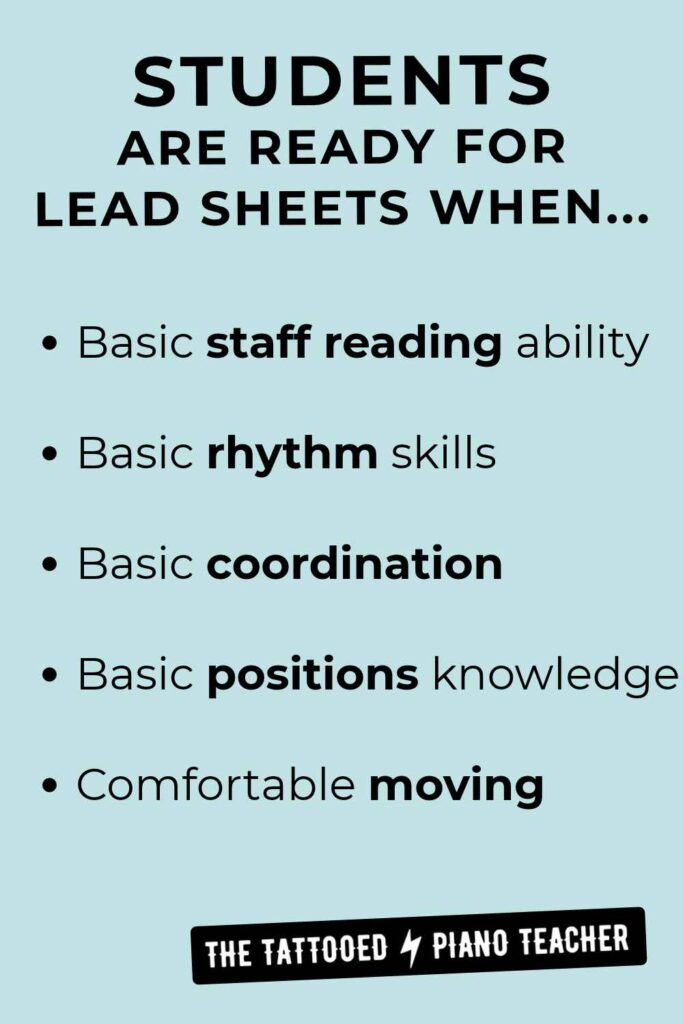
Before starting lead sheets, students should have…
- Ability to read simple melodies (basic staff knowledge)
- Basic rhythm skills
- Basic coordination of the hands together
- Familiarity with 5-finger positions (notice they do not need to know chords to start)
- Comfort finding notes and patterns at the keyboard (they should be able to move positions)
Once they’ve developed these basic skills at the piano, they’re ready to start a first lead sheet project such as this:
Piano Method Books That Introduce Lead Sheets
Depending on which method books you use, you may find lead sheet learning right inside of the books!
Personally, I like to start lead sheet learning earlier and revisit it more often than most method books include, but knowing it’s in the book is a good starting place.
Here are some methods that include lead sheets.
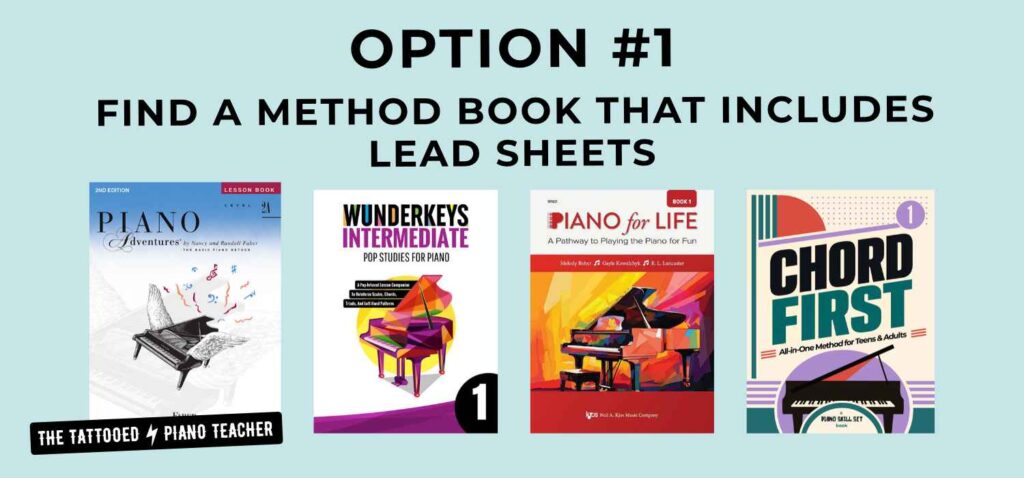
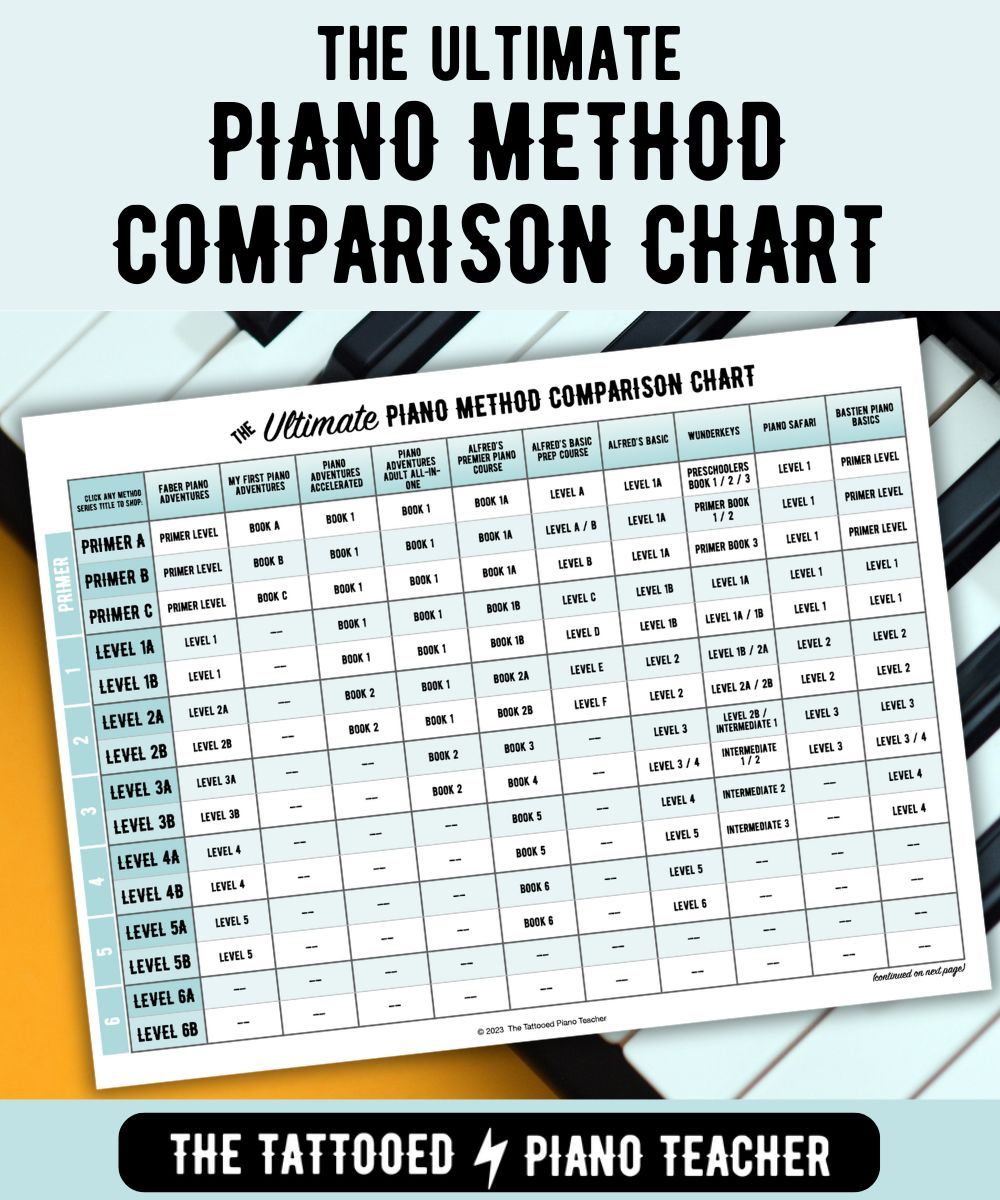
Piano Adventures
Check out my full review of Piano Adventures here.
Starting in the Level 2A Lesson Book, Piano Adventures lesson books all include one lead sheet song with increasingly difficult left hand patterns as the student progresses.
Piano Adventures Adult All-in-One books also include a couple of lead sheet songs.
Shop for Piano Adventures books.
WunderKeys
WunderKeys Pop Staff Books 1-3 use lead sheets almost exclusively. This unique curriculum designed for older beginners (elementary level) uses a “pop staff” where simple left hand chords (played as 5ths) are represented with chord symbols on a line below the treble staff melody.
Check out my full review of WunderKeys Pop Staff here (video).
WunderKeys Intermediate Books 1-3 also include lead sheet songs in every unit with simple, traditional chord symbols above a treble staff.
Kjos Piano for Life
Kjos Piano for Life is new (and new to me!). I haven’t ordered these books yet, but they look interesting! They take a fresh approach to beginner method books for older beginners and adults. One aspect I really liked the sound of…
Lead sheets included in the method books!
I’m sure I’ll be ordering these books soon and posting a review. In the meantime, if you do decide to give these books a try, please leave me a comment and let me know what you think.
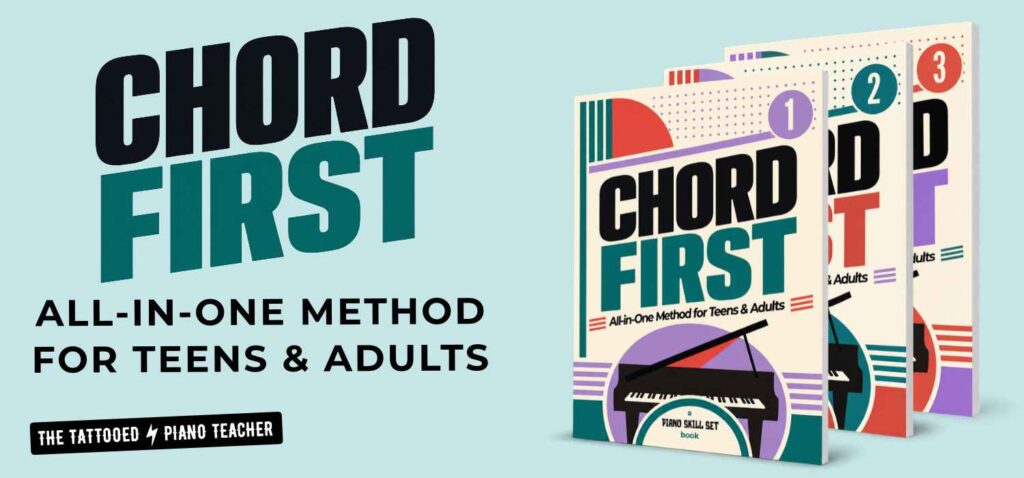
Chord First All-in-One Method for Teens & Adults
In all transparency, this is a book I authored! Chord First All-in-One Method was created for older beginners who want to sound good right away, but not miss out on the theory and technique they would get from a traditional method book.
This hybrid method book includes lots of familiar songs and original contemporary/pop/jazz tunes. It uses simple chord shapes (left hand 5ths and 6ths) to get students playing great-sounding progressions the very first week. But it also teaches staff reading along the way.
Theory and technique are included in every unit as well as composition and improv. And, best of all, all of the songs can be played as lead sheets!
Shop for Chord First All-in-One Method.
Supplemental Books That Use Lead Sheets
Now, if you’re not quite ready to ditch your current piano method books just yet…no worries. There are other options out there.
Before I share some other books with lead sheets, I’d like to suggest simply using one of the above books AS a supplement book alongside your favorite lesson book! For example, if you use Alfred or Bastien books, try pairing them with WunderKeys Pop Staff or Chord First for a truly hybrid and well-rounded lesson experience.
But, let’s talk about some supplemental resources that can also give your students lead sheet practice.
Piano Pronto Lead Sheets
The author of the Piano Pronto method series has a few single-song sheets that show the left hand pattern and invite students to learn a song in lead sheet form.
Shop for Piano Pronto Lead Sheets.
Faber BigTime Supplemental Books
At the BigTime Level (Level 4), Faber supplemental books add chord symbols above the music. While these songs are fully notated, the chord symbols add the possibility of treating the songs either partially or entirely as a lead sheet.
Two caveats here.
- Note that not all BigTime books have the chord symbols. Look at the preview before buying. (For example, the BigTime Hymns does not. The BigTime Jazz does.)
- And note that the pages are busy and the chord symbols are not highlighted or big. You may have to do a little highlighting yourself to get students to focus on the chord symbols rather than the bass clef if that is your goal.
Modern PVG Books and Sheets
Almost all modern sheet music and collections include chord symbols above the treble staff. This means that any special song your student wants to learn, or artist they have a book of, is a candidate for lead sheet practice.
PVG stands for Piano-Vocal-Guitar and is a common way of notating pop music. Students could practice lead sheet reading by using the chord symbols at the top for the left hand, and the vocal line (melody) for their right hand.
Take care that you don’t hand over a complicated song to a beginner! These melodies and chords can be quite challenging. But for the right intermediate student, these personalized projects can open up a world of inspiration.
Shop PVG collections and sheets here.
Moving Beyond the Method Book
Some method books or resources will walk you and your student step by step through the process of learning to read lead sheets. If you prefer this type of guided and incremental learning, try WunderKeys Pop Staff or Chord First.
However, if you’re quite versed in lead sheets yourself and are ready to go “off-book,” here are some ways to do that using any method book, supplemental songbook, or single song project.
Try My Beginner Lead Sheet Packs
If you’re just diving into the wide world of lead sheets with your piano students, the easiest way to introduce lead sheets on the side (without committing to a whole book) is to try one of my Beginner Lead Sheet Packs!
These are packs of 9-10 songs students will recognize that show exactly how to play the chords before they begin.
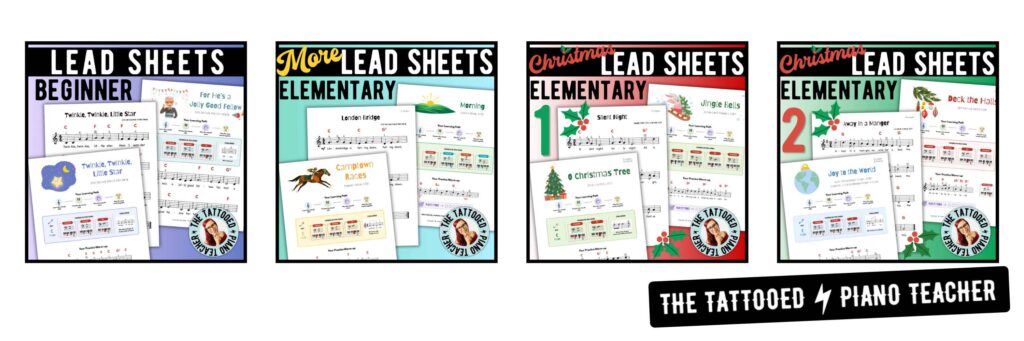
By starting with a simple, familiar melody for the right hand and keeping the left hand chords super simple, students can focus on mastering this new way of reading music–which is no small feat!
These packs include every song in three different chord configurations so there’s something for every level of student.
Currently available in my shop:
- Beginner Lead Sheets Pack 1 – these are the easiest songs, many with just 2 or 3 chords
- Elementary Lead Sheets Pack 2 – these get a little more challenging for both hands than the first pack
- Christmas Lead Sheet Pack 1 – 10 familiar Christmas tunes for all levels
- Christmas Lead Sheet Pack 2 – 10 more familiar Christmas tunes for all levels
Print a Lead Sheet
Many common songs can be found (sometimes free) online to print and learn. Be careful to use only scores that are public domain or have the copyright owners permission. Let’s model good ethics for our students!
Simply Google the title plus “lead sheet” and see what comes up.
Once you have your lead sheet, here’s how to walk your student through the learning process:
- Learn the right hand melody as written in the treble staff. (For PVG arrangements, they would likely be reading the vocal line.)
- Review all chord symbols and figure out how the left hand will play each one. Create and print a customized “chord chart” if needed.
- Now, practice playing the hands together!
Transcribe a Melody
If you can’t find a good lead sheet already done for you, transcribe the melody of a familiar tune onto treble staff.
Then, work out what chords will fit. If the student has a naturally good ear and reasonable theory knowledge, you can involve them in this process. Write in all chord symbols.
You’ve got yourself a lead sheet. Follow the steps above.
Rewrite an Existing Song
Sometimes your student comes to you with a score or an idea for a song project that is over their current ability. This is a great opportunity to create a simplified lead sheet version of the desired song.
From the existing score, extract just the melody notes and write them in treble staff. Transpose the key signature if needed.
Next, decide which chords will work best (using the original score as guidance). The student can be involved in this process if it interests them.
Write in the chord symbols above the treble staff and follow the above steps to learn the song.
Change a Method Book Song
Choose a method book or supplement book song to re-arrange as a lead sheet.
Write in the chord symbols if they aren’t already present. This can be a great theory exercise to do together with the student. Look at each left hand pattern and figure out what chord it represents.
Once you have the chord symbols written in, relearn the song with the existing right hand treble staff part plus the chord symbols for the left hand.
Encourage the student to avoid following the bass clef notes, but instead think in “chords” and make up their own patterns. It can be helpful to give the student a few patterns to choose from, such as…
- Open 5ths held
- Triads held
- Open 6ths for inversions
- Octave with 5th in the middle
- Arpeggio pattern ascending
- Or simple 5th arpeggio (Ex: C then G for C Major Chord)
- Alberti bass pattern for a classical vibe
- Lower octave for more drama; upper octave for calmer feel
Expanding Lead Sheet Skills Over Time
The beauty of working with lead sheet reading early and often in a pianist learning experience, is that they can get used to the mindset and build upon what they know.
Here is an example expansion over a few years of a piano student’s study:
- Primer level:
- Using a single whole note to represent a chord (Ex: hold a C for C Major or Minor chord)
- Level 1:
- Using a 5th in the left held as a whole note to represent a chord (Ex: hold a C+G for C Major or Minor chord)
- Level 2:
- Using a root position triad, major and minor (Ex: C+E+G for C Major)
- Using a 6th to represent an inverted chord (Ex: C+A for F/C)
- Adding broken chords with simple 5ths (Ex: C then G for C Major)
- Level 3:
- Incorporating easy inversions (Ex: C+F+A for F/C)
- Adding 3-note representations for V7 chords (Ex: B+F+G for G7)
- Learning Alberti bass (Ex: C-G-E-G for C Major)
- Broken chord triads (Ex: C then E then G for C Major)
- Blues shuffle (Ex: C+G to C+A etc for C Major Blues)
And so on!
Matching Lead Sheets to Student Musical Interests
One of the reasons the “off-book” approach is so brilliant is that it allows students to carve their own path.
It is common to start every student with similar lead sheet projects, say in Level 1 (elementary level). And if you feel more comfortable using a book, curriculum, or set of songs for everyone, that can work just fine to start. (Especially if you land on a few songs that 90% of your students know and like.)
But, as soon as their musical tastes start to emerge, usually in the tween years, run with that!
Lead sheets make it possible to jump from genre to genre, covering a wide variety of styles and techniques, or really head down one genre path to help them reach a goal.
So, listen and experiment! Find what lights up each of your students, and choose songs that they’ll play immediately when they get home!
Do they like…
- Pop
- Movie
- Broadway
- Jazz
- Blues
- Rock
- Folk
- World
- Worship
- New Age
ANYthing can be a lead sheet project successfully! It’s not just jazz standards.
But this is up to you. It’s up to you to figure out what they like. It’s up to you to find the right song. It’s up to you to get the lead sheet project started and guide them to make it sound polished.
So…are you UP for the challenge?
Encouraging Creativity and Musical Independence
Final advice.
As piano teachers, it’s easy to fall into the trap of making every musical decision for our students. Lead sheets give us a chance to step back and let them take some ownership of the music.
Encourage students to experiment with different accompaniment patterns, tempos, dynamics, and styles. If they ask, “Which one is right?” the answer is often, “Try both and see which you like better!”
Do a ton of listening with your students (telling them to listen on YouTube usually doesn’t land…do it with them).
But also keep in mind, not every lead sheet needs to sound the same, and that’s the beauty of them.
Lead sheets create opportunities for students to make musical choices, develop confidence, and discover their own musical voice.
Over time, those small decisions can help transform students from note readers into independent musicians
And if lead sheets naturally morph into composition or improvisation, encourage this all the way!