We’re on a quest to find the best method book series for older beginners, students age 10 and up, who need a solid foundation to their piano journey.
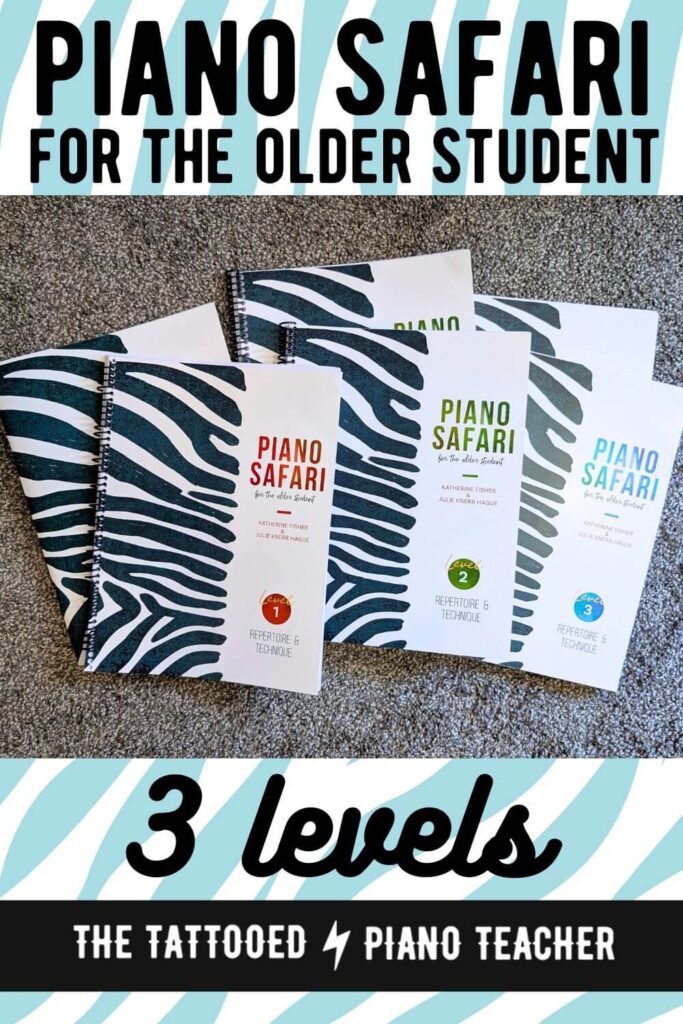
The next up on our list is Piano Safari for the Older Student. I ordered every single book in this series, looked them over for months, and used them with my own students.
Let’s find out if this is a series that piano teachers have been searching for.
Piano Safari vs Piano Safari for the Older Student
This article is going to focus on the Piano Safari series designed for ages 12 and up.
If you’re more interested in finding a method series for your “average” age beginners, in other words, ages 6 through 10, then you might want to check out my original review of the core Piano Safari series.
But if you’re here for those older beginners that come to your studio ready to learn, then let’s dive into the Piano Safari for the Older Student.
10 Categories for Comparing Piano Methods
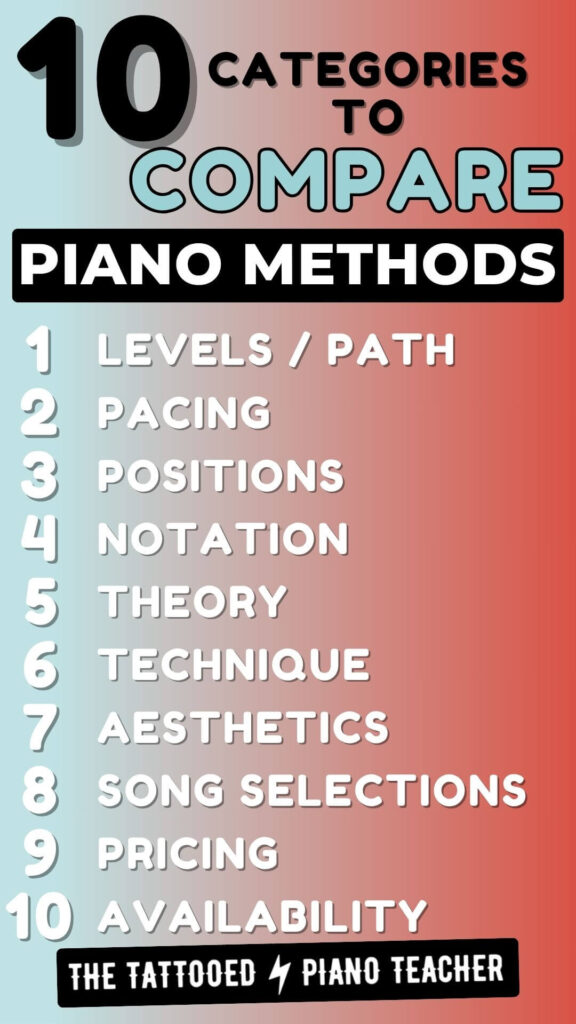
As always in my piano method reviews, we’re going to be using my 10 categories for comparison.
We’ll go through every aspect of this method book series, including:
- How many levels (and how comprehensive)
- The pacing of this series
- How hand positions are used and introduced
- How the notation looks
- Theory included
- Technique emphasized
- The aesthetics of these books,
- The song selection throughout the series,
- Cost of the books,
- And where you can buy them.
For more general advice and information about comparing piano method series, check out my article about my system for comparison: Pick the Perfect Piano Method.
Levels (Overall Path) of Piano Safari for the Older Student
We’re going to start with the levels so we can see the overall path that a student would take in this series, and then we’ll dive into Pacing and all the other categories.
How Many Levels in Piano Safari for the Older Student?
There are three levels in the Piano Safari for the Older Student series, and they are comprehensive.
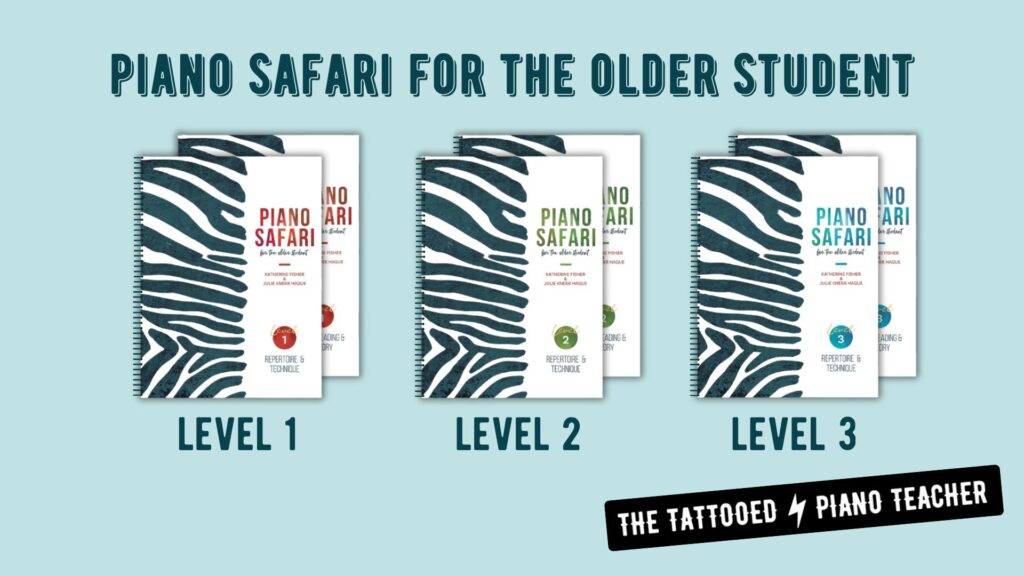
In each level, there are two main core books that are all-inclusive. Each level has a:
- REPERTOIRE & TECHNIQUE book
- SIGHT READING & THEORY book
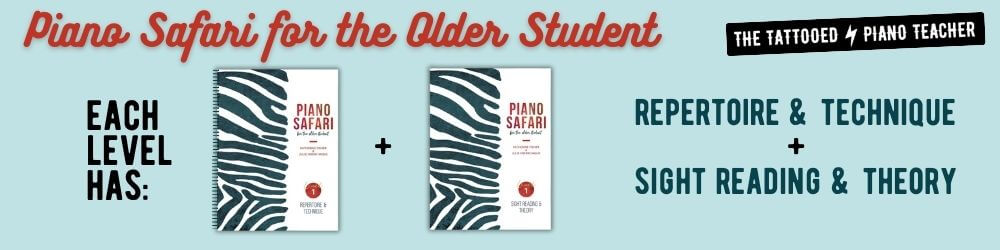
The Repertoire & Technique Book will be the main lesson book.
A complimentary Sight Reading & Theory Book supplements the learning process. More about this book in the Theory section of this review.
How Far Will the Piano Safari for the Older Student series take a student?
By the time they are finished with the Piano Safari for the Older Student Level 3 book, they will be at an Early Intermediate level.
This is similar to the regular Piano Safari series–it just gets there faster.
However, a quick note that the level three in the older beginner series does take the student into a few extra more challenging pieces than where the original Piano Safari series cuts off.
Where would the student go next after completing the Piano Safari for the Older Student series?
Because they’ll be entering into the Intermediate level, they can really go in any direction they want. Intermediate classical literature books could be a next step. A pop series like the Wunderkeys Intermediate series could come next. Or any combination of intermediate studies.
The Piano Safari authors do have a series called The Advancing Pianist, Level 1 and Level 2. However, note that that is just sight reading and technique, not literature books.
Although there are only three levels, this really is truly going to take a student from very beginner all the way to early intermediate. So, it does fill the shoes of a normal core method book series Level 1 through 5, let’s say.
My First Impression of Piano Safari for the Older Student
When these books came in the mail, I immediately grabbed that Level 1 Repertoire & Technique Book!
If you caught my Faber Accelerated Piano Adventures review, you know that I’m not too thrilled about how that book series starts a beginner’s journey in the first units of Level 1. So, I was eager to know: How does it start in Level 1? I excitedly opened up the Level 1 Repertoire & Technique Book and paged through those first few pages.
At first: Disappointment
Honestly, at first I was confused and a little disappointed. Given what I know about the regular Piano Safari series and how it starts with teaching pieces by rote and the amazing compositions that these authors make, I thought surely the Piano Safari for the Older Student would get these older beginners playing really cool music right away.
And that wasn’t exactly the case.
So my expectations were quite high for the first few pages of Level 1, and I was a little disappointed.
First Few Pages of Level 1
However, the more I looked through the book, the more I started to understand where the method was going. Like many method books for teens and adults, this does start with some very dry instructional pages. Pictures of how to sit at the piano, here’s what a quarter note is, here are the notes on the piano, etc.
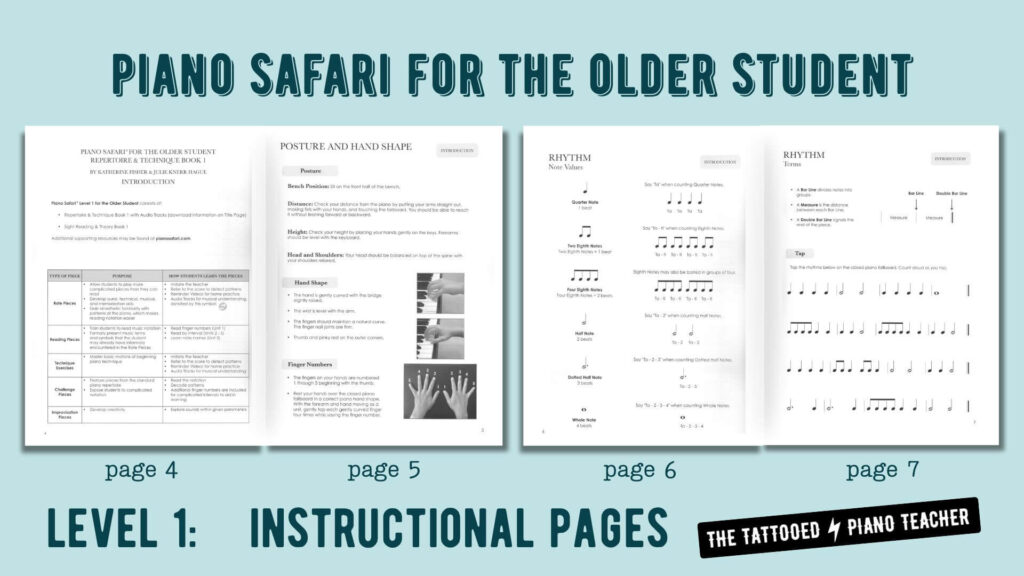
And they’re not actually playing any songs until you get several pages into the book. Then the first couple songs that they’re playing are just playing every white key and simple songs on the black keys.
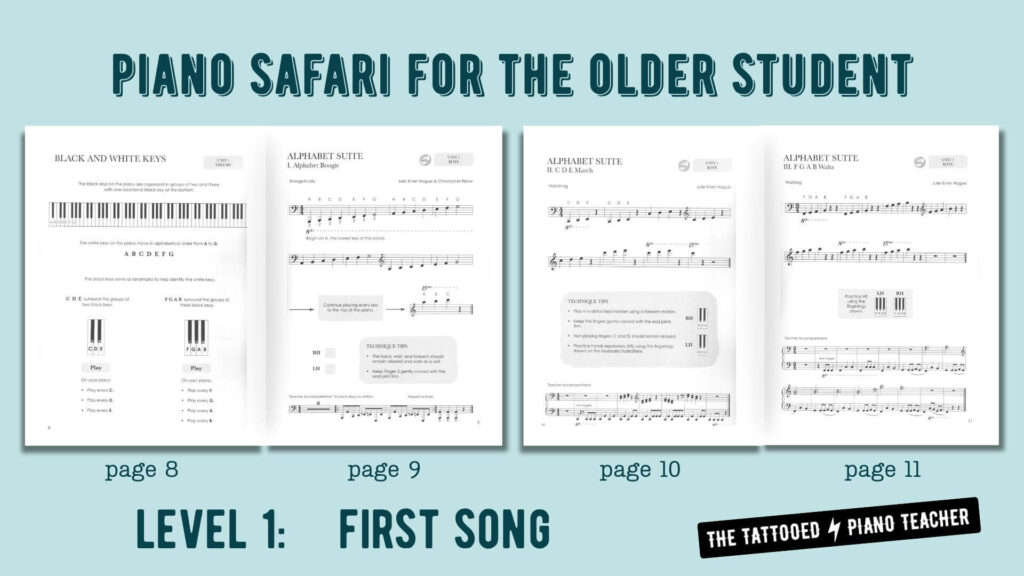
My Expectations for Piano Safari for Older Beginners
I was expecting something a little bit different–maybe a little twist on how those first couple lessons with our older beginners was going to go–and I didn’t really find that in this book. But I wasn’t about to give up on this entire series just because I was a little disappointed with the first pages of level one. So I kept looking through and I kept looking through trying to get that overall big picture of how the pacing of this journey was going to go for this student over a few years time.
Piano Safari’s Balance of All Aspects of Piano Learning
And what I noticed was the author’s attempt to balance all of these elements of learning the piano. Really, that’s what was showing up in the beginning of Level 1 was the beginning of this balance where they’re really trying to include so many different elements into this method. And that I do appreciate.
What do I mean by balancing different elements?
I mean including:
- Rote learning (learning by ear where the teacher is demonstrating and the student is copying)
- Reading (solid note reading skills, and we’ll talk about that more in Notation)
- Technique is huge in this series.
- Theory is included as well, even in the main lesson book.
- Tried and true classics (first familiar folk tunes, then classical themes, and eventually standard piano etudes and intermediate literature).
- And, yes, there are cool sounding songs by these talented composers as well.
And all of that mixed with some exposure to jazz and improvisation assignments as well.
Conclusion About the Beginning of Piano Safari for the Older Student Level 1
So, although I might have not designed the first few pages of Level 1 the same one that these authors did, as I look over the students whole journey, I can see how they’re going to get a good mix of a lot of different activities.
They’re not going to have any holes in their learning as they move through the levels.
And after a few typical older beginner starter dry pages, they do get a little bit of that Piano Safari magic. We’ll talk about that more in Song Selection.
In conclusion, I needed to look at the whole of the experience, not just fixate on the first few pages in Level 1’s Repertoire & Technique Book.
Pacing of Piano Safari for the Older Student
Now that you understand how the book layout and the levels work, let’s talk about the pacing as they move through these three levels.
Pacing just describes…
- How quickly the songs get more challenging,
- How quickly the new theory and technique concepts are introduced to students along their journey.
The overall pacing of the Piano Safari method, say in comparison to the Faber Accelerated Piano Adventures series, is pretty similar, but it does get students into playing more advanced techniques right away because it’s a very technique-heavy method.
And because of its unique approach to note reading, notes are slow to be introduced at the start of the journey but, if all goes well, a Piano Safari student will become a solid note reader by the time they get to the end of this series.
So I would say pacing is AVERAGE to FAST, but with some balanced breaks in the forward motion.
Hand Positions in Piano Safari for the Older Student

Let’s move on to the hand positions.
No Hand Positions Used in Piano Safari
Piano Safari and the Piano Safari for the Older Student are the same in that there are NO HAND POSITIONS introduced, talked about, shown–no hand positions whatsoever.
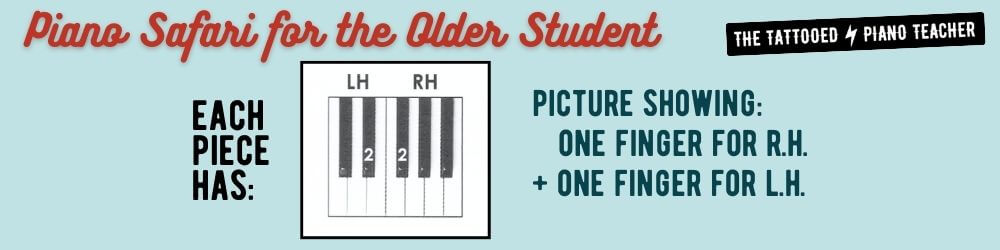
At the beginning of each piece, students are given a picture of the keys showing where they put one finger from the right hand and one finger for the left hand. The rest of the notes they figure out from there. They are reading by patterns and intervals. They are not locked into a position at any point in time.
It’s only in Level 2 that we start to talk about scales. All of the major pentascales (5-finger scales) are shown at the beginning of Level 2 Repertoire & Technique.

How does having no positions affect the learning process in Piano Safari?
So, learning the piano without any established or taught hand positions–how does this turn out and how do teachers feel about this approach?
Some teachers absolutely adore this. They don’t want their students locked into a position. They don’t want them thinking “4 = F” and associating that and locking that in to the point where they can’t even move their hands to a new position.
And while I totally hear that, I also have had students who their brain just needs the structure of the position, can’t really function outside of the position. And for that reason, I would say that this might not be the best method for every single student without exception.
But when used and taught in the correct manner to the correct type of student learning style, this can be a successful and freeing approach to learning the piano as a tween or teen beginning piano student.
Notation Used in Piano Safari for the Older Student
Let’s move on to notation, which is also a unique approach in the Piano Safari method series.
At the very beginning of the student’s journey in Level 1, there is a mix of rote pieces and reading pieces.
Rote Pieces in Piano Safari
ROTE pieces are written on the staff from Day One.
The intention is that the teacher would teach it by ear by demonstration and that the student would be seeing the notes on the staff but not actually reading them yet.
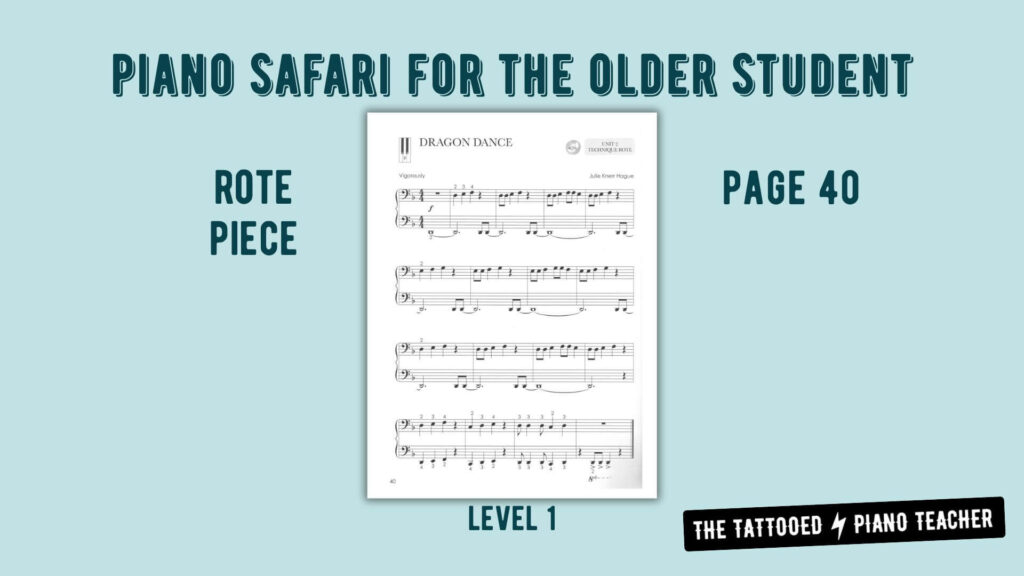
The advantage to songs learned by rote?
- Students are exposed to traditional staff notation very early without the pressure to have to name every note they see or fully understand the grand staff.
- Students get to play complex and great-sounding songs right away because they are imitating what they see and hear from the teacher, rather than having to read notes and rhythms.
- Some students love and thrive in this mode of learning a new piece. They love using their ear and exploring without having to figure out on-the-page notation cues.
And some of the potential disadvantages to rote learning?
- Some students struggle with aural memory. This may be a frustrating experience if imitating and remembering doesn’t come naturally without reading notation on the page.
- Students often imitate a song perfectly in the lesson, but forget how the song goes at home. Piano Safari has made some videos to help with this issue, but it can be difficult to get students to go the extra mile with at-home practice if they don’t immediately know how to play something.
- It can be overwhelming or confusing to see a fully notated staff song with complex rhythms and ledge line notes on the page, serving to “turn off” a student who is easily overwhelmed by a new challenge.
- Some students just don’t enjoy this. It feels uncomfortable to be asked to mimic what they have just seen or heard. They feel on-the-spot and would rather read a piece in the traditional way.
Early Reading Pieces (Off-Staff Notation) in Piano Safari
READING pieces are also included. These are written in off-staff notation until the staff is introduced. These songs include songs on the black keys and songs on the white keys, reading by finger number.
The off-staff notation is very simple on the page. It works the same way as pre-reading beginner songs in other methods, but the look of it may be slightly different from what you’re used to.
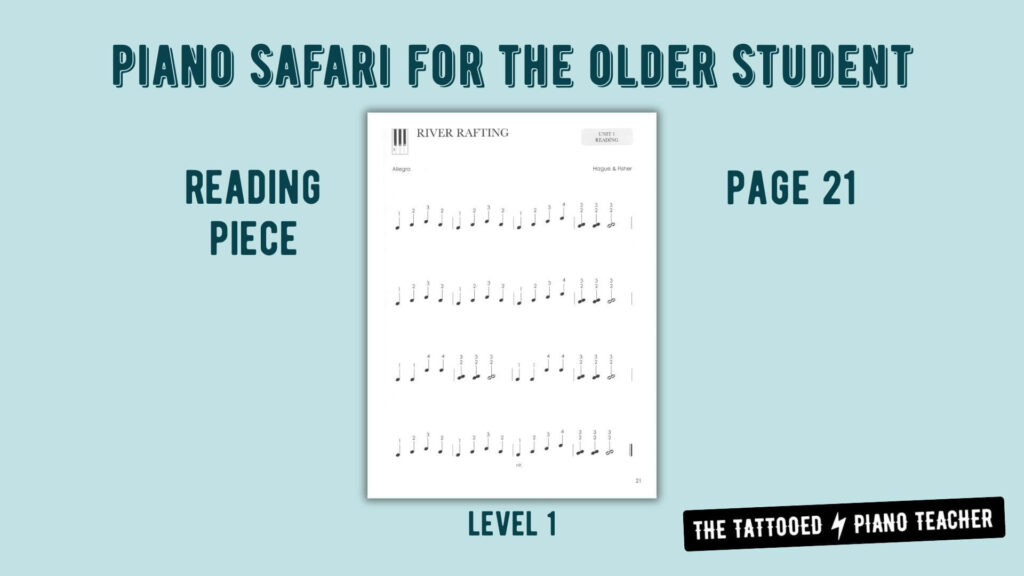
Compared to my Pre-reading Piano Skill Set books, it’s pretty plain and simple! Which do you like better? Do you like color-coded notes and hand cues? Or do you prefer the no-nonsense black and white page design? We’ll talk more about this in Aesthetics.
Introducing the Staff in Level 1 Piano Safari for the Older Student
The staff is officially introduced on page 29 of Level 1. Students are only taught three notes. These are their Landmark Notes and throughout the entire book of Level 1 (until the end of the book).
They are only told what those three notes are. The Landmark Notes are: Bass C, Middle C, and Treble G.
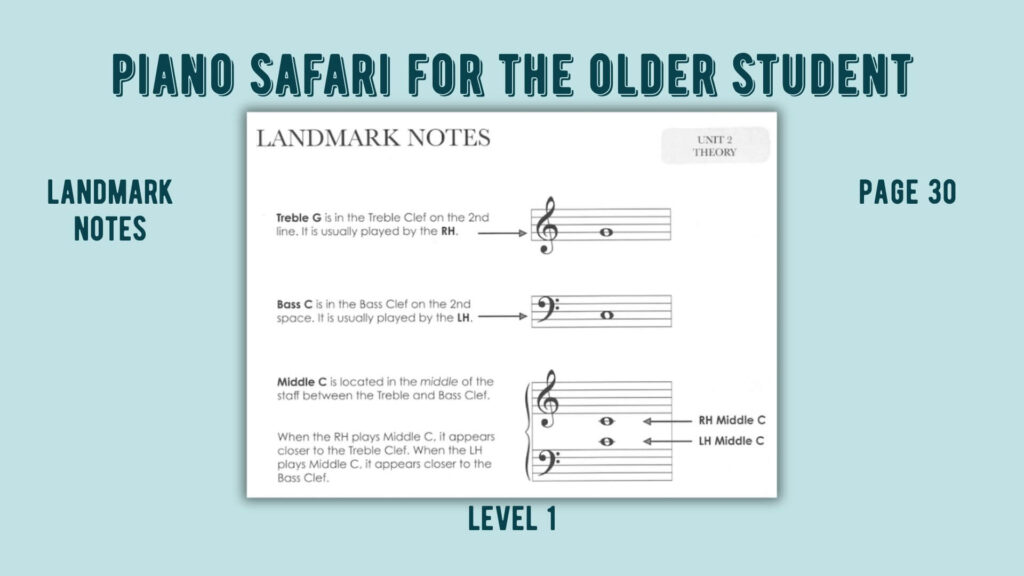
Every song in Level 1 will start with the right hand on one of these notes and the left hand on one of these notes. Therefore, all songs throughout Level 1 start with a C or a G, but it will be a different finger and a different, dare I say, position, (although there are no official positions) for every song.
So, students need to identify those Landmark Notes for their starting note and then they are reading by step from there. And then once skips and thirds are introduced, then they’re reading by skips as well.
Learning the Rest of the Notes on the Staff at the End of Level 1
At the end of Level 1 (page 80), students are introduced to the rest of the staff.
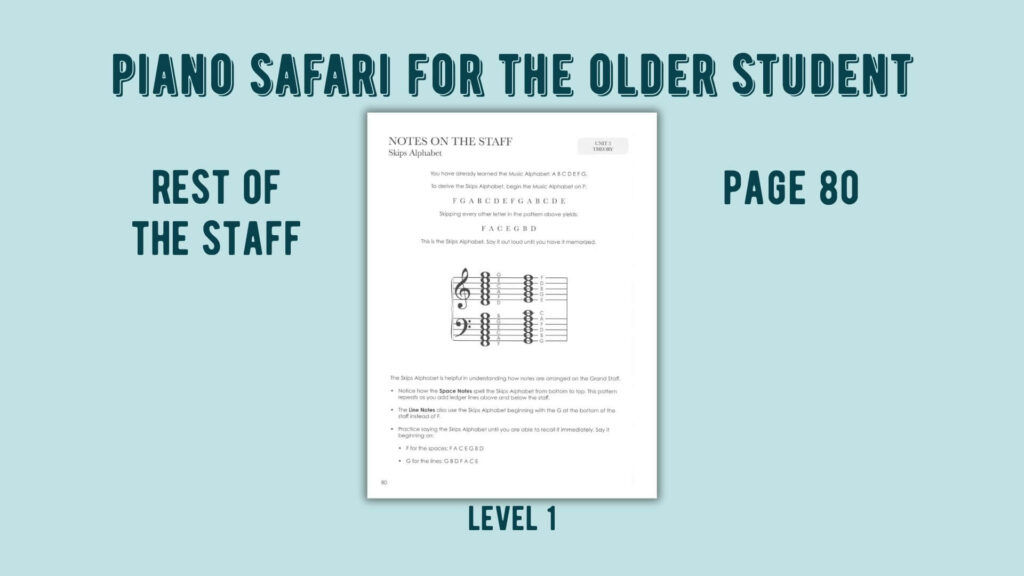
They’ve had these three landmark notes plus seeing other notes on the staff and reading by pattern, not necessarily naming them. Then at the very end, they’re shown all the notes on the staff.
From there on out, they’re expected to basically be able to read any note on the staff.
So this is kind of a “trust the process” type of approach. Much different than Wunderkeys which will introduce one new note and then drill that note until the student can recognize it, and then we add another new note. Or similar to the Faber Piano Adventures which uses the Landmark Notes but also teaches what the other notes are called around it.
But Piano Safari is really all about recognizing patterns, learning by ear and sight together.
Once the student is exposed to all the notes on the staff at the end of Level 1, then in Level 2 they are essentially expected to read all notes on the staff.

Piano Safari Uses Intervallic Reading
The authors call this a INTERVALLIC reading approach.
Intervallic reading is:
- reading by interval
- reading by pattern
- reading by distance from those landmark notes.
While I don’t love the landmark approach for young kids, because I think that they think step-wise through the alphabet a little bit more, for older beginners, this could definitely be successful as older beginners are more able to recognize that one landmark note they’re looking for and then read by pattern from there.
Theory in Piano Safari for the Older Student
Let’s talk about the theory included in this series.
Comprehensive Sight Reading & Theory Books
The theory books that came in the box with my lesson books were thick.
- Level 1 is 68 pages (staple-bound)
- Level 2 is 76 pages (spiral-bound)
- Level 3 is 104 pages (spiral-bound)
Lots of Sight-Reading in Piano Safari
Why so much theory? Are they going to be writing all these pages? No. Most of each Sight Reading & Theory book is sight-reading.
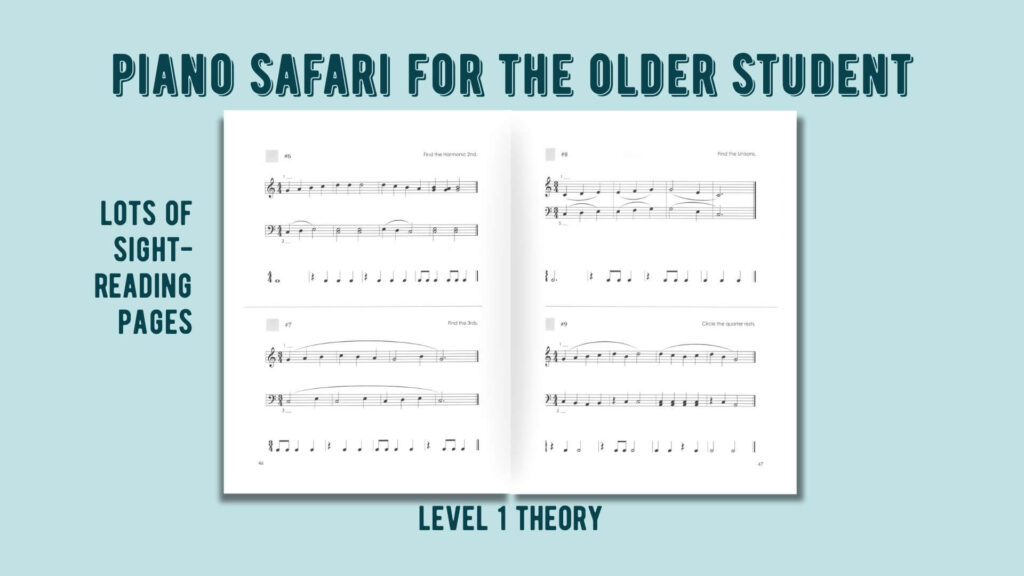
So if you’re familiar with the regular Piano Safari series, then you know that there are these sight reading cards that you can put in front of the student and work with them. Those same cards, or the content that’s on those cards, is contained within these theory books.
The books contain a lot of sight-reading pages and a good amount of writing pages as well.
My Opinion of the Piano Safari for the Older Student Sight Reading & Theory Books
Overall, I do think that these theory books look pretty solid. Although instead of being so heavy on the sight reading, which I understand is very important for a intervallic reading approach, I wish there was like a little more ear training, improvisation, and a variety of activities worked into the theory book as well. And I wish there was a little more review.
But if I was going to commit to this series, I would definitely include the Sight Reading & Theory books alongside the Repertoire & Technique books.
Advanced Theory Included in Level 3 Sight Reading & Theory Book
One other note about theory: Level 3 does get quite advanced, and this is the same with the later levels of the regular Piano Safari series. They get into analyzing chords, inversions, identifying chords by their letter name as well as their Roman numeral.
So, the analysis and harmonization gets pretty advanced, which I think is great. I think chord knowledge is really important for the type of music that most kids want to write and play these days.
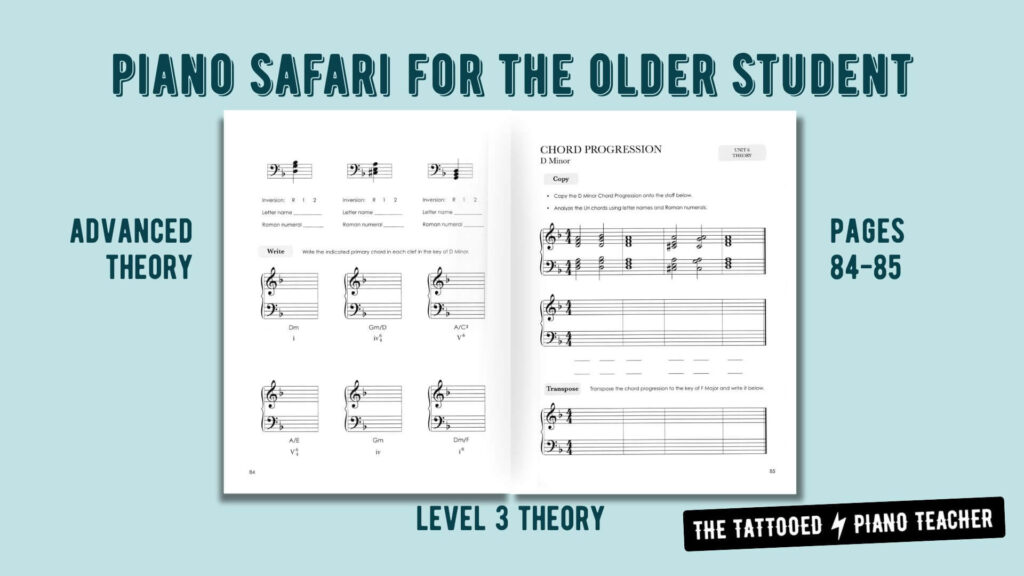
For a student who really does not enjoy sight reading, theory, or having at-home assignments in general, this may be a tough sell, especially the Level 2 and Level 3 Sight Reading & Theory books. In this case, teachers may want to consider pairing the Repertoire & Technique Book with a more “casual” theory book, or be prepared to skip pages liberally.
Technique is Emphasized in Piano Safari for the Older Student
Let’s talk about technique. I’ve already mentioned that this is a TECHNIQUE-FOCUSED series. And I mentioned that overall, the pacing of this series is pretty average, but when it comes to technique, this series is fast and furious getting beginning students doing some pretty advanced techniques right away.
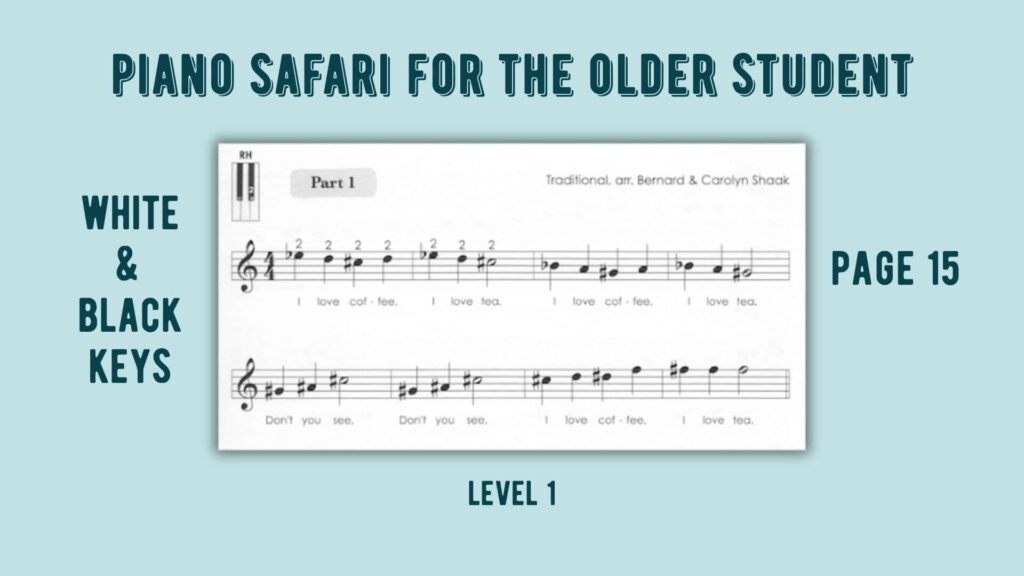
Let’s look at a couple of examples of this fast-paced technique at the beginning of the Level 1 Repertoire & Technique Book.
Level 1 Technique Challenge: Chromatic Patterns Early On
Right away in the beginning of the pianist’s journey, they are moving from black keys to white keys very quickly, which we wouldn’t normally ask a beginning student to do until a little bit later on. Typically this is introduced more gradually until a full chromatic scale is eventually expected by the third or fourth lesson book in other series.
Notice here that one of the very first songs students are learning is using various forms of chromatic scales.
But it is taught by rote and played with just Finger 2 (pointer finger) making it accessible for beginning students.
Level 1 Technique Challenge: Syncopated Pedaling Right Away
I was surprised to see the overlapping or intuitive pedaling with lifts (called Syncopated Pedaling in Piano Safari) introduced right away in Level 1.
Presumably, this student hasn’t even tried the pedal as far as even just pushing it down and holding it through a song. And they are expected to do the overlapping pedal?
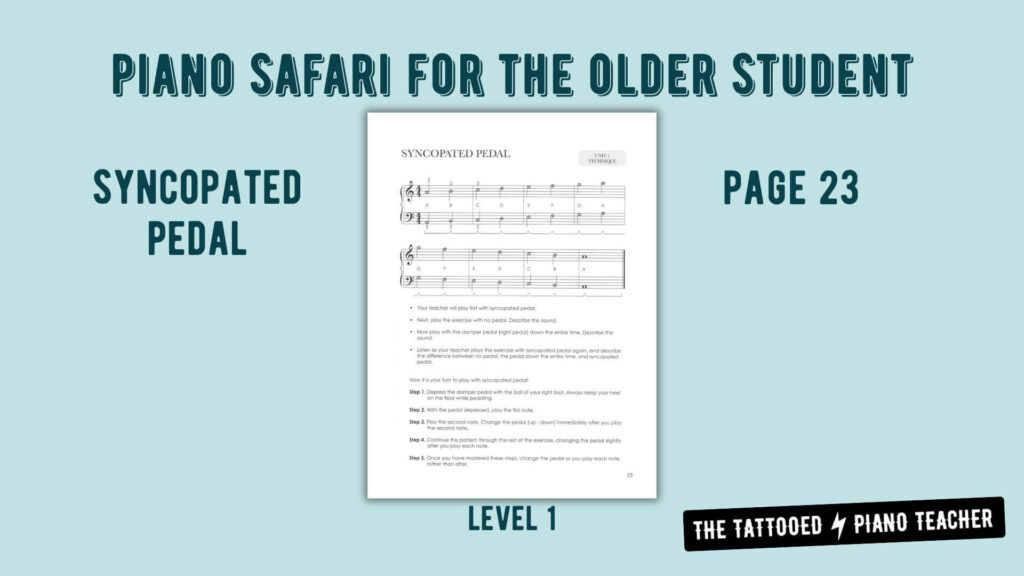
I’m guessing that this is a little bit of a rough start with this technical skill given the required coordination of the foot and hands, but I also know that students do love pedaling.
So, I wonder how this works out with different age students if they’re able to do this overlapping pedal technique.
There’s even a song right away that has the pedal simile instruction. I’m not sure how students are supposed to intuitively pedal once a measure if they’ve just started playing piano.
So you see my point that we are really throwing students into the world of technique right away, expecting a lot of them.
How Does This Technique-Heavy Approach Work?
The result of expecting big things from beginner piano student hands?
I believe this series is again showing us that it not suited for every single student we will encounter.
But for the right student? I bet they rise to the challenge!
Piano Safari builds a support system to make this happen for students.
- Rote Pieces, teaching by ear, means you can ask students to do more than they’re able to sightread on the staff.
- Intervallic Reading approach means they don’t have to know the name of every note because they’re reading by pattern by sound.
These two factors allow technique to be “up-leveled” even at the beginning stages.
List of Technique Skills Introduced in Piano Safari for the Older Student
If you’re curious how the new technique skills are rolled out within each book, let me just give you a quick rundown.
LEVEL 1 – List of Technique Skills Introduced
- Firm fingertips
- Arm weight
- Syncopated pedal
- Legato vs non-legato
- Three-note slur
- Wrist rotation
LEVEL 2 – List of Technique Skills Introduced
- Major and minor pentascales and triads
- Phrasing
- One-hand scales in one- and two-octave patterns
- Inversions
- Arpeggios
LEVEL 3 – List of Technique Skills Introduced
- Hanon patterns
- Two-octave arpeggios (one hand at a time)
- Chord progressions (I, IV, V, V7)
- Waltz bass
- Broken chord accompaniment
- Chromatic scale

Aesthetics of Piano Safari for the Older Student
You’ve had a peek into some of the pages, but we’re going to officially talk aesthetics next.
Interior Aesthetics
On the interior, it’s black and white. It’s just the titles and the songs. There are no (or very, very few) pictures.
This is similar to the regular Piano Safari book pages, it’s still black and white and it’s still very simple. But the regular Piano Safari books have some zoo animal illustrations.
Those are all taken away in the older student books.
Personally, I like a little color. I like some pictures. I like some imaginative design on the pages, even as an adult or teen student.
But the pages do look really clean and the fonts are very modern looking. I think the engraving looks really nice. I feel like these books do look very professional when you open them up, actually inside and out.
Exterior Aesthetics
My one complaint about the beautiful exteriors is the floppy spiral books that require another book or rigid surface behind them on my piano so they don’t flop over at the top of each page. All in all, a small complaint.
I do think the outside of these books is really appealing.
Song Selection in Piano Safari for the Older Student
Let’s talk about a very important category: song selection.
Beginning of Level 1 Repertoire & Technique Book
As I mentioned in First Impressions, I had high expectations because this is Piano Safari. I know these composers and they’re wonderful. And I really wanted that beginning to start off with some really compelling pieces, and it kind of let me down a little bit.
I Love Coffee: Student Favorite
However, there is a song at the beginning of Level 1 that I know is a student favorite, and that’s I Love Coffee. I don’t know if older beginner students are drinking coffee yet or not, but this is the classic melody that everybody knows. I’m sure this would be a student favorite for most.

Jazz Pieces
I think it’s interesting that the first two “real” songs a new student will play at the beginning of Level 1 are both very jazzy sounding. Most students would be drawn to that.
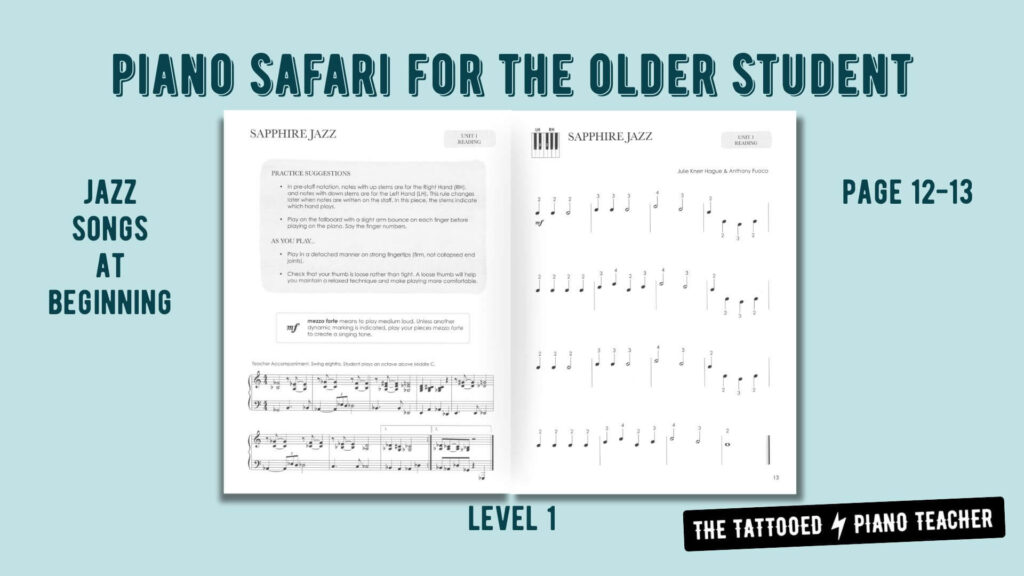
However, I have had a few students who like really don’t like jazz. A student who doesn’t appreciate the sound of these seventh chords and chromatic harmonies presented in the teacher duets of these first two songs might be a turn-off for some students.
First Contemporary Piece
When we get to page 46 in Level 1, we finally get like the first real contemporary-style composition by the authors of this book. And it’s gorgeous. I know that this song would really capture students imaginations and give them a feeling of, “This is the reason I’m playing piano.”
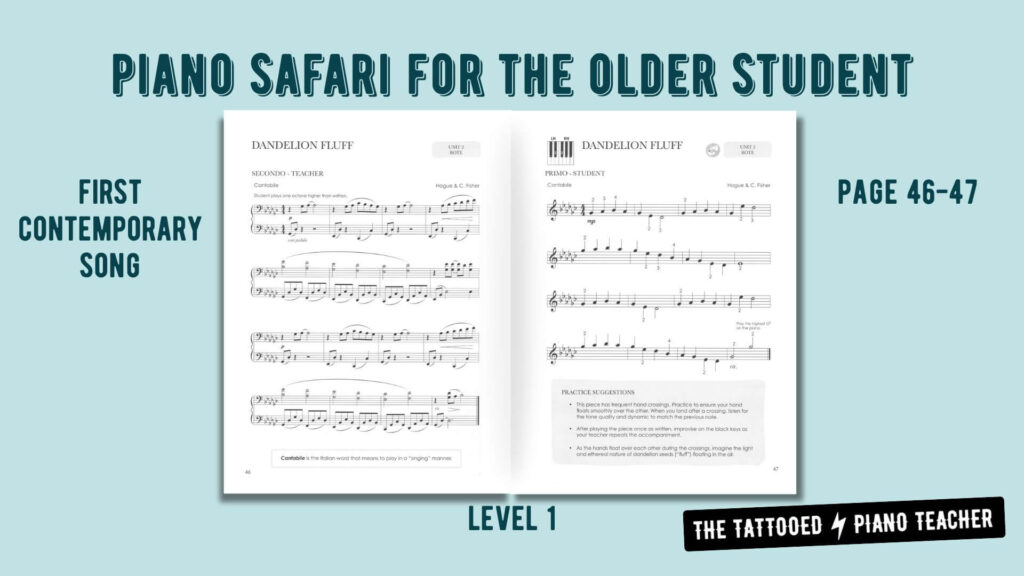
They have to wait till page 46 until they get that, but from then on out, there are those contemporary songs sprinkled in.
I wish there were more of these original contemporary sounding pieces for the authors, honestly. But I, again, can see how they’re really trying to balance different genres and different aspects of the musical journey so that we get a well-rounded piano player by the time we’re out of the Piano Safari series.
Song Selection Throughout the Levels
So, as far as the mix of songs in each level, just as a generalization…
In Level 1, we get a nice mix of like those typical folk songs that everybody plays at the beginning of their journey, a dabbling of classical themes (just a few), and then a couple of contemporary pieces, and a bit of jazz. It’s a pretty good variety.
Moving into Level 2 and then Level 3, it gets more classical… and even more classical.
By the time you’ve reached the end of Level 3, it is very heavy on the classical with a few of those gorgeous contemporary compositions thrown in. The contemporary compositions are either a New Age sound or more of a Jazz sound.
It does get pretty heavy on the classical themes and classical etudes, especially in Level 3. But hopefully there would be enough variety sprinkled throughout to appeal to students, even if they’re not really into classical music.

Pricing: How Much Does Piano Safari for the Older Student Cost?
Let’s talk about pricing, because these are not the cheapest books in the world.
However, given how thick and comprehensive each book is, I don’t think it would be a hard sell to get a family to purchase these books.
So, let’s run down the prices. All three Repertoire & Technique books are $19.95 each. They are all spiral-bound and quite thick as far as lesson books go.

The accompanying Sight Reading & Theory books are priced differently by level, each level adding more pages. Level 1 is staple-bound. Level 2 and 3 are spiral-bound.
- Level 1 is $14.95
- Level 2 is $15.95
- Level 3 is $16.95

Please keep in mind that these prices are accurate as of the posting of this article in 2025, and could change at any time. Check the most up-to-date prices on PianoSafari.com.
However, to save a little money, if you’re planning on getting both Level 1 books or both Level 2 books etc., you can get a little bit of a deal by buying them in a 2-book Pack. This will save you a few dollars per level if you plan to use both the Repertoire & Technique Book alongside the Sight Reading & Theory Book.
Availability: Where to Buy Piano Safari
As far as availability goes, sorry, you’re not going to be getting these on Amazon.
The only place you can purchase these books is on Piano Safari’s website.
That does mean that you won’t likely see any sales on these books, and you have to pay the shipping.
So, if you’re planning on purchasing or using Piano Safari methods, you might want to plan ahead a little bit so you can make a bulk order.
I do think that even though they’re a little more expensive, they are worth the few extra dollars that you pay because they are very comprehensive and they cover a lot of material in each book.
My Opinion of Piano Safari for the Older Student
The final question: Have we found the older beginner series?
I don’t know.
There are still a few things, especially about the very beginning of the Level 1 beginner’s journey that just have me questioning whether we should keep looking out there for the ultimate older beginner method.
So, I am going to keep searching out there in the world for the best piano method series for older beginners.
Let me know in the comments if this looks like the series for you or if you’re going to keep looking as well.
Exclusive Extended Content for Piano Safari Teachers: COMING SOON
And I want to invite you to consider joining my YouTube channel as a member.
With each piano method review I do, I’m going to record extended videos.
The extended videos will include:
- Behind-the-scenes clips of me teaching from the methods that I’m talking about with real students, so you can see them in action and get some lesson ideas. You’ll hear about the mistakes I make and how not to make them with the new method books. And it’ll hopefully help you prepare if you plan on using these methods or if you’re still not sure if it’s the one for you.
- I also plan on posting members-only exclusive videos that are play-throughs of each method book so you can hear (and see) every single song in these books.
In addition to this exclusive piano method review content, I’ll also offer perks like…
- Members-only Polls to decide what content I create next
- Priority Replies to comments and questions
All of that will be on the member side of this channel.
As of today, it’s still a work in progress.
Keep checking back to this page or directly on my YouTube Channel homepage. When you see the JOIN BUTTON you’ll know the Member Channel is up and running!

How Does Piano Pronto Correlate To Other Methods?
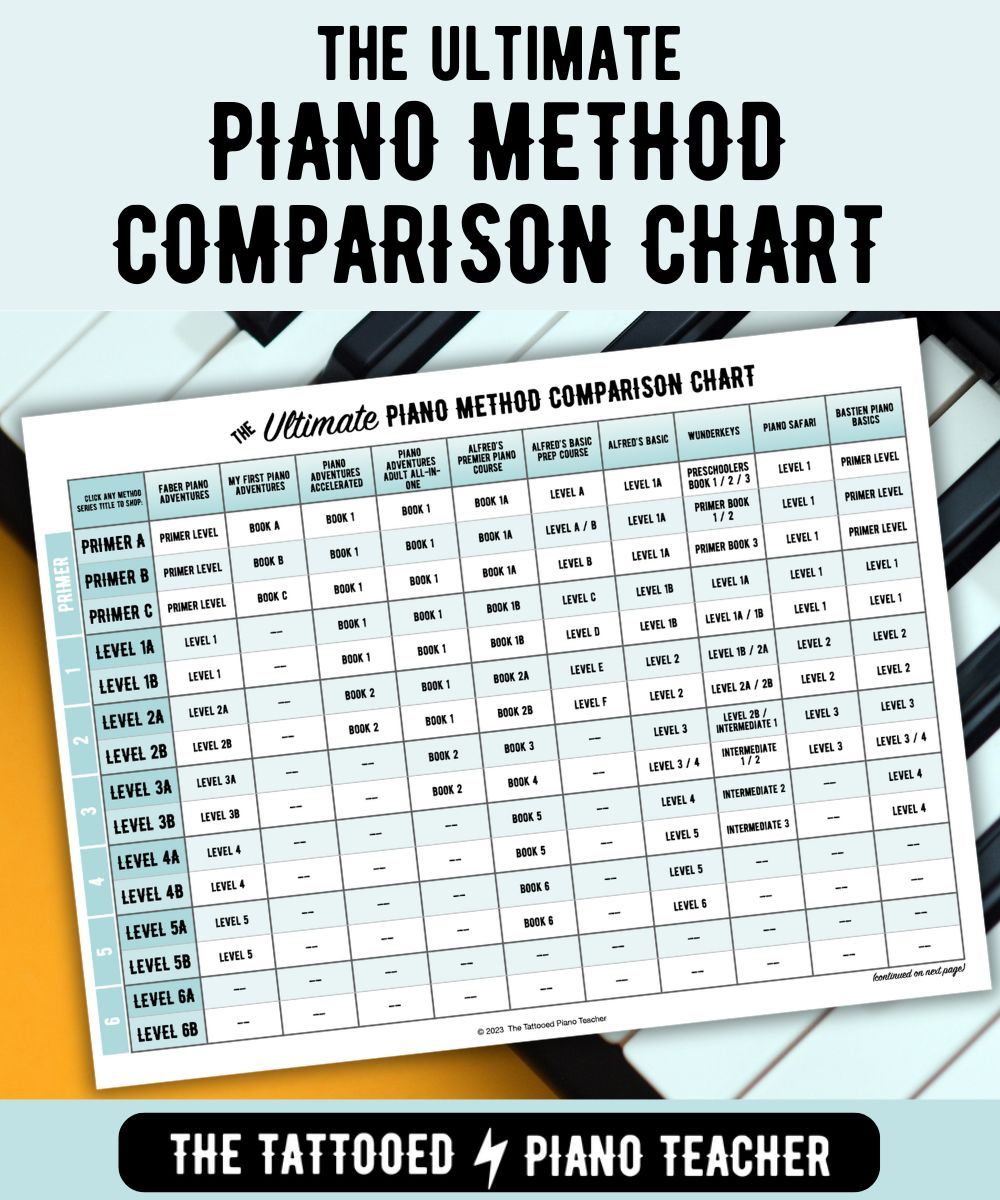
Be sure to download my FREE Ultimate Piano Method Comparison Chart!
It includes Piano Safari levels as well as other popular methods so you can see how the books line up with what you’re currently using.
Other Method Book Reviews?
Looking for more research? Here’s a list of all of the piano method reviews I’ve done so far!
- Best Piano Method Book for Beginners: My Top 3 Picks
- Faber Piano Adventures for Beginners: The Best or Overrated?
- Alfred’s Premier Piano Course For Beginners: Would You Switch?
- Wunderkeys For Beginners: Too Slow or a Completely Unique Approach?
- Piano Made Fun for the Young: The Best Piano Method for Young Beginners You’ve Never Heard Of
- My First Piano Adventure: A Fun Way to Teach Young Beginners
- Best Piano Method Books for Young Beginners: My Top 3 Picks
- Wunderkeys Piano for Preschoolers: Fun for Ages 3-4
- Faber Piano Adventures Levels in Order
- Faber Adult Piano Adventures Review: Best Piano Book for Adults?
- Piano Safari Review: Learning by Rote as a Piano Method
- 7 Supplemental Songbooks Your Level 1 Students Will Love
- The Very Useful Piano Library: WunderKeys Supplemental Songbook Series
- Piano Pronto Review: Teach Beginners With Familiar Tunes