Have you ever noticed that your piano students practice familiar songs way more than their method book songs? Well Piano Pronto creator Jennifer Eklund also noticed this, and she created an entire series around this concept.
Welcome to my review of the Piano Pronto method books!
After 20 years of teaching piano, I had never tried any of the Piano Pronto lesson books. I heard enough about them to know I just had to give them a try!
While this review is my own personal experience, I assure you I have spent months pouring over each level in this series. I have played, researched, read, and tried these books with my own piano students to bring you the most comprehensive and succinct overview of this series you will find on the internet!
So if you’re ready, let’s dive into the Piano Pronto series by Jennifer Eklund.
Piano Pronto: An In-Depth Review & Comparison
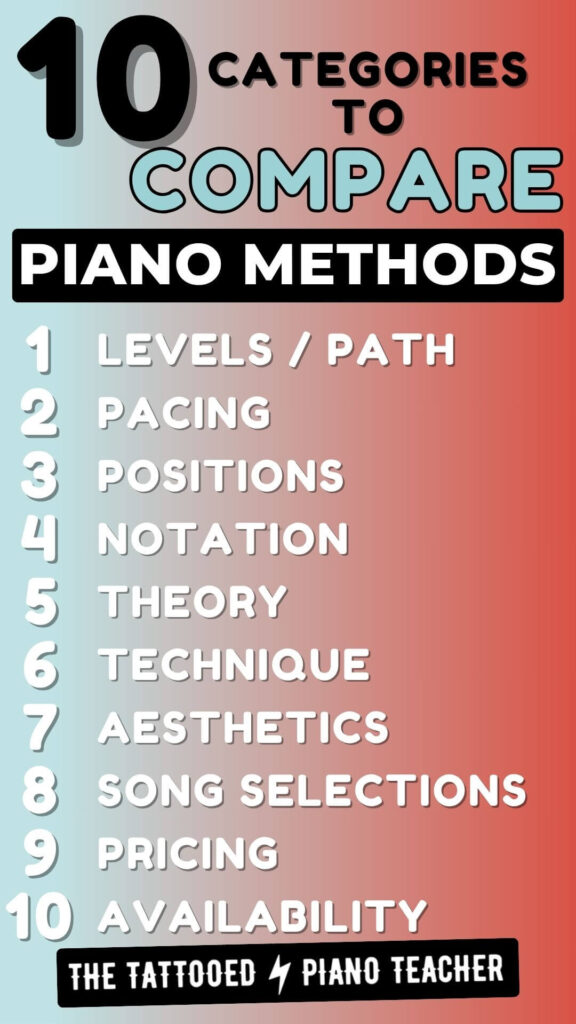
When reviewing piano methods, I always use my 10 categories for comparison. However, today I’m changing the order.
Yes, we’re still going to do all 10 comparison categories, but we’re actually going to start with the Levels/Overall Path of the entire series. The reason for this is the unique book level names used in the Piano Pronto series, as well as the extensive library including optional books and different path options as students move through the series.
Understanding how the series works will make it easier for us to compare, contrast, and talk about the series.
Piano Pronto Levels
I’ll just briefly mention that Piano Pronto library of books is extensive! There are books specifically designed for Younger Beginners, and Older Beginners, but for the sake of this review, I’ll stick with the MAIN SERIES OR PATH.
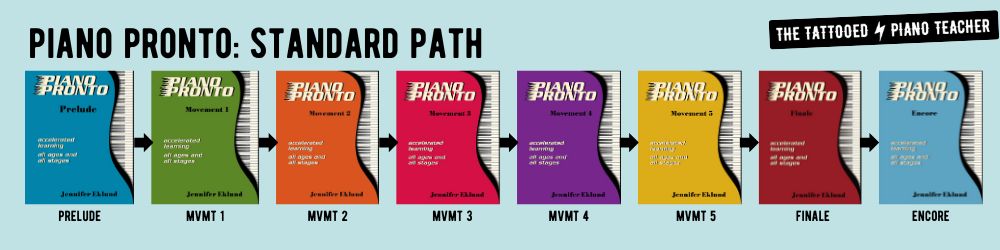
Standard Path Through the Piano Pronto Levels
We’ll start with the standard path through the levels that a 10-year-old and up would take through the levels:
- Prelude (this is Piano Pronto’s Primer Level Lesson Book)
- Movement 1
- Movement 2
- Movement 3
- Movement 4
- Movement 5
- Finale
- Encore
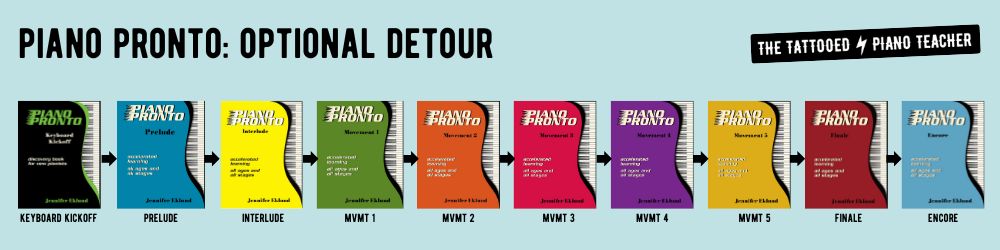
But we’re not done there! There are other path options for students who need a deviation from the above order of books.
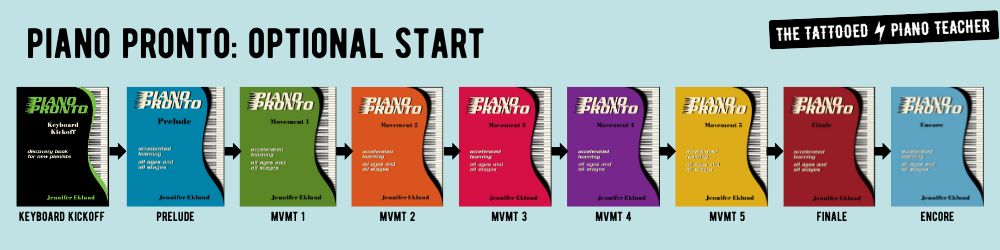
Optional Beginner Primer Book: Keyboard Kickoff
Here is our first optional path deviation. For students under age 10 starting their piano journey, Piano Pronto offers a Primer Level book that would come BEFORE the Prelude level.
So for beginners age 6-9, this would be the path through the levels:
- Keyboard Kickoff
- Prelude
- Movement 1
- Movement 2
- Movement 3
- Movement 4
- Movement 5
- Finale
- Encore
Optional Primer Bridge Level: Interlude
The second optional path deviation is for students who complete the Primer level book(s) and need some extra support before graduating to the Movement 1 level.
The Piano Pronto Interlude book is a truly unique option for Primer students. The Interlude book includes songs already learned in Keyboard Kickoff and Prelude, but in a DIFFERENT KEY/POSITION.
The Interlude level would allow students to explore more hand positions on the keys as well as hone their note reading skills before tackling the challenges offered in Movement 1.
For a student who took advantage of the Interlude path option, here is the path through the levels:
- Keyboard Kickoff (age 6-9)
- Prelude
- Interlude
- Movement 1
- Movement 2
- Movement 3
- Movement 4
- Movement 5
- Finale
- Encore
Optional Quick Finish: Coda
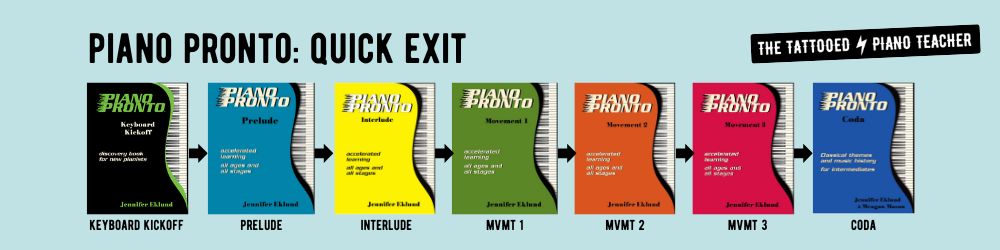
And the final path deviation offered by the Piano Pronto series is the Coda book.
The Coda book is designed for students who want an early exit from piano methods.
The Coda book replaces Movement 4, Movement 5, Finale, and Encore levels.
Within the pages of the Coda book, you’ll find selections from the levels it replaces (Movement 4, Movement 5, Finale, and Encore).
A student who utilizes the Coda book’s early exit would take this path:
- Keyboard Kickoff (age 6-9)
- Prelude
- Movement 1
- Movement 2
- Movement 3
- Coda
How Far Does the Piano Pronto Take an Advancing Student?
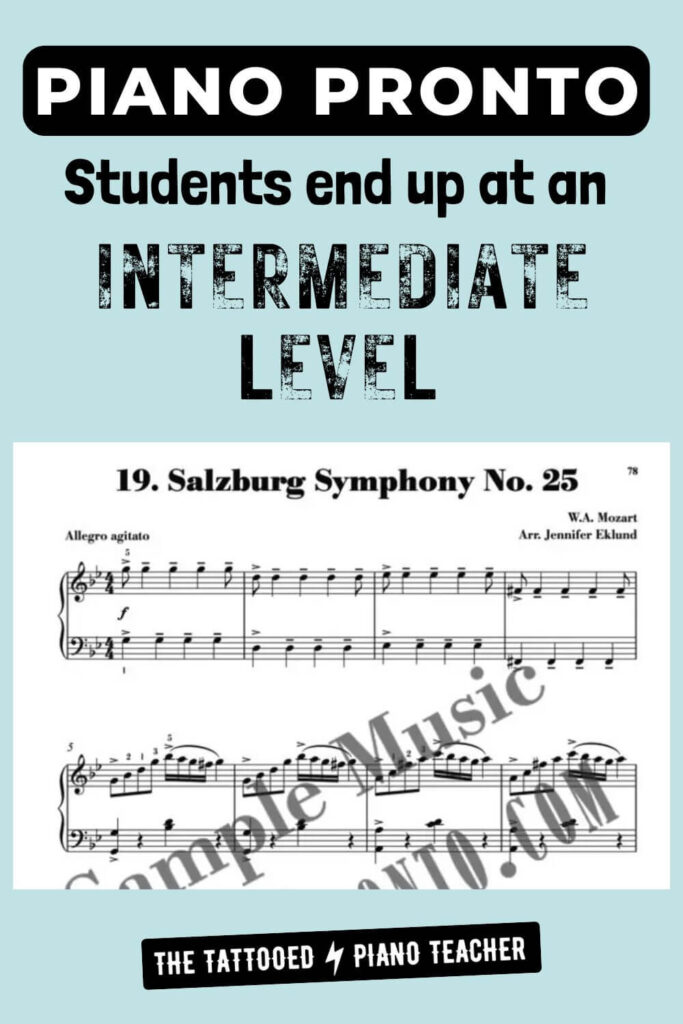
A piano student who completes all levels of the Piano Pronto series would end up at a true Intermediate (to Late Intermediate) level.
This series does take students farther into Intermediate “territory” than most piano method book series. I would say that by the end of this series, students would be playing at an Intermediate to Late Intermediate level, and would be well past the difficulty level of Piano Adventures Level 5.
Now that you understand…
- how the levels work,
- the different path options,
- how extensive this series is,
- and the unique names of the books
… now we can really dive into the content of this series. Next we’ll talk about the pacing of this series.
Pacing of Piano Pronto
Pacing describes how quickly a method moves through the concepts and gets more difficult in its literature.
The Piano Pronto series is a self-proclaimed “accelerated” series. It says so right on the cover of each book!
I would agree that Piano Pronto moves at an accelerated pace, especially at first.
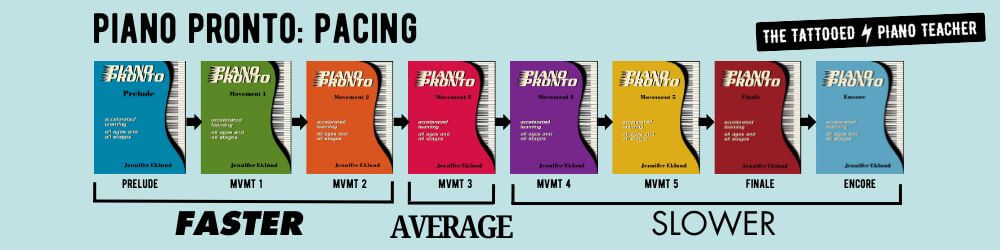
After working with this series, I would summarize the pacing as follows:
- FAST Pacing in the Prelude, Movement 1, and Movement 2 levels
- AVERAGE Pacing in Movement 3
- SLOWER Pacing in Movement 4, Movement 5, Finale, and Encore levels
Compared to Faber Piano Adventures
To further illustrate the pacing of the levels, here is a comparison between each Piano Pronto level and its equal in the Faber Piano Adventures series (in my opinion):
Fast-Paced Primer Level
As you’ll notice the accelerated progression is most concentrated in the Primer level books—Keyboard Kickoff and Prelude.
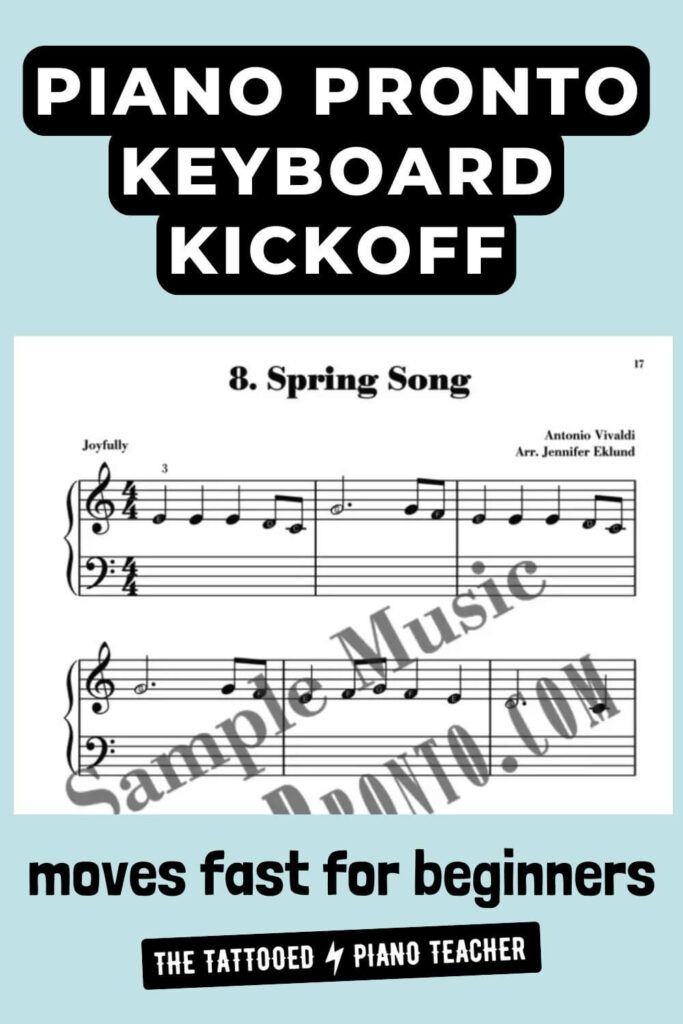
Keyboard Kickoff
Keyboard Kickoff is the very first book of the Piano Pronto series, designed as an optional start for piano students under the age of 10.
Keyboard Kickoff moves faster than most Primer books (first book of a piano method book series). With an absence of off-staff notation, black key songs, and Middle C Position songs, this book may be too technically difficult for younger beginners.
If considering the Keyboard Kickoff level for a beginner, I would recommend it for ages 7-9 or a coordinated and quick-learning 6-year-old.
Prelude
Piano Pronto’s Prelude level is either the first OR second book of the series for beginners. If students, started in Keyboard Kickoff, they would then proceed to Prelude.
For a student age 10 and up, the author recommends just starting with the Prelude level foregoing the Keyboard Kickoff book altogether.
There is quite a bit of overlap between the Keyboard Kickoff book and the Prelude book. They cover many of the same concepts in a similar way. Students who complete Keyboard Kickoff successfully can skip the first portion of Prelude. And those who struggled a bit with any part of the Keyboard Kickoff book may benefit from the review that the first pages of Prelude offers.
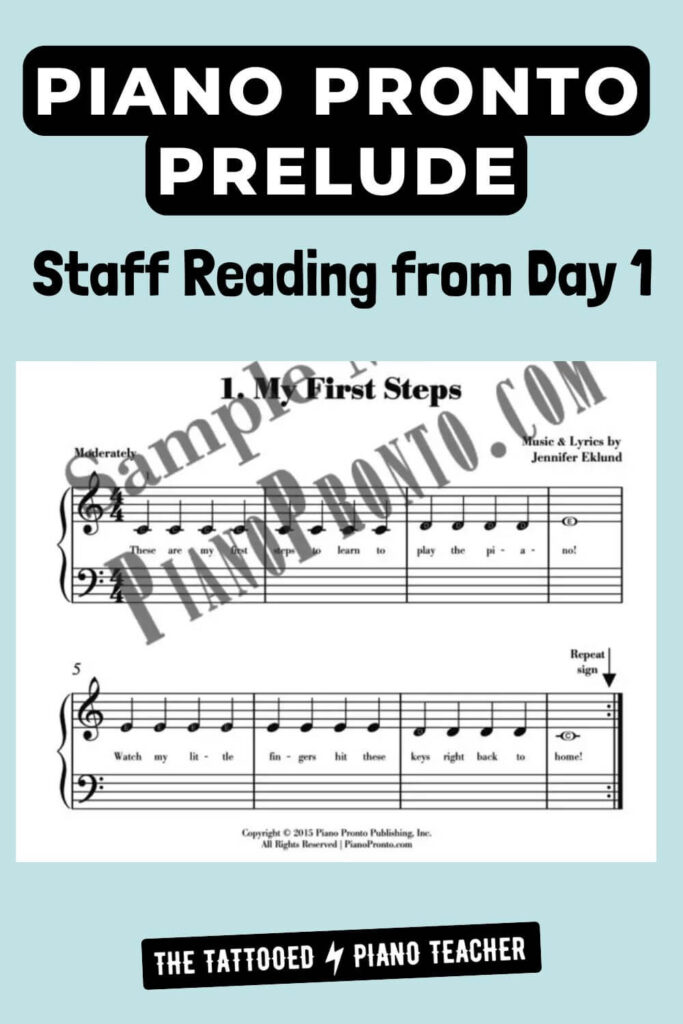
If Keyboard Kickoff moves fast (for a Primer level beginner book), Prelude moves REALLY FAST. Students will be asked to read notes on the staff right away, conquer eighth note and dotted rhythms, and master 5-finger independence even in the first dozen songs of the book.
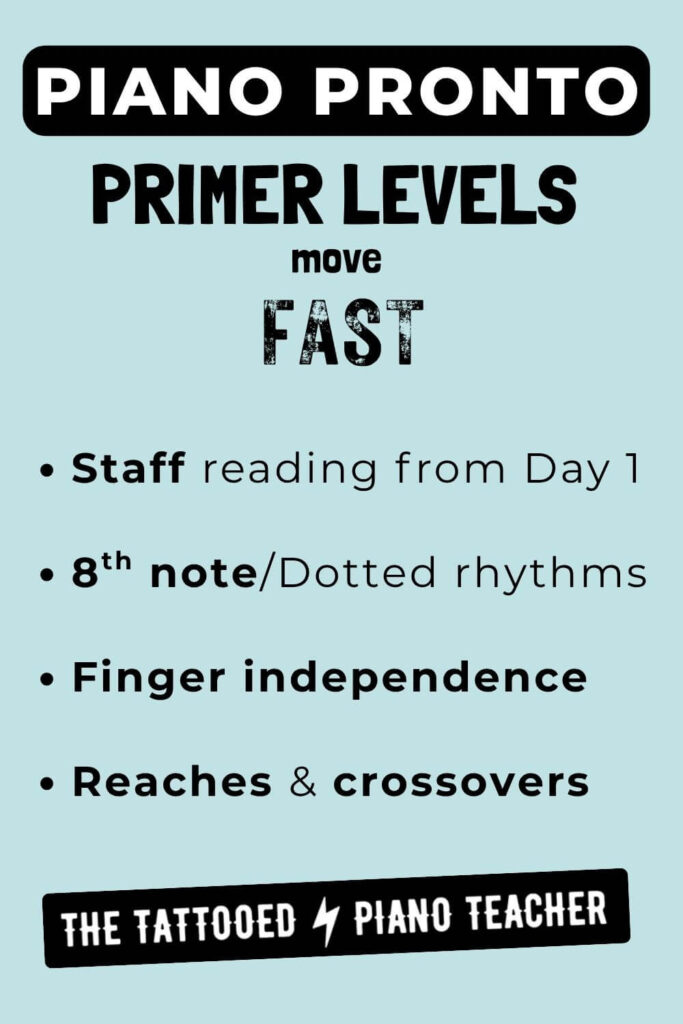
Accelerated Aspects of Primer Levels
To summarize, both the Keyboard Kickoff and Prelude books are fast-paced because of these factors:
- Staff reading from Day 1
- Eighth notes and dotted quarter note rhythms
- Technically challenging melodies (require finger independence)
- Reaches and crossovers
For a student who is a little bit of an older beginner or already has some musical experience or aptitude, the accelerated start that Piano Pronto offers may be just perfect!
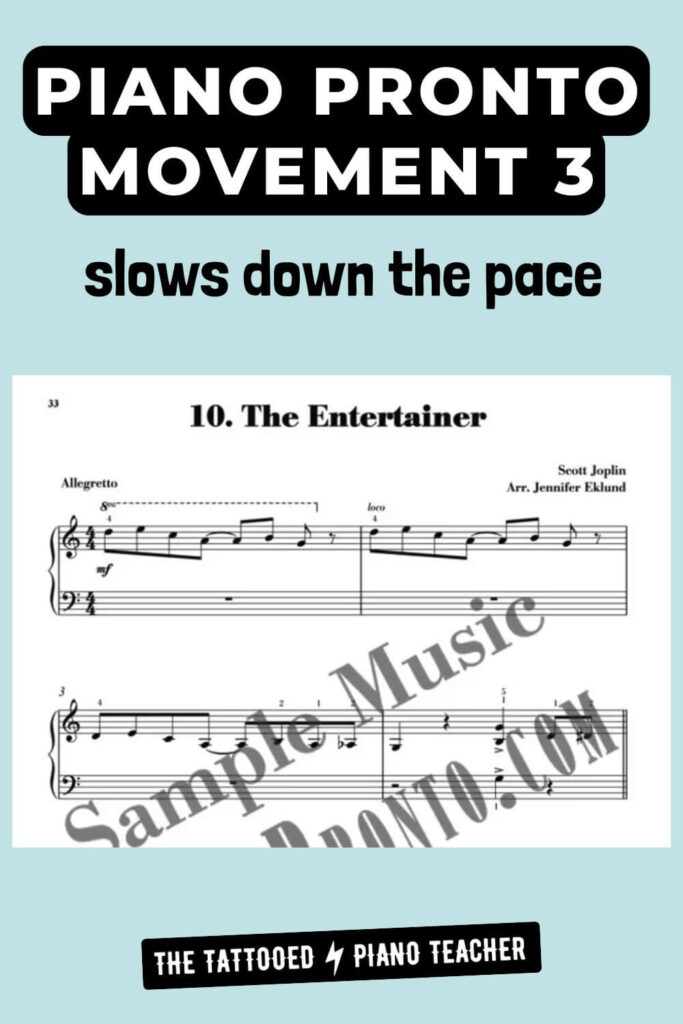
Slow-Paced Later Levels
From Movement 3 and beyond, Piano Pronto’s pacing slows down.
Movement 3 is comparable to Faber Piano Adventures Level 3B.
Movement 4 and Movement 5 more or less compare to Faber Piano Adventures Level 4.
Finale and Encore roughly correlate to Faber Piano Adventures Level 5, although we could argue that the Encore level takes students beyond Piano Adventures Level 5.
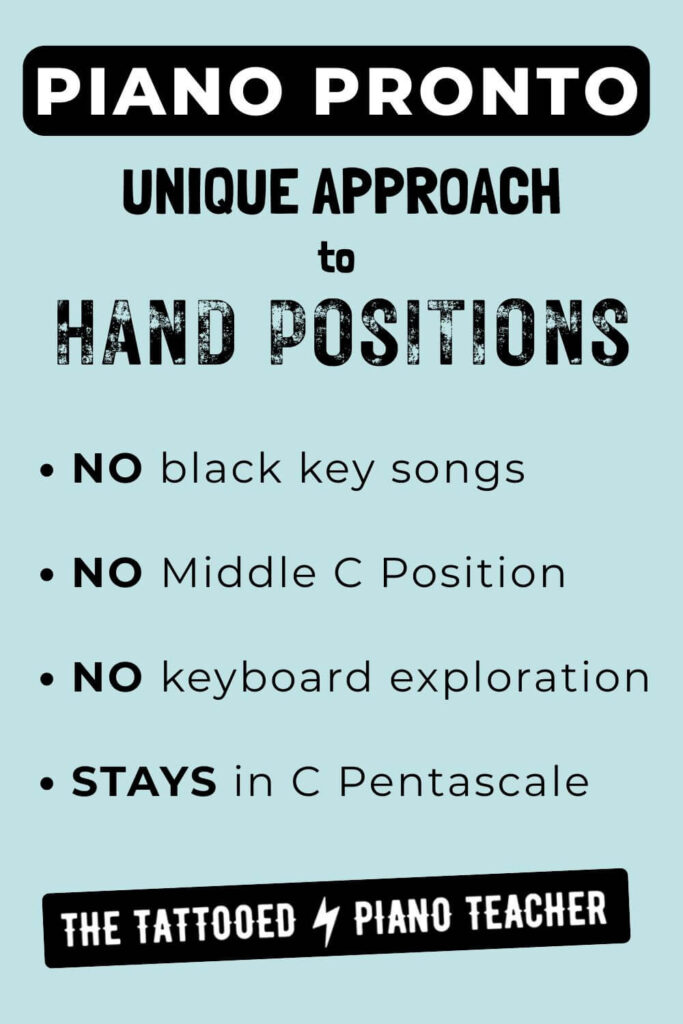
Hand Positions in Piano Pronto
I can safely say I haven’t seen another method book take quite the same approach when it comes to the beginning of the piano method journey!
Piano Pronto’s unique approach in the Primer levels:
- NO Black Key Songs (Piano Pronto starts on the white keys from the first song)
- NO Middle C Position (after several songs using only the Right Hand on C-D-E-F-G, the Left Hand joins in the C Pentascale!)
- NO Keyboard Exploration (hands stay in position in the middle of the keyboard until Movement 2!)
- Stays in the C Pentascale for a long time, but with alterations (crossovers, reaches)
Notation in Piano Pronto
The notation of Piano Pronto books, especially in the early level, is also unique.
No Off-Staff Notation
The first thing you’ll notice when opening either the Keyboard Kickoff or the Prelude Primer level books is that there is NO Off-Staff Notation! Students are reading notes on the staff from Day 1.
Another series that takes this approach (more or less) is the Piano Safari series. However, the Piano Safari series relies on songs taught by rote to ease students into fluent note reading.
In contrast, Piano Pronto does not promote teaching by rote. Instead, note names are shown in the noteheads to help ease students into reading notes on the staff at the beginning of their piano journey.
No Hints for Moves
Like all piano methods, strategically placed finger numbers guide students as they read through their songs.
But unlike other methods, there are NO HINTS of any kind that a move, reach, or crossover is coming up! Whereas Faber adds a circle around the finger number or the word “move,” there is no special indication in the Piano Pronto books. Students are on their own to recognize any alterations to the five-finger hand position they started with.
Thankfully, the author prepares students to recognize any upcoming surprises before they try the song…we’ll preview this unique feature in the “Technique” section!
No Pedal Marks
I was surprised to learn that the author, Jennifer Eklund, chose to leave pedal marks out of all songs in this series. Yes, you read that right: There are NO PEDAL MARKS added to any Piano Pronto song!
With the exception of…one piece!
Here’s how it works:
- At the end of Movement 1, pedal marks are introduced. (And not just pedal marks, but overlapping pedal/intuitive pedal…you know, with the lifts!)
- For the final piece of Movement 1, which is Fur Elise – arranged, pedal marks (with lifts) are added to the score.
- The author then instructs students and teachers to pedal intuitively from here on out when it seems appropriate.
So you will not see any pedal marks added to any other song besides Fur Elise.
What my take on this approach?
While I teach and endorse intuitive pedaling, I don’t think it comes naturally from Day 1 for every student! There are going to be students that don’t know when to pedal, how to pedal, are over-pedaling, are lifting at the wrong times, etc. I see pedal lifts as an advanced skill that requires a good ear and real coordination!
As a teacher, I like the idea of starting the pedal mastery path with pedal marks and lifts written into the music until the student develops a sense of when pedal should be added, how much, how often to lift, the perfect timing of each lift, etc. Yes, we piano teachers can guide this process, but at some point I feel like I’d end up writing in the pedal lifts for students in Movement 2 and possibly Movement 3 until they get it!
What’s your take on this? Let me know in the comments!
Theory in Piano Pronto
There is a a separate theory book for some of the levels and there is some theory included in all of the lesson levels. We’re starting to see the all-in-one book aspects to the Piano Pronto series, but we’ll talk about that more when we get to Technique.
Some Theory Included Within Lesson Books
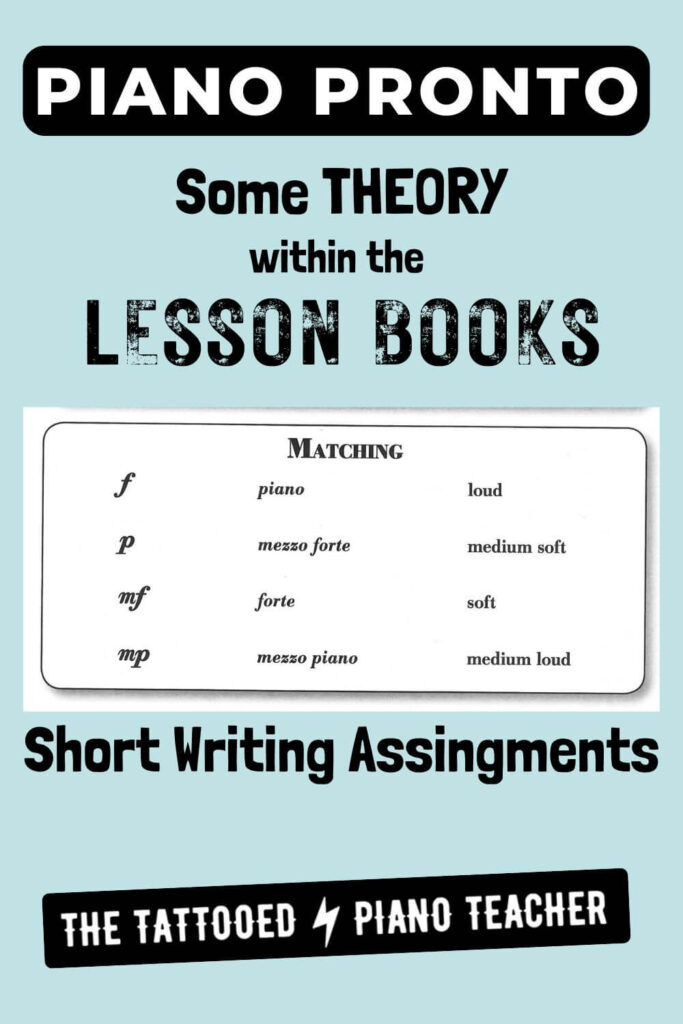
Within the main lesson book of each level, students will encounter very short writing assignments here and there. New theory concepts are clearly introduced and get their own pages. But it’s a lot of words and not a ton of writing on the student’s part.
So, within the main lesson book, it would be the teacher explaining or talking through these pages for the most part.
One very unique feature worth mentioning is the questions that appear before each song. These are the types of questions we piano teachers like to ask before a student sight-reads a piece. Questions like, “What key is it in?” “What’s the time signature?” etc.
These analysis questions appear before each song in the Piano Pronto main lesson books!
Power Pages: Piano Pronto Theory Books
The separate theory books are called Power Pages and they correlate beautifully with the main lesson book.
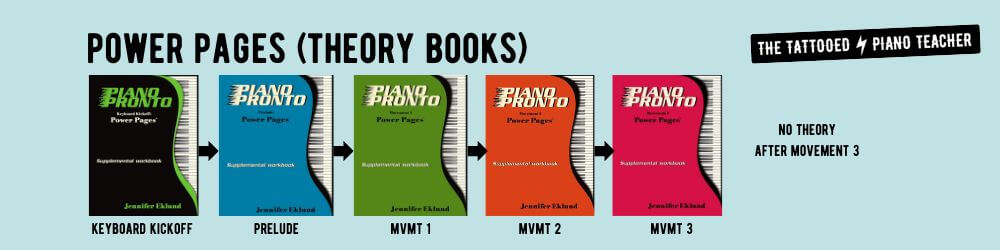
In fact, the lesson book songs are numbered and the theory assignments are numbered to go along with the song. So it is super clear what is supposed to be happening and they pair together perfectly.
The Power Pages books are filled with
- writing assignments
- ear training
- copying music excerpts
- sight-reading.
I like the look of the Power Pages as a theory book. However, the Power Pages are only available up through Movement 3. Students in Movement 4, Movement 5, Finale, Encore, or Coda would not have a correlating separate theory book available in the Piano Pronto series. Because students would be farther along, likely they would have success pairing an outside theory series of your choosing.
Next let’s talk about technique.
Technique in Piano Pronto
Technique is one of the most unique aspects about the Piano Pronto series, and probably my biggest complaint.
No Technique Books
There are no dedicated technique books to correspond to the Piano Pronto series.
Now, the all-in-one nature of the main lesson books means that there is some technique introduced in the books.
However, I I’m going to use the word “introduced” instead of “included” because the technical aspects of playing the piano, such as scales and arpeggios, are only introduced when they directly correlate to the song coming up. And they’re only introduced once. There’s very little review written into the book.
There’s no library of scales.
There are no warm-up pages.
I think that this really puts a burden on the teacher to keep up with those technical skills and make sure that students are reviewing those on a weekly basis.
The Author’s Opinion on Technique
This is not an accident, in fact Jennifer puts a blurb about technique, or the lack thereof, in the beginning of all of her books:
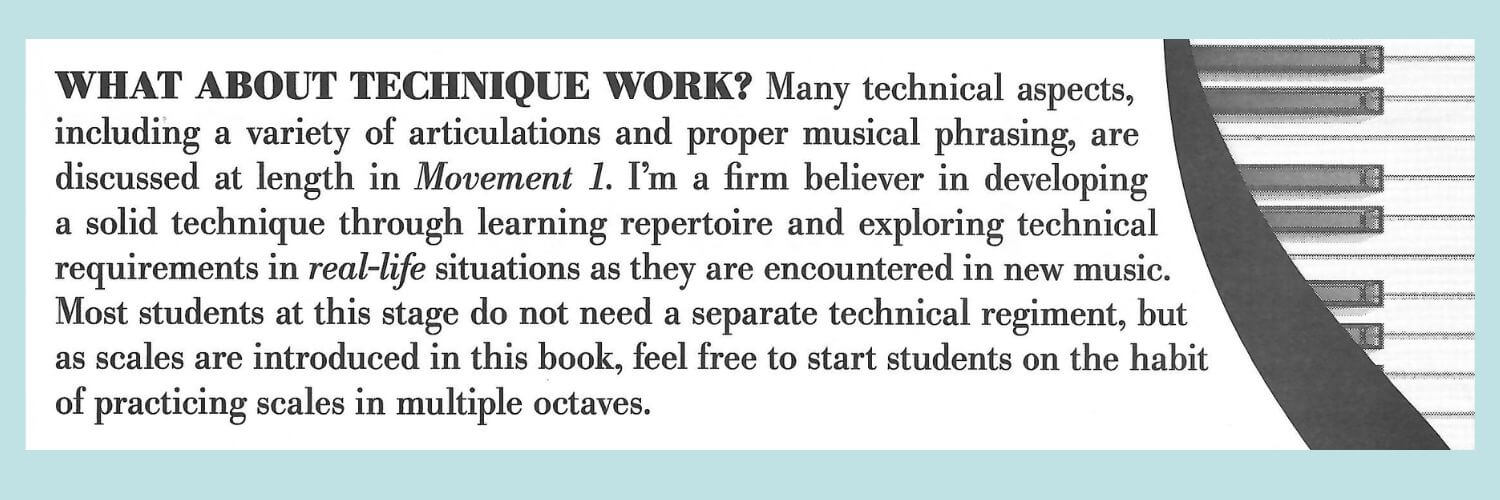
So that is her take on it–approach technique from a functional standpoint. Give students a variety of repertoire to work on and address whatever technical things they’ll need to conquer that piece.
While I do see the validity of this mindset I don’t think that the logical progression of technique can be left to these songs, especially when the songs are all real literature–either folk tunes or classical themes–and there aren’t any etudes or pieces written specifically to work on a technical patterns (except for a short scale song that Jennifer wrote for each new scale that’s introduced).
With Piano Pronto, it is the duty of the teacher to stay on top of technical work or add something tangible on the side.
Pronto Prep Before Each Song
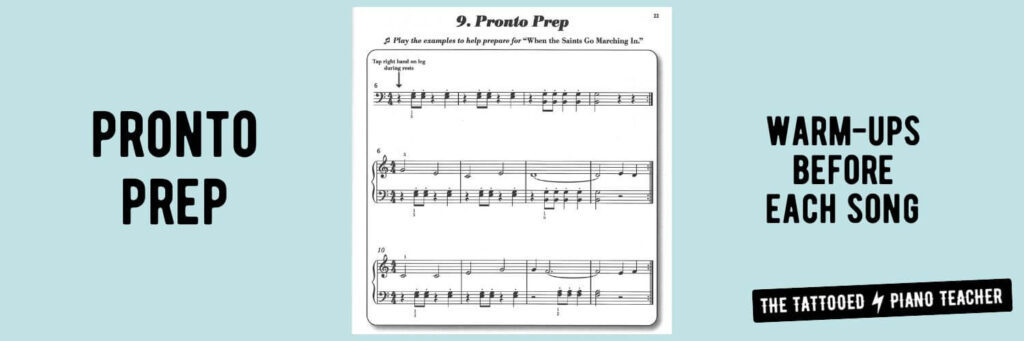
The technique that’s included within these books is in the form of a short Pronto Prep before each piece.
Each song that’s coming up will highlight either its trickiest technical feat or its trickiest note reading section, and those parts of the piece will be pulled out for a series of warmups before learning each piece.
The Aesthetics of Piano Pronto Books
Aesthetically, there’s something I love about these books, and it is the smell of the pages of these books when they are brand new. Call me crazy, but I always smell my new piano method books right out of the books! Why do these smell so delicious?
Aesthetically, here’s what I don’t love, and what I do think is advantageous for these books (besides the smell).
Piano Pronto Interior: Plain & Simple
I don’t love that there’s no color. It’s just black and white.
I can see the value in leaving out juvenile elements making it more of an all-ages method book (and we’ll talk about that more in the Song Selection category) but personally me and my students, we love pictures! We love stories! We love games! We love characters! We love color!
The premise of the Piano Pronto books is that there are no distractions. It’s just the words and the song. And some teachers really do appreciate the simplicity of each page’s no-frills design.
A Homemade Look
Personally, I don’t love the overall look of these books. To me they look like they were created on Microsoft Word. I’m sorry, I’m all about homemade resources, but I just feel like these are a little too homegrown looking for me. Just something about the fonts, shaded boxes, and layout. They feel a little outdated to my eye.
Numbered Songs
One thing I do love is that all of the songs are numbered. Brilliant! You can just say, “Play song #7.”
Book Design
Beyond that, the books open really nicely. They stay flat.
They are very thick books with lots of pages. Even so, in my experience, the cover stays on most of the time. (Update: I did have a couple of students who lost their Piano Pronto book covers after a couple of months.)
Song Selection
The songs in these books may truly be the most unique thing about this series.
Piano Pronto’s Core Philosophy: Familiar Tunes
As you already know, this method was created on the premise that students learn easier and have more fun with tunes they are familiar with.
So nearly all of the songs are not original compositions by the author.
Instead the books abound with:
- folk tunes
- classical themes
- plus a couple of original compositions
Song Selection: Level By Level
Here’s how it works throughout the levels.
In the beginning levels like the Keyboard Kickoff and the Prelude level, students are almost exclusively learning folk tunes with the occasional classical theme.
In Movement 1 we have about half folk tunes and half arrangements of classical themes and pieces.
In Movement 2 through Movement 5 the song selection is heavy on the classical. So Movement 2, 3, 4, and 5 are almost entirely classical arrangements, either simplified versions of piano solo pieces in the classical realm or orchestral pieces that have been simpified to a piano solo theme.
Finally, when you get to the Finale and the Encore (which we’re now well into the intermediate level), we finally get some original classical pieces. But there are still a lot of like orchestral arrangements or simplified versions of piano pieces.
When I first ordered these books, I kind of expected them to be like a classical music lover’s dream. However, now comparing the Piano Safari books with the Piano Pronto books, I can see how Piano Safari is all about using those easier classical etudes in their original form. Whereas the Piano Pronto books, even up into the higher levels, are still serving mostly arrangements of classical works, both for orchestra and solo piano.
Pros and Cons of Song Selection in Piano Pronto
Here’s what I think is GOOD about this approach.
- Immediately recognizable tunes
- Remember how they sound at home
- Pacing & aesthetics, along with song selection, will appeal to older beginners
- Exposure to classical themes
- Jennifer Eklund’s beautiful original compositions
And some aspects of the song selection I feel may be LACKING.
- Kids may not know a lot of these older folk tunes
- Older beginners may not enjoy playing “Farmer in the Dell,” “Old MacDonald,” etc.
- Almost entirely arrangements instead of real classical literature for the piano (until very later levels)
- Lacking in jazz selections
- ALL (almost) classical in the later levels
- Not many original compositions (a couple per level)
Piano Pronto’s Extensive Library
Despite my desire to have more of Jennifer’s original compositions included within the Piano Pronto method books, it’s worth noting that Piano Pronto offers a very extensive library of single songs and supplemental books.
If you use Piano Pronto and find that a student really enjoys the original pieces included, you could find oodles of options to add to their curriculum on pianopronto.com.
Pricing of Piano Pronto
I would say that per book these are slightly higher than the average method book price, however they are an all-in-one style method book (or almost all-in-one considering they don’t contain a lot of theory and technique), and they do take you farther than the average lesson book. Because they are more comprehensive, I consider them a good value.
All of the main lesson books are around $12.
If you add the Power Pages (theory book) for the first few levels, these are also about $12 each.
But read on to find out how to get a discount off of these books!
Availability of Piano Pronto Books
You can only get these books on pianopronto.com. They are not sold through any other retailer. And you do have to pay shipping.
However, Piano Pronto’s website runs monthly sales!
The first week of each month is 15% off all of method books so you can plan ahead and save quite a bit of money.
Summary of Piano Pronto
Time to summarize what we have learned during our in-depth look at this series.
Let’s quickly list off what is truly unique about the piano Pronto Series so we can start to get an overview of the series and whether it’s worth your time.

What is Unique About Piano Pronto?
What’s unique about this series?
- NO Original Tunes (or very few)
- NO Pictures, Games, or Activities
- NO Off-Staff Notation or Black Key Songs at the beginning
- NO Middle C Position
- ONLY C Pentascale for both hands at the beginning of the journey (with alterations)
- NO Moves are marked in the music
- NO Pedal Markings throughout the series
- NO dedicated, logical Technique added to this series (or very little)
- Not a lot of Review
- A General Responsibility of the Teacher to make sure all of the bases are covered and everything gets reviewed systematically
Where Piano Pronto Shines
Where this series really shines is:
- Flexible Path Options
- Comprehensive (almost) All-in-One Books
- Familiar Tunes expertly arranged
- Exposure to Classical Literature (albeit arrangements)
- No-frills Aesthetics for the potential of an all-ages method
- Jennifer Eklund’s compositions and arranging skills
My Opinion of Piano Pronto
Let me sum up my general opinion after spending some time with the Piano Pronto books.
Things I don’t like personally about this method book series are…
- the aesthetics, like the fonts and the layout of the book, the lack of color, pictures, activities, games, characters
- the song choices don’t appeal to me a whole lot, outdated folk tunes, prevalence of arrangements (classical)
- doubts that Keyboard Kickoff would work well with a younger beginner
- lack of logical, reviewed technique and warm-up patterns
- lack of extended theory books
But I like…
- innovative path options
- Pronto Prep sections (and questions) before each song
- Power Pages theory books
- Jennifer’s original compositions
In conclusion, I am not completely convinced to switch to Piano Pronto as a method book series, however I am thankful that I have added these books to my shelf for the right student and the right situation.
Who is Piano Pronto Right For?
What do I think would be the right student in the right situation? Well I’m so glad you asked!
Here’s who I think these method books would be really good for and who should check this out.
Piano Pronto May Not Work For…
I don’t think that this method book series is right for young beginners or teens and adults just because of the selection of folk tunes.
Until Movement 1, for a teen or adult who was very interested in classical music and was able to start with Movement 1.
I also don’t think this would be the right piano series for a newer piano teacher because the teacher has to take on the role to make sure some of those holes are filled. I don’t think that this is a plug-and-play type of method book series, and for a new teacher starting out I would encourage them to start with another method book series and look at this after after a couple years of teaching.
Try Piano Pronto if…
Here’s who I think should definitely check out this series, or at least give it a look.
Teachers, if you have an average age (7-9) to an older beginner (10-14) piano student who is coming in and maybe has some prior music experience, this series might be just the right pace at the beginning of their journey to get them off and running and playing some tunes that they like sooner rather than later.
This also might be appropriate for a transfer student situation if they’ve had some prior piano experience but you don’t want to backtrack them in the same method book that they came in with.
I could see certain points in this series working for someone who is technically or rhythmically ahead of the game but struggles in the note reading category.
I also think that an orchestra student who wants to play real orchestral, recognizable themes, would really thrive in this series.
Also if you have a super pragmatic student who just hates doing anything outside of what’s directly related to the song they’re working on, they might really like the layout and the pacing of these books.
And if you’re a seasoned teacher, you’ve been doing this for a while, and you like “frankensteining” your own curriculum for your students–pulling a little of that and a little of this–I would encourage you to check out the Piano Pronto books and add them in where it seems appropriate.
I could see Movement 3 being helpful for a student running through the Piano Adventures Level 3A who isn’t quite ready for Level 3B. Movement 3 could be an amazing review and bridge into 3B.
Or a student who flew through all the Piano Adventure method books through Level 4, but maybe they are younger and have smaller hands and can’t do the reaches in Level 5 or they need more song choice at that level before leveling up to the next one. I think Piano Pronto would offer a lot of options in the upper levels for a student like that, if they’re into classical music.
What Do You Think?
Will you give Piano Pronto a try? Let the community how it goes if you do!
How Does Piano Pronto Correlate To Other Methods?
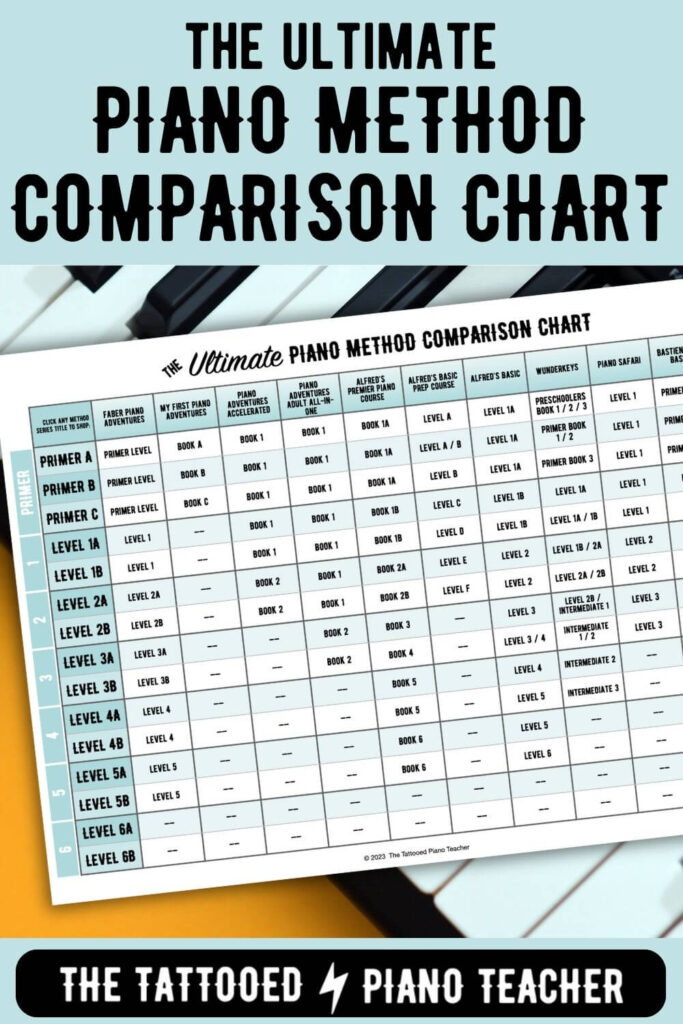
Be sure to download my FREE Ultimate Piano Method Comparison Chart!
It includes Piano Pronto levels as well as other popular methods so you can see how the books line up with what you’re currently using.
Other Method Book Reviews?
Looking for more research? Here’s a list of all of the piano method reviews I’ve done so far!
- Best Piano Method Book for Beginners: My Top 3 Picks
- Faber Piano Adventures for Beginners: The Best or Overrated?
- Alfred’s Premier Piano Course For Beginners: Would You Switch?
- Wunderkeys For Beginners: Too Slow or a Completely Unique Approach?
- Piano Made Fun for the Young: The Best Piano Method for Young Beginners You’ve Never Heard Of
- My First Piano Adventure: A Fun Way to Teach Young Beginners
- Best Piano Method Books for Young Beginners: My Top 3 Picks
- Wunderkeys Piano for Preschoolers: Fun for Ages 3-4
- Faber Piano Adventures Levels in Order
- Faber Adult Piano Adventures Review: Best Piano Book for Adults?
- Piano Safari Review: Learning by Rote as a Piano Method
- 7 Supplemental Songbooks Your Level 1 Students Will Love
- The Very Useful Piano Library: WunderKeys Supplemental Songbook Series