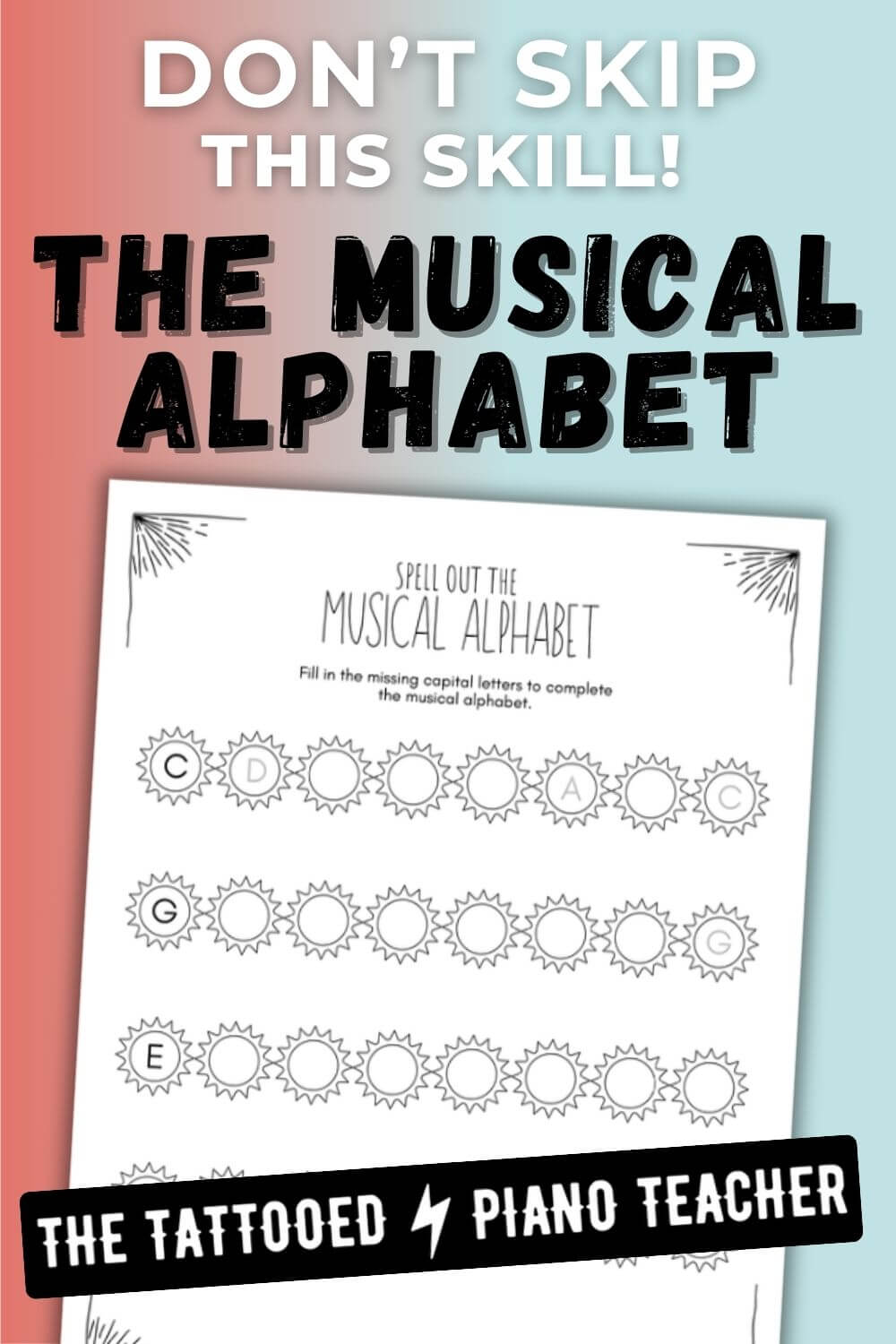
What is the number one missed skill for beginning piano students? The musical alphabet!
Most books either briefly mention the musical alphabet or ask students to recite it once and that’s it.
As adult musicians, it seems so simple that we take it for granted. But the musical alphabet is a critical pre-reading skill (one of 13 pre-reading skills) that should be carefully introduced and reviewed until it is mastered.
In this article, I’ll share with you…
- Why this one simple skill is so vital to later reading skills
- How the musical alphabet prepares students for reading patterns
- When and how to introduce the musical alphabet
- How to master and review it
- Worksheets you can print and use right away to help your students
- My own Pre-Reading Level method books that emphasize the musical alphabet along with 12 other pre-reading skills!
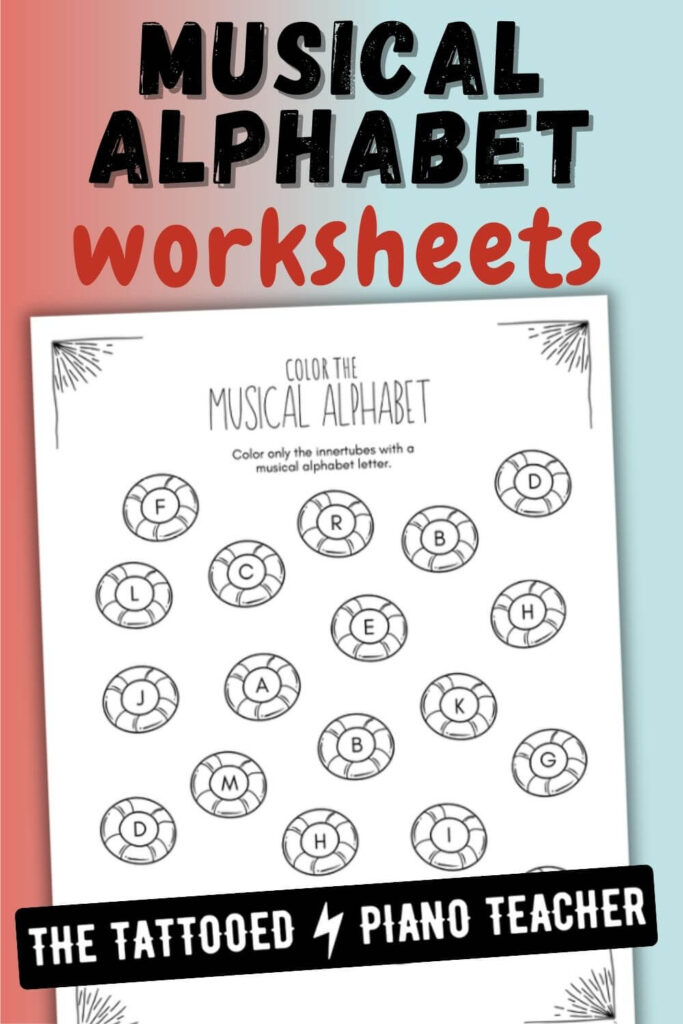
Here for the Musical Alphabet Worksheets?
Look, I get it. You’re a busy teacher! If you landed on this page seeking the perfect set of printable worksheets for your students, here you go!
But if you’re here for the full scoop on teaching the musical alphabet, read on, Teacher Friend!
Why is the Musical Alphabet So Important for Beginners?
My favorite quote from one of my adult piano students was:
“It’s not the notes that trip me up…it’s the alphabet.”
And I knew exactly what she meant when she said that!
An Alphabet-Based Note System
Here’s the deal. Like it or not, we’re working with an alphabet-based note system, at least here in the U.S.
Understanding “C-D-E” begins with understanding “A-B-C,” so to speak.
Everything from scales to chords to the staff is based on these seven letters. So we better have them down.
Imagine you’re trying to teach a student a year down the road that the note below Middle C is a B. If they haven’t fully internalized and automated the fact that B comes before C, they will struggle to name the note on the staff as well and may even stare blankly at the keys not being able to name it.
Knowing is Not KNOWing
You may be thinking, “My students come to me already knowing their A-B-Cs. And if they know the whole alphabet, then they know the musical alphabet.”
My late grandmother was able to recite the whole alphabet backwards at lightning speed. It was a fun skill she had worked on until it was perfected. Now, I know the alphabet and can figure out the letters moving backwards…let’s see, there’s Z, then Y, then it would be X, next is… But I really have to think about it.
So next time you have a beginning student prove that they can name the first seven letters of the alphabet, don’t trust that your work with the musical alphabet is done!
If a student has to recite the A-B-C’s from the beginning to figure out what comes after F, they don’t KNOW the musical alphabet inside out!
Backwards, Too
And let’s not forget that it’s just as important to know what comes before F than it is to know what comes after F!
That means, like my grandma, students need to spout off the musical alphabet backwards as fluently as they can forwards, and be able to name the previous letter if given only a single letter to work with (without having to sing their A-B-Cs).
A quick test you can try is to ask a beginning student to name the C white key on the piano (most students can as we focus on Middle C first). Then ask them the name of the key to the left. If they have to really ponder it, or if they have to “count up” from the previous C, they don’t know their alphabet backwards!
The Musical Alphabet Prepares Students to Read Note Patterns
Mastering the musical alphabet goes beyond just knowing what the next key is. It sets up a beginning piano student to read simple to complex note patterns, making them better at intervals and master sight-readers someday!
Music Intervals
I’ve noticed that students who don’t fully absorb the musical alphabet forwards and backwards in their early piano days, struggle to comprehend intervals later on.
Starting with steps and skips in the Primer Level, students who understand that up from E is F, and down from E is D, will latch onto steps (and later 2nds) easily.
Even more so with skips (3rds). A student who really, really knows their musical alphabet will easily jump from E to G, and subsequently from E down to C.
There’s a clear progression of learning:
Musical Alphabet –> White Key Names –> Steps & Skips –> Notes on the Staff –> Intervals –> Complex Patterns
Sight-reading by Pattern
Many students easily recognize shape patterns such as repeating motives, sequences, up an octave, up a third, etc. But those who also mastered the musical alphabet at the beginning of their journey will relate the note name to the pattern, making them unstoppable sight-readers as they progress.
When to Introduce the Musical Alphabet
Most method books do touch on the musical alphabet right away, and that is when it should come up in the lessons!
The First Lesson
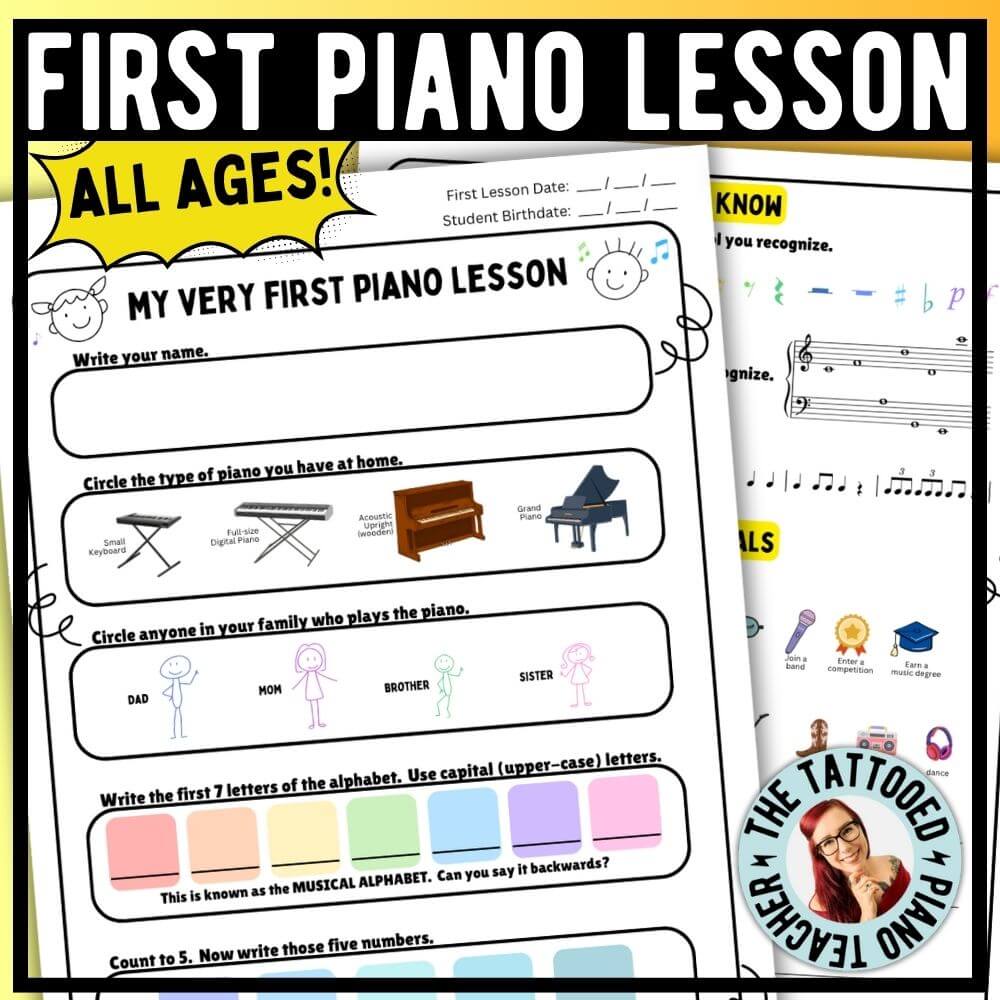
In fact, I talk about the musical alphabet in my first trial lesson interview with a new student of any age. It’s written into my First Piano Lesson Interview Worksheets (includes different sheets for all ages).
Start simple, by naming the first seven letters of the alphabet. Relate it to the white key names right away for older beginners.
And for more tips on what to teach at the first lesson, check out this article.
The First Month of Lessons
Within the first month of lessons (or sooner for an older student), add on to the concept of the musical alphabet.
Move beyond just saying the first seven letter of the alphabet, and talk about how it starts over with A after G.
Start to speak it backwards in its entirety. Make it into a rhythmic rhyme.
Introduce some basic worksheets requiring students to write out the musical alphabet forwards and backwards.
Review Every Week
Don’t skip this! Keep reviewing and reviewing, even if it seems basic.
Hone In
Time to quiz students on just two or three letters of the musical alphabet in order. Force them to let go of their dependence on the alphabet recitation or song. They need to know E-F-G without having to speak A-B-C-D!
Hone in on steps up and down.
- What comes after E?
- What comes before E?
Relate at Every Step
Working on white keys? Relate musical alphabet knowledge to the white key names.
Learning the first notes on the staff? Review the musical alphabet in relation to the new note or notes.
Identifying steps vs skips? Time to brush up on the musical alphabet.
Musical Alphabet Worksheets for Piano Students
If I’ve convinced you of the importance of drilling the musical alphabet, then, like me, you’re probably thinking your piano method book isn’t doing this pre-reading skill justice!

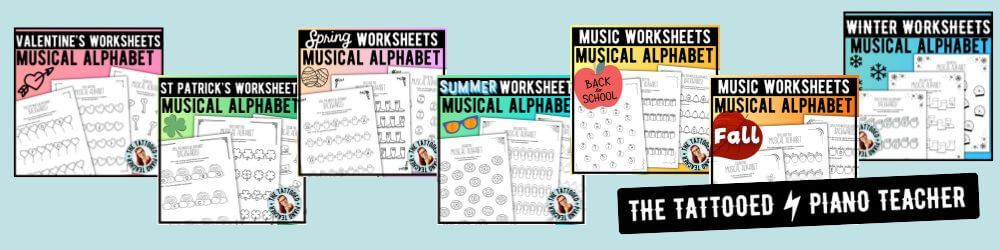
Enter, my Musical Alphabet Worksheets. For just a few bucks, you can print and use (and reuse) these 10 straightforward printable student worksheets to make sure your students are getting it!
No, worksheets aren’t the magical answer. Students need to speak, sing, recite, relate, and review the musical alphabet in lessons with you. But worksheets are a great way to make sure the musical alphabet gets its “fifteen minutes of fame” in your lesson studio with your beginner piano students.
I have a set for every season. The worksheets in each set are very similar with a different theme. Choose the season you want, buy, print, done. 🙂

Skill-Focused Pre-Reading Piano Method Book
And if your current beginner piano method is not checking all of the boxes for you and your students, consider checking out my Pre-Reading Level method book series!
As the first level in my Piano Skill Set series, these books highlight and carefully review the 13 Skills I deem most important in those first weeks of piano study.
This very beginning piano books are designed to work as supplementary books to any piano method you’re already accustomed to using. Or they can stand on their own as a first set of piano books for young beginners.
Try one of these books, or use them together as they were designed to correlate!
- Piano Skill Set Pre-reading WRITING Book
- Piano Skill Set Pre-reading TECHNIQUE Book
- Piano Skill Set Pre-reading SONGBOOK: Pets Will Play
13 Pre-reading Skills
Learn more about the 13 essential pre-reading level skills I included within the Piano Skill Set books in this video: