If you’ve been searching for the perfect theory book for your older beginner, teen, or adult piano students, let me introduce you to…
Essential Elements Piano Theory books authored by Mona Rejino and published by Hal Leonard.
I bet you’ve never heard of this theory book series, but it’s a supplemental series of books you’ll want to know about!
The Problem With Method Series Theory Books
Often the theory books that come along with our piano students’ method book series leave something to be desired. While they may correlate perfectly with your chosen main lesson book, you might want to branch off and get your students a better music theory curriculum.
The theory books that correlate with many piano methods can be…
- shallow (don’t dive into theory deep enough)
- cluttered (so many things to do on each page)
- not consistent (when each page has different activities, students give up on figuring out what they’re supposed to do)
- juvenile in aesthetics (making them seem too kiddish for older students)
What Older Beginner Piano Students Need in a Theory Book
So what are we seeking for our older beginners, teens, and adult piano students?
Well, we want a theory book that is…
- comprehensive, but not overwhelming
- clean design
- adult friendly aesthetics
- clear layout & instructions
- progresses quickly, but doesn’t skip over anything
Essential Elements Piano Theory Series for Older Beginners
So, let’s dive into this theory series to see if it fits the needs of our older students!
How many levels in Essential Elements Piano Theory series?
There are 8 levels in this series.
Does it work for very beginners?
Yes! Level 1 starts with pre-reading foundational basics such as key names & finger numbers (see concept list below).
What about younger kids?
This series could definitely work for any age, but note that it is an accelerated pace and would work better for fast learners or older students.
Can it replace my student’s current method theory book?
Likely, yes! Check out the level overviews below and grab the comparison chart so you can see if this series is right for the student you have in mind.
Where Can I Buy Essential Elements Piano Theory Books?
These books are available from Amazon!
Click here to shop all Essential Elements Piano Theory books.
Or jump to the level you’d like to purchase:
Activities in Essential Elements Piano Theory series
You’ll find a variety of activities in this series for a well-rounded curriculum. I like that each book follows a similar format and cycle through types of activities for some continuity as well.
Activities in this series include:
- Writing
- Rhythm
- Ear training
- Review
- Puzzles
- Analysis
- (later levels) Improv & Composition
Topics Covered in the Beginning Levels of Essential Elements Piano Theory
In Levels 1-2, students will cover the basics, such as…
- Key names
- Finger numbers
- Note names
- Note & rest values
- Terms & symbols
- Intervals
And so on as they progress.
By the time they get to Level 8, they’re working on high school/college-level theory & analysis (see concept list below).
Do I Start with Level 1 or 2?
For a very beginning student, start with Level 1.
For a student with some experience (already knows some notes on the staff), skip into Level 2.
And if you’re looking to integrate a later level student into this series, check out the next section!
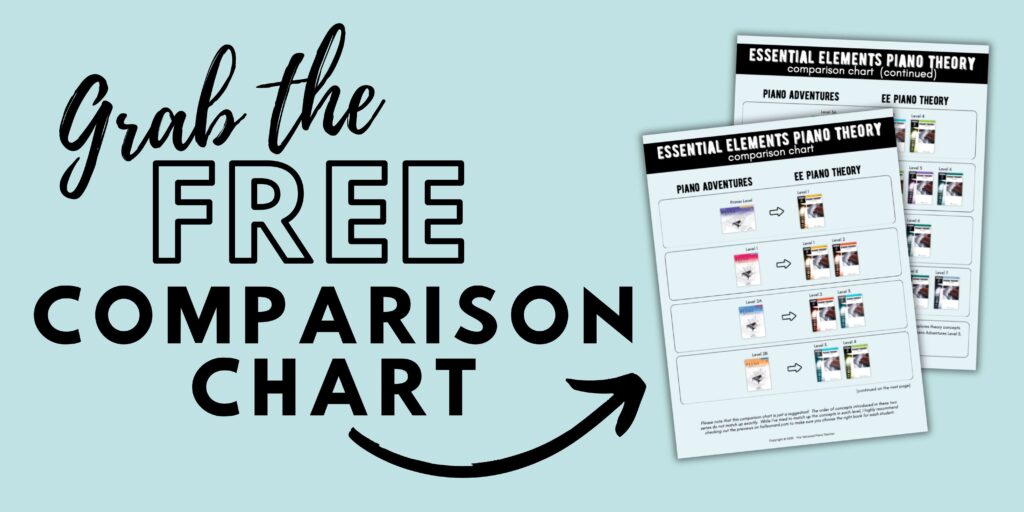
Essential Elements Piano Theory Comparison Chart
If you’re looking for a chart that will help you compare the levels of the Essential Elements Piano Theory series to Piano Adventures levels.
It’s free, so grab that chart if you’re looking to integrate this theory book series into your studio.
List of Music Theory Concepts Introduced in Each Level
If you’re looking to line up this series with other theory books or method books, here is a summarization of the theory concepts introduced in each level of the Essential Elements Piano Theory books.
Level 1
- Black key groups
- Music alphabet
- Naming white keys
- Quarter, half, & whole notes & rests
- Bar lines & measures
- Double bar line & repeat sign
- Finger numbers & RH/LH
- Stem direction
- Repeat, up & down
- Line & space notes
- Steps & skips
- Treble & bass clef
- Grand staff
- Guide notes: Treble G, Bass F, Middle C
- Ledger Lines
- Time signatures: 4/4, 3/4, 2/4
- Dotted half note
- Piano & forte
- Treble C & Bass C
- Naming notes on the grand staff
- Stem rule
- 5-finger patterns
Level 2
- Staff to keyboard
- Stepping & skipping from guide notes
- Mezzo piano & mezzo forte
- Adagio, Andante, Moderato, & Allegro
- Legato & staccato
- D.C. al Fine
- Tie & slur
- Drawing quarter, half, & whole rests
- Completing measures in 2/4, 3/4, & 4/4
- Melodic and harmonic 2nds, 3rds, 4ths, & 5ths
- Writing G-B-D-F on the grand staff
- Transposition
- Sharps, flats, & naturals
Level 3
- Eighth notes & rests
- Accidentals & enharmonics
- Half steps & whole steps
- Major & minor 5-finger patterns & triads
- Pianissimo, fortissimo, crescendo, & diminuendo
- Ritardando & a tempo
- Accent & tenuto
- Fermata, ottava, repeats, 1st/2nd ending, pedal mark
Level 4
- Dotted quarter note
- Upbeats
- Reading & naming ledger lines
- 6ths, 7ths, & octaves
- Key & major scales: C, G, D, F, Bb
- 12-bar blues improvisation
- More terms & symbols
Level 5
- Time signatures: 3/8, 6/8
- Triplet
- Syncopation
- Primary triads in major & minor keys (I, IV, V7)
- Inversions
- Relative minor key signatures
- Minor scales: Am, Em, Bm, Dm, & Gm
- 3 forms of minor scales
- Major & minor 3rds
- Perfect 5ths
- Identifying & naming major & minor triads
Level 6
- Common & cut time
- Sixteenth note & rest
- Dotted eighth note rhythms
- Order of sharps & flats
- Identifying sharp & flat keys
- Writing major sharp & flat keys
- Major circle of fifths
- Naming & drawing perfect & major intervals
- Augmented & diminished triads
- Cadences & chord progressions
- Dominant 7th chords
Level 7
- Sixteenth notes & rests in 3/4 & 6/8
- Simple, compound, & asymmetrical meter
- Minor sharp & flat key signatures & scales
- Minor circle of fifths
- Double sharps & flats
- Enharmonic notes
- Raising & lowering notes with accidentals
- Major & minor intervals
- Diatonic & chromatic intervals
- Augmented & diminished intervals
- Question & answer phrases
- Motives
- Sequences
- Imitation
Level 8
- Primary & secondary triads in major & minor scales
- Scale degree names
- Figured bass & slash chords
- Parallel major & minor keys & scales
- Chromatic, whole tone, & blues scales
- Polyphonic & homophonic textures in music
- Binary & ternary forms in music
- Composing & improvisation
- Common chord progressions & four part harmony
- Harmonizing a melody
- Neighboring tones & passing tones
- Blocked, broken, waltz bass, & jump bass accompaniment patterns
Summary: How to Use Essential Elements Piano Theory Books
So, to summarize, I would recommend using these books in the following situations:
- Replace the theory book in any method book series
- Supplement a method series for students moving into the later levels or finishing their method books
- For a theory camp or group class
The Ultimate Piano Method Chart
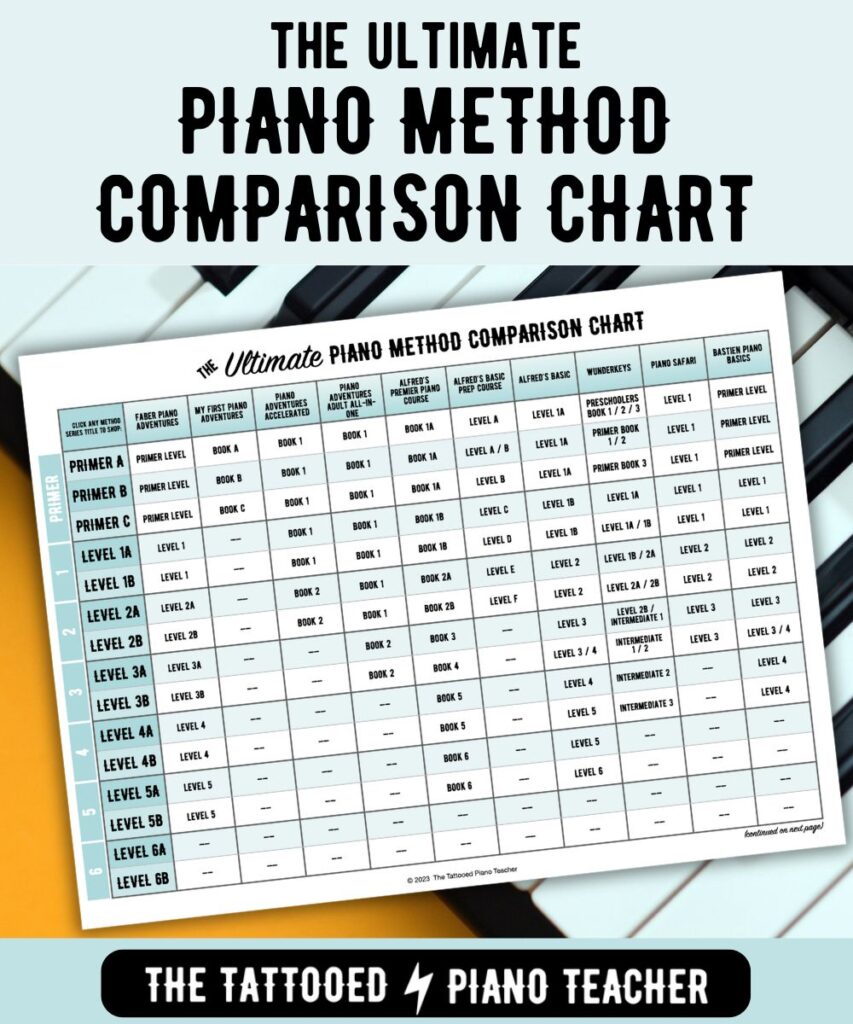
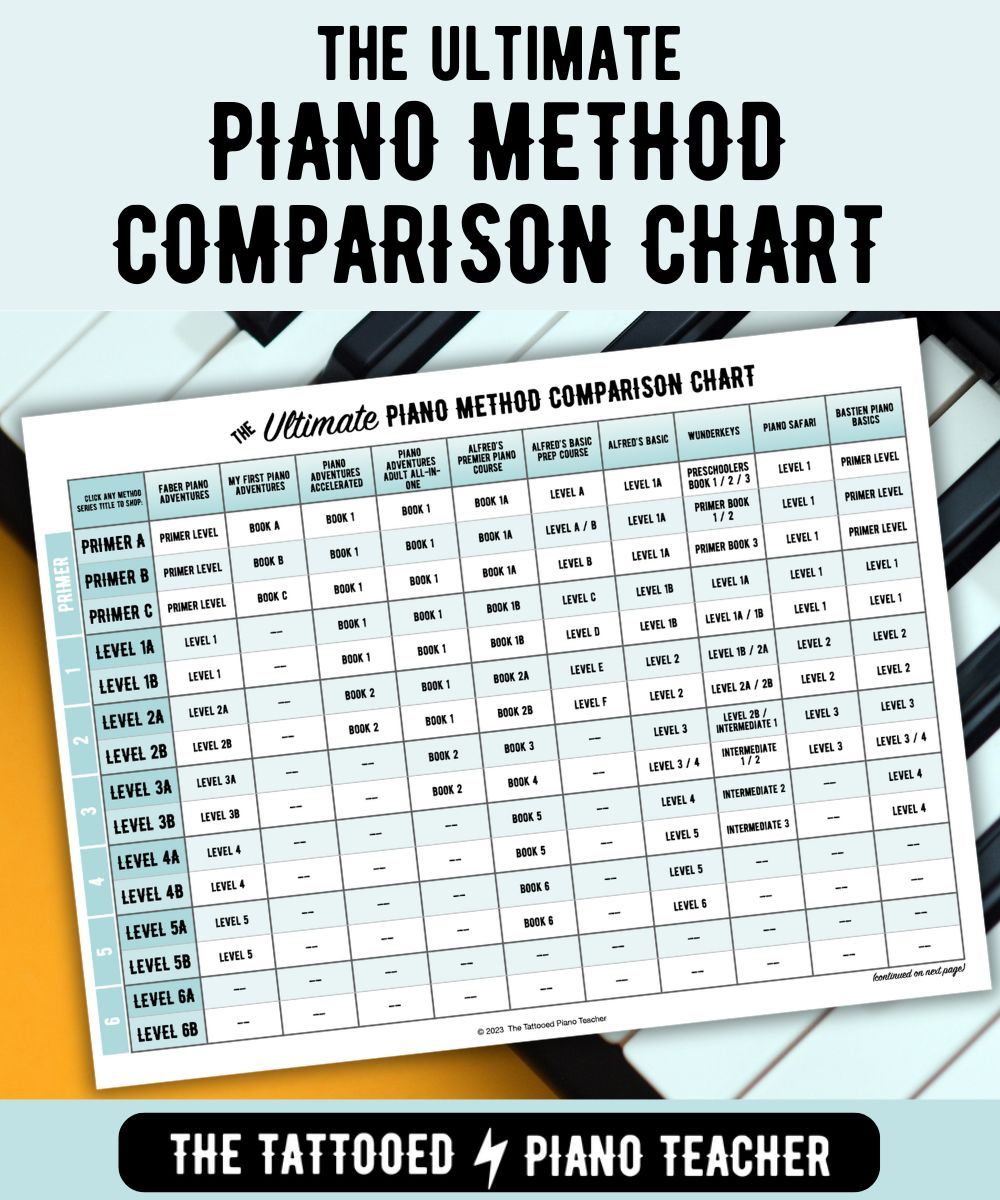
Years ago, I created a more comprehensive level-by-level chart comparing 17 of the most popular piano method series.
If you download the preview chart and are wondering, “But I don’t use Piano Adventures! How with this help me?” This chart below could be helpful in comparing Piano Adventures to your favorite method series.