Have you ever had a piano student who actually practices at home, but you’re just not seeing much progress from week to week?
As piano teachers, we’re constantly encouraging our students to practice more. We ask them to practice every day, recommend a certain number of minutes, and remind them that consistent practice is essential to making progress.
But what if the problem isn’t how much they’re practicing? What if they don’t really understand what they’re supposed to be accomplishing during that practice time?
I want to share a simple change you can make to your students’ weekly assignments that can help them practice more effectively and, potentially, make them more motivated to sit down at the piano in the first place.
And to explain this concept, I’m going to start with an analogy that has absolutely nothing to do with music!
Practicing Piano Is Like Stirring Brownie Batter
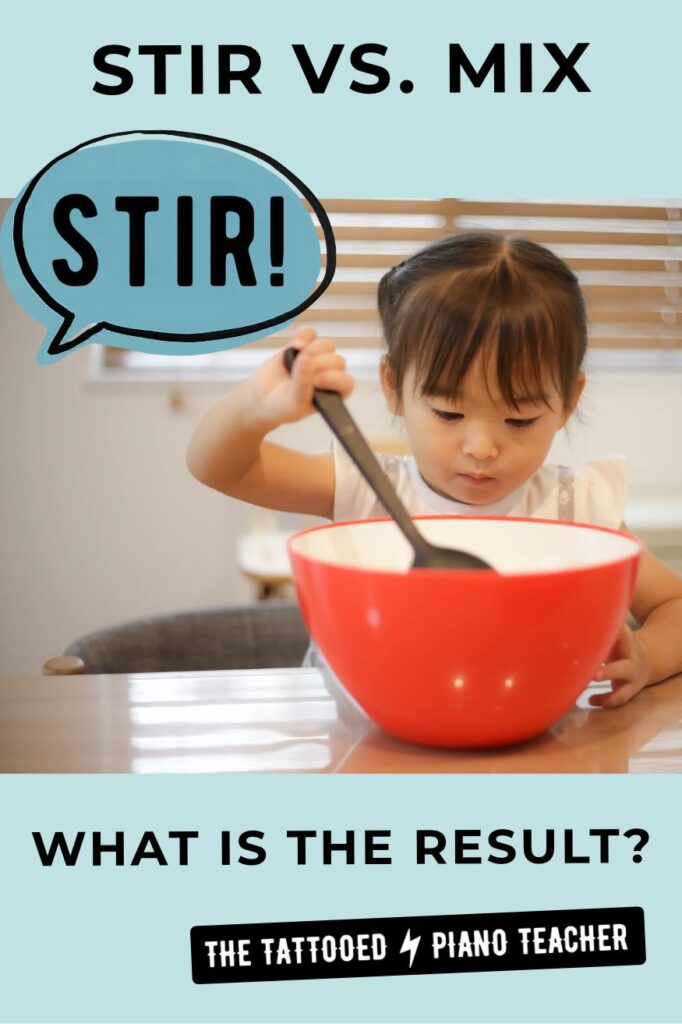
When my son was little, he loved helping me bake. We’d dump all the ingredients into a mixing bowl, I’d hand him a big spoon, and tell him to stir while I cleaned up the kitchen.
A few minutes later, I’d come back to find him still stirring away, but nothing was actually getting mixed! The flour was still sitting in one corner, the wet ingredients were in another, and he was just moving the spoon around and around.
I’d gently take the bowl and spoon from him, make a few strategic movements, and suddenly all the ingredients were incorporated.
Why could I accomplish in a few seconds what he hadn’t managed to do in several minutes?
Because he was trying to STIR, and I was trying to MIX.
He was doing exactly what I’d asked him to do. But while he was focused on the motion of stirring, I understood the purpose of that motion. I knew the ingredients needed to be incorporated, and I knew how to accomplish that goal.
Now think about how we assign piano practice. When we tell our students to “practice page 17” or even “practice for 30 minutes” are we essentially telling them to “stir?”
Are We Assigning Practice or Assigning Progress?
Think about some of the instructions we regularly give our piano students:
- Practice this song.
- Practice more this week.
- Practice your assignments every day.
- Practice for 15 minutes.
The truth is, for many students, just getting them to practice…at ALL (or more) is priority one as it should be! But as teachers, are we stuck in “Get Them to Practice” mode that we aren’t seeing or serving the students who actually are practicing but need more support?
Some students already know how to practice effectively. They can identify problem areas, isolate difficult passages, and work through challenges independently. They’re good to go.
But others may play through a piece repeatedly without correcting mistakes, or spend their practice time playing only the sections they already know well. They’re putting in the time, but not necessarily making progress. That’s who this article is for.
And this is where micro practice goals come in. By giving students a specific, achievable challenge, we provide direction for their practice time and something meaningful to work toward.
Why Micro Practice Goals Can Be More Motivating
Think about how video games work. Have you ever had to tell your child to play a video game for 20 minutes? Probably not!
Kids will happily spend hours playing games, even when they get challenging, because there’s a constant cycle of challenges and rewards. Complete one objective, unlock the next, and keep going!
Piano practice can work the same way. Rather than assigning a certain number of minutes, we can give students specific, achievable goals that make practicing more motivating and rewarding.

And here’s another benefit:
When students focus on improving ONE aspect of a piece, they often improve several other aspects along the way.
Let me show you what I mean with some examples from the Piano Adventures method books.
4 Examples of Micro Practice Goals for Piano Students
These examples range from Level 1 through Level 3A, but the strategies can be applied to just about any piece of music at any level.
1. Dynamics: The Lonely Pine (Piano Adventures Level 1)
Let’s say you have a student working on The Lonely Pine in Level 1. There are several things we could focus on in this piece, including reading the higher treble clef notes, coordinating the pedal, and mastering the movement in measure 6.
But instead of assigning all of those things individually, what if we focused on the dynamics?
The student’s goal for the week could be to master the dynamic changes throughout the piece, including the soft left hand against the louder right hand, the mezzo forte in the second line, and the quiet ending.
As they work toward achieving those dynamic changes, they’re also getting additional experience with the pedal, reading those higher notes, and navigating the tricky movement in measure 6.
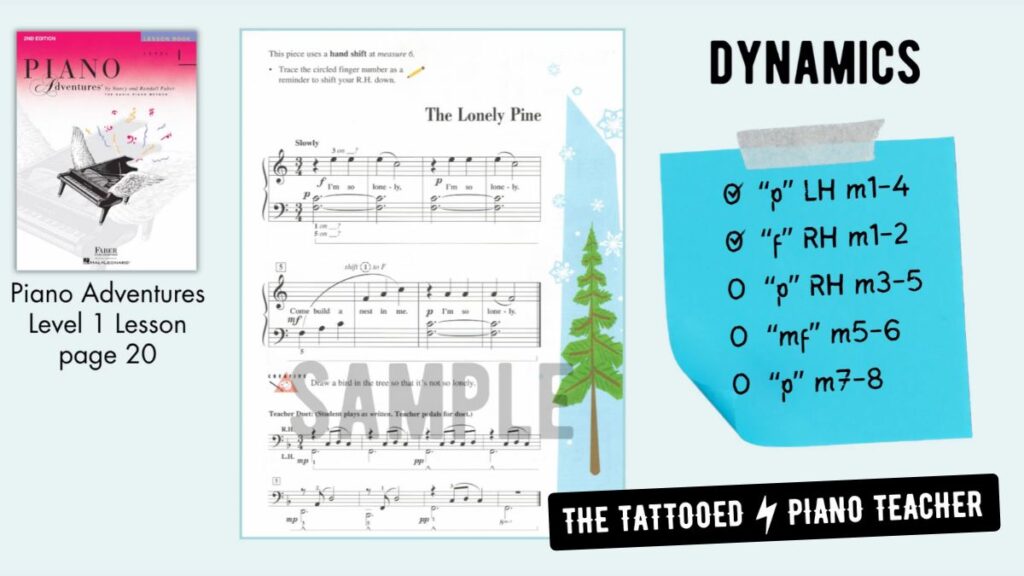
To make the assignment more tangible, we could create a checklist of the different dynamic changes:
- Soft left hand in measures 1–4
- Forte right hand in measures 1–2
- Soft right hand in measures 3-4
- Louder on the second line
- Quiet ending
Another option would be to have the student create a color-coded dynamics map on a separate piece of paper. They could keep that map inside their book as a visual reminder of the musical changes they’re working toward, and perhaps even use it to memorize the piece!
2. Articulation: The Queen’s Royal Entrance (Piano Adventures Level 2A)
Now let’s move up to Level 2A and look at The Queen’s Royal Entrance.
One of the challenges in this piece is moving fluently between the D major and C major chords. We could certainly tell the student to practice those chord changes until they become comfortable, but what if we approached the assignment from a different angle?
What if the goal was to make every articulation as clear and expressive as possible?
We’re talking about crisp staccatos, smooth legatos, and strong, punchy accents that really give the piece its character.
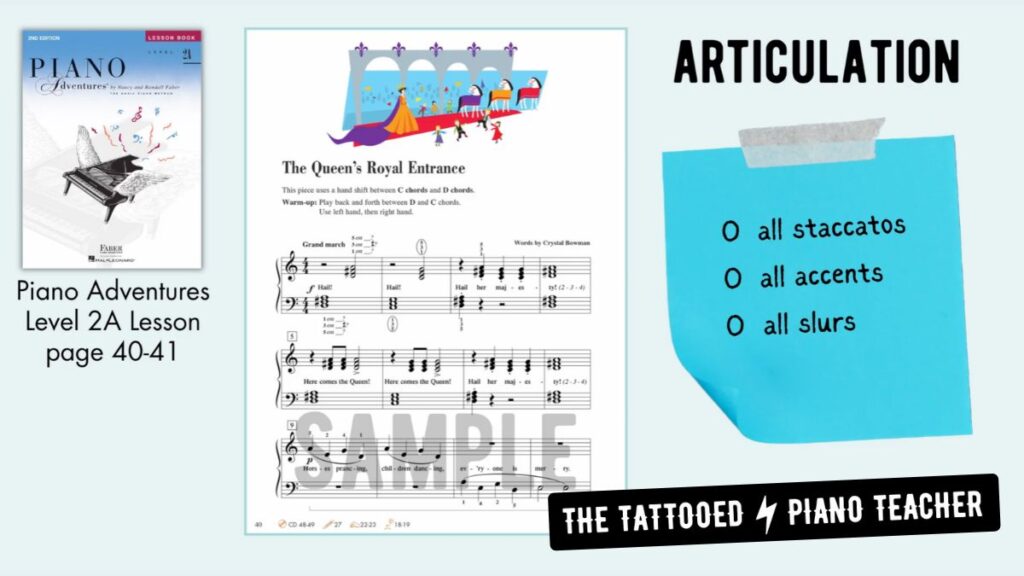
While the student is concentrating on those articulations, they’re also practicing the correct notes, rhythms, and chord changes. They may end up playing those tricky chord transitions many more times than they would have if we’d simply told them to practice moving between the chords.
Again, we can make this assignment more concrete with a checklist or a color-coded articulation map. Perhaps the student checks off each type of articulation once they’ve mastered it.
3. Repetition: Pumpkin Boogie (Piano Adventures Level 2B)
Next, let’s look at Pumpkin Boogie from Level 2B.
One of the challenges in this piece is the syncopated rhythm that first appears in measure 4. But rather than assigning a general goal to improve the syncopation, we could give the student a very tangible repetition challenge.
Play measure 15 through the end of the piece ten times before your next lesson.
Draw ten little circles or checkboxes in their assignment book and have them mark one each time they complete that section. They can do all ten repetitions in one day, spread them throughout the week, or divide them however they’d like.
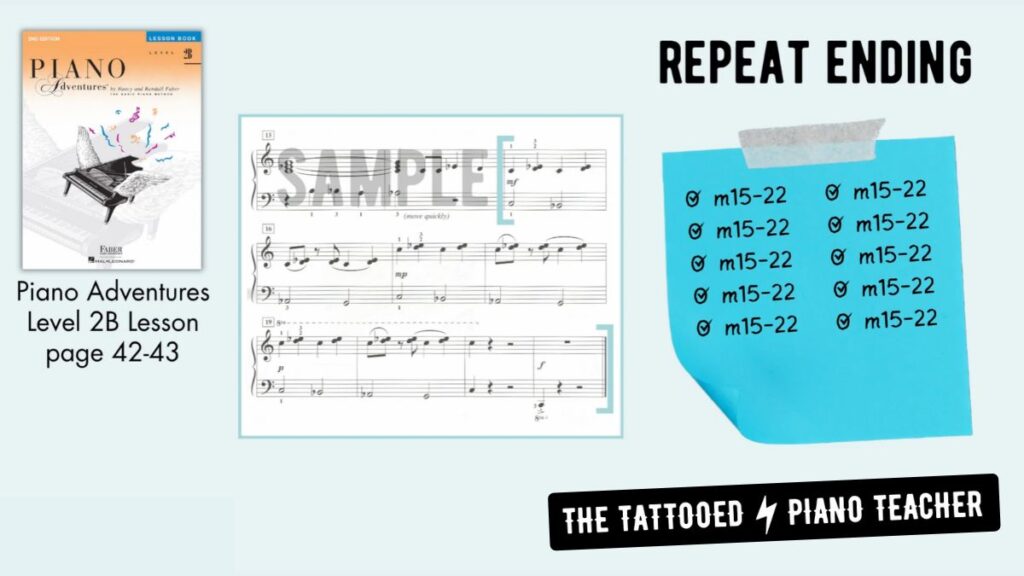
Each time they work on that ending, they’re practicing the upward movement, the gradually decreasing dynamics, AND the syncopated rhythm.
Of course, this strategy works best when the student already understands how to play the passage correctly. We don’t want to encourage ten repetitions of the same mistakes! But for a student who understands the music and simply needs more experience playing it, a repetition challenge can be a useful way to encourage that additional practice.
4. Speed: Chariot Race (Piano Adventures Level 3A Technique)
Let’s say your student is working on Chariot Race in the Level 3A Technique & Artistry book. They’ve learned the notes and rhythms, but they just can’t seem to get the piece up to speed.
In my experience, students can often play the opening section quite quickly, but things start slowing down around measure 5.
So instead of telling the student to practice the entire piece faster, let’s focus on a portion of that middle section and give them a metronome challenge.
Start at a tempo they can already play comfortably, or even a little slower. Let’s say quarter note = 50. Then create a series of incremental tempo goals for the student to work through.
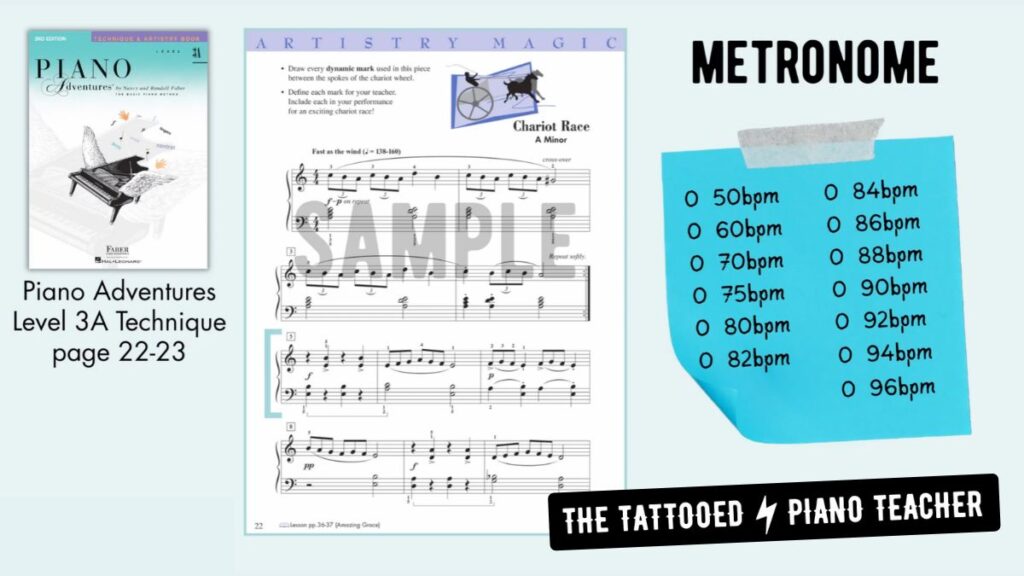
The student checks off each tempo once they can play the assigned section accurately and steadily. You can adjust the increments and final tempo to suit the student’s current abilities, of course.
By the time they’ve reached that final tempo, they’ve likely played the most difficult section of the piece MANY times. They’ve worked on accuracy, coordination, and fluency while focusing on one very clear objective: getting faster!
FREE Printable: Micro-Goals for Piano Students
Need some inspiration for your own students?
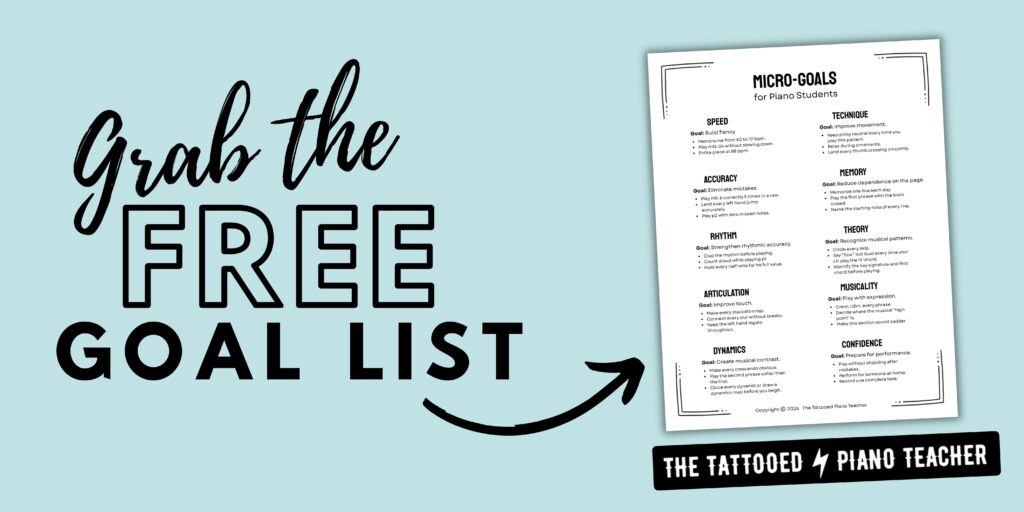
I’ve created a Free Micro-Goals for Piano Students Cheat Sheet with 30 practice goal ideas in ten different categories: speed, accuracy, rhythm, articulation, dynamics, technique, memory, theory, musicality, and confidence.
Each category includes three examples that you can use as written or adapt to whatever your student is currently working on.
Print it out and keep it near your piano or in your teaching binder for those times when you’re drawing a blank on what kind of practice goal to assign!
How to Create Your Own Piano Practice Micro-Goals
The most effective micro-goal will depend on your student, the piece they’re working on, and what they need to improve right now.
When you’re creating your own goals, I recommend thinking through three questions.
1. What Are They Improving?
Identify the specific skill or problem you want the student to work on. Maybe it’s a difficult rhythm, an awkward hand movement, a dynamic contrast, or a section that needs to be played faster.
For example, let’s say your student is struggling with a left-hand leap from G down to C.
2. How Are They Going to Improve It?
Decide on a practice strategy that will help the student accomplish that goal.
For our left-hand leap, perhaps we’re going to have the student practice the movement with a metronome, beginning slowly and gradually increasing the tempo. We might start with just the two notes involved in the leap before incorporating the surrounding measures.
3. How Will They Know They’ve Achieved the Goal?
This is the most important part! Your student should be able to recognize when they’ve successfully completed the assignment.
For our left-hand leap, perhaps the final goal is to perform the movement accurately at quarter note = 100.
So our complete micro-goal might be:
Practice the left-hand leap from G down to C using gradually increasing metronome tempos until you can play it accurately at 100 BPM.
Now the student knows what to work on, how to work on it, and when they’ve accomplished the assignment.
What If the Student Doesn’t Meet Their Practice Goal?
Not every student is going to come back the following week having accomplished their micro-goal. And that’s okay! In fact, that gives us some valuable information.
Perhaps the goal was too difficult, the student didn’t understand the practice strategy, or they simply didn’t spend enough time working on it. Whatever the reason, we now have something specific to discuss and adjust.
Compare that to a student who comes back after a week of being told to “practice more.”
- Did they practice more?
- Did they practice effectively?
- Did they improve anything?
With micro-goals, we have a much clearer picture of what the student was trying to accomplish and where they may need additional support. And when they DO accomplish their goal, they get to come back to their lesson proud of something specific they’ve achieved!
Better Piano Practice Starts With Better Assignments
When we’re trying to get piano students to practice more consistently, it’s tempting to focus on how many minutes they spend at the piano or how many days they practice each week.
And those things do matter. Some students genuinely need encouragement to practice more often, while others already have effective practice skills but struggle to make time for the piano.
But for students who don’t yet understand how to practice effectively, simply increasing their practice time may not be the solution.
One of my favorite piano practice tips is to stop thinking only about how MUCH students are practicing and start considering what they’re actually accomplishing during that time.
So the next time you’re about to tell a student to practice page 17, consider what you actually want them to accomplish on that page. Is there a musical detail to master, a difficult movement to improve, or a measurable goal they could work toward throughout the week?
Instead of telling students to stir, let’s teach them to MIX.
Want to Go Deeper? Creating Independent Practicers
Giving students specific practice goals is an excellent starting point, but ultimately, we want them to develop the skills to recognize problems and create their OWN practice goals.
That’s exactly what I discuss in my members-only Deep Dive, Creating Independent Practicers.
In that video, I share how I teach students to practice DURING their piano lessons, including ways to observe their practice habits, guide them through problem-solving, and gradually help them become more independent musicians.
Members in Tiers 2 and 3 also have access to my growing library of Deep Dives, book flip-throughs and play-throughs, Book of the Month features, behind-the-scenes lesson footage, and more.
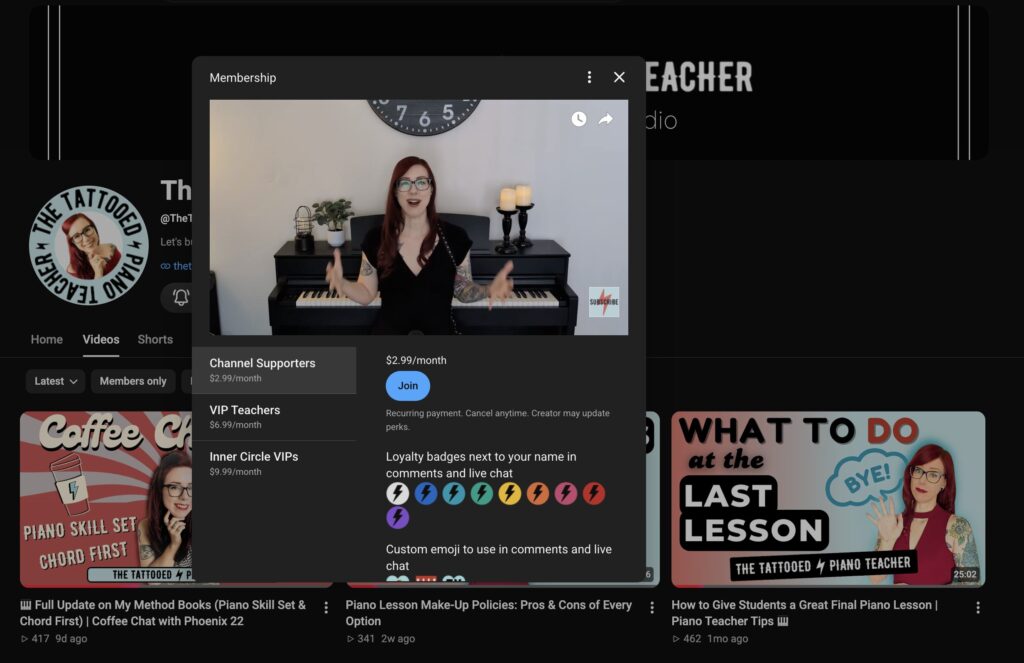
Learn more about The Tattooed Piano Teacher membership.

Take Goal Setting a Step Further with the Piano Skill Set Assignment Book
If you want to make goal setting a regular part of your students’ piano lessons, check out my Piano Skill Set Goal Setting Assignment Book.
This 5″ x 8″ book includes 52 weekly assignment pages with space for weekly priorities, individual assignments, and daily practice tracking. It’s designed to help students stay organized while giving teachers a convenient place to record specific practice goals.
But it goes beyond weekly assignments! Each quarter includes goal brainstorming pages, a practice contract, and a progress chart so students can work toward larger goals throughout the year.
It’s a great way to combine the short-term micro-goals we’ve discussed in this article with longer-term goals that students can track over time.