If you are a piano teacher, you have probably heard someone say that you “need” an email list.

But do you really?
The honest answer is: not always.
Some piano teachers are completely fine without an email list. If your studio is full, your waitlist is healthy, and you have no interest in teaching online, selling resources, running camps, or growing beyond your current setup, you probably do not need to add one more thing to your plate.
But if you are trying to grow your piano studio, fill group classes, teach online, run music camps, sell digital resources, or build a business beyond weekly private lessons, an email list can become one of the most useful tools in your business.
In this post, I’ll walk you through who needs an email list, who probably does not, what an email list can actually do for a piano teacher, and how to start one without making it complicated.
I’ll also share two email marketing platforms I’ve personally used. Both are solid options, but they serve slightly different needs.
This post contains affiliate links, which means I may earn a commission if you sign up through my links, at no extra cost to you.
What Is an Email List?
An email list is simply a list of people who have given you permission to email them.
For piano teachers, that might include:
- Current piano families
- Prospective students
- Parents interested in summer camps or group classes
- Customers who buy your digital resources
- Blog readers or YouTube viewers who want to hear more from you
You can use an email list to send studio updates, announce openings, promote events, share practice tips, sell resources, or keep in touch with people who are interested in what you offer.
It does not have to be complicated.
At its most basic, an email list gives you a direct way to reach people who already said, “Yes, I want to hear from you.”
Do All Piano Teachers Need an Email List?
No.
Let’s start there, because I do not think every piano teacher needs to jump into email marketing just because business influencers say so.
You may not need an email list if:
- Your studio is full and stays full through referrals
- You have a waitlist and do not need more inquiries
- You only teach local private lessons
- You are not interested in selling online
- You do not run camps, group classes, workshops, or special events
- You already communicate with your piano families effectively through another system
If that sounds like you, an email list may be unnecessary right now.
But if you are hoping to grow in any direction, it is worth considering.
Piano Teachers Who Should Consider Starting an Email List
An email list becomes much more valuable when you are trying to build something beyond a simple full studio.
Here are the piano teachers who may benefit most.
1. Piano Teachers Who Want to Fill Studio Openings
If you occasionally have openings and feel like you have to scramble to fill them, an email list can help.
Instead of posting once on social media and hoping the right local family sees it, you can email people who have already shown interest in your studio.
For example, you could email:
- Past inquiries
- Current studio families who may know someone
- Local parents who downloaded a free beginner piano guide
- Families interested in summer lessons or trial lessons
This gives you a warmer audience than a random social media post.
2. Piano Studio Owners Who Run Camps or Workshops
If you run summer camps, composition camps, group classes, theory workshops, studio events, or seasonal programs, an email list can be incredibly useful.
Events usually need more promotion than regular lessons.
You may need to remind families:
- What the event is
- Who it is for
- When registration opens
- Why it is valuable
- When spots are almost full
An email list gives you a simple way to promote these opportunities without relying only on social media or one announcement at lessons.
3. Piano Teachers Who Want to Teach Online
If you want to teach online, your audience is no longer limited to your town.
That is exciting, but it also means you need a way to build trust with people who may not know you personally.
An email list can help you stay connected with potential online students or families while they are deciding whether to work with you.
You could use email to share:
- Practice tips
- Student success stories
- Online lesson availability
- Helpful videos
- Your teaching philosophy
- Answers to common questions about online piano lessons
When someone is considering online lessons, they may not be ready to sign up the first time they find you. Email gives them a way to stay connected until they are ready.
4. Piano Teachers Who Want to Start Group Classes
Group classes are wonderful, but they often require a different kind of marketing than private lessons.
You are not just filling one weekly lesson spot. You may need to fill several seats at once.
An email list allows you to announce the class, explain who it is for, and follow up with reminders before registration closes.
This works especially well for:
- Preschool music classes
- Beginner group piano
- Theory clubs
- Partner lessons
- Summer group classes
- Homeschool music classes
- Adult beginner classes
If you want to fill a group, you need a way to reach more than one family at a time.
5. Piano Teachers Who Sell Digital Products or Teaching Resources
If you sell sheet music, printable worksheets, games, method books, courses, or digital downloads, an email list is one of the best ways to market those products.
Social media can help people discover you, but email is where you can build a stronger connection.
You can use email to:
- Announce new products
- Share teaching ideas
- Send seasonal resource recommendations
- Promote sales carefully
- Highlight customer favorites
- Launch courses or memberships
For piano teachers who sell to other teachers, this is especially important.
Someone might find you through a blog post, Pinterest pin, YouTube video, or Instagram post. But if they leave without joining your email list, you may never reach them again.
6. Piano Teachers Who Create Content
If you are writing blog posts, making YouTube videos, posting teaching or practice tips, or creating social media content, an email list gives your audience a place to go next.
This matters because social media platforms are unpredictable.
You do not control:
- Who sees your posts
- When they see them
- Whether the algorithm likes your content this week
- Whether a platform changes its rules
Email gives you more control.
It does not replace content creation, but it supports it.
For example, a piano teacher could make a YouTube video about beginner piano practice tips and invite viewers to download a free practice checklist. That checklist adds people to the email list. Then, over time, those people can learn more about lessons, resources, or studio offerings.
What Should Piano Teachers Send to Their Email List?
This is where many teachers get stuck.
They think, “Okay, I made an email list. Now what am I supposed to say?”
You do not need to write fancy newsletters.
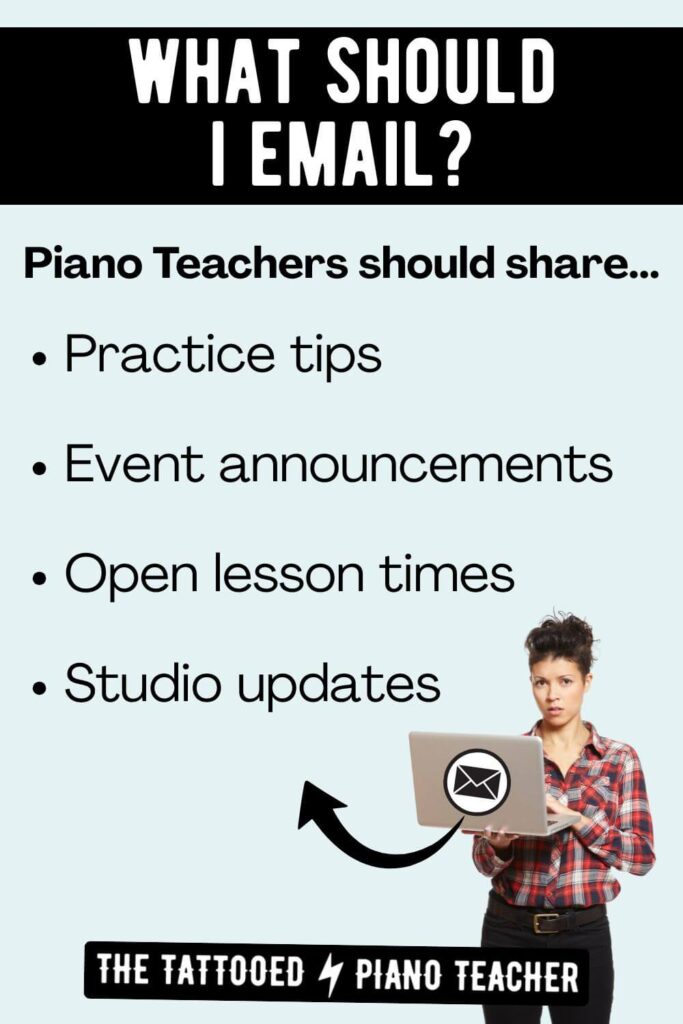
Here are simple email ideas for piano teachers:
- Practice tips for parents
- Studio updates
- Open lesson spots
- Camp registration announcements
- Group class invitations
- Seasonal practice ideas
- Recital reminders
- New blog posts or YouTube videos
- Favorite teaching resources
- New digital products
- Behind-the-scenes studio updates
- Answers to common parent questions
The goal is not to write a novel every week.
The goal is to stay helpful and stay visible.
How Often Should Piano Teachers Email Their List?
You do not need to email frequently to make an email list effective.
For most piano teachers, one email every 2–4 weeks is more than enough to stay on families’ radar without overwhelming them.
Remember, you are not trying to become a newsletter writer. You are simply staying visible to families who may be considering lessons now or in the future.
If you only email when you have an opening or announcement, that can still work. But sending occasional helpful or engaging emails in between makes a difference. When families hear from you more regularly, they are more likely to remember you when they are ready to enroll.
Here are a few simple types of emails you can rotate through:
- A quick tip for parents (how to help their child practice, how to choose a keyboard, etc.)
- A behind-the-scenes look at your studio (recitals, activities, student progress)
- A reminder of what you offer (beginner lessons, group classes, summer options)
- An announcement (open lesson times, new class openings, upcoming camps)
A simple rhythm could look like this:
Week 1: Parent tip or beginner advice
Week 3: Studio update or student highlight
Week 5: Reminder about lessons or how to get started
Week 7: Announcement (openings, camps, or group classes)
This does not need to be rigid or perfectly scheduled.
The goal is simply to stay consistent enough that when a parent thinks, “I should get my child into piano lessons,” your name comes to mind first.
How to Start an Email List as a Piano Teacher
Here is the simple version.
Step 1: Choose an Email Marketing Platform
You need an email service provider. This is different from sending regular emails through Gmail.
An email marketing platform lets you collect subscribers, create signup forms, send broadcasts, and follow email laws such as unsubscribe links.
Two platforms I have personally used are Kit and Flodesk.
Kit
Kit (formally ConvertKit) is a strong option if you want more organization and automation.
It is especially helpful if you plan to:
- Tag subscribers by interest
- Create email sequences
- Build funnels
- Sell digital products
- Segment parents, students, or customers
- Grow a more advanced online business
Kit can be a great fit if you want more flexibility and structure behind the scenes.
Flodesk
Flodesk is a strong option if you want emails that are easy to design and beautiful right away.
It is especially helpful if you want:
- Pretty email templates
- A simpler writing experience
- Nice-looking signup forms
- A more visual platform
- Less tech overwhelm
Flodesk can be a great fit if you want something clean, simple, and easy to use.
You can check out Flodesk here.
Step 2: Create a Simple Freebie
You do not technically need a freebie to start an email list, but it helps.
A freebie gives people a reason to join.
For piano teachers, freebie ideas might include:
- How to shop for a piano/keyboard guide
- “Before your first lesson” guide
- Piano parent practice tips
- Free printable theory resource
- FAQs about piano lessons (“Is four too young to start?” etc)
Keep it simple.
Your freebie does not need to be huge. In fact, smaller is usually better.
A helpful one-page checklist can work better than a giant PDF nobody reads.
Step 3: Create a Signup Form
Once you have your platform and freebie, create a signup form.
You can place your signup form:
- On your website homepage
- At the bottom of blog posts
- In your YouTube description
- On your studio inquiry page
- On your social media profile
- On a dedicated landing page
- In your digital product shop
- In your email signature
The goal is to make it easy for interested people to join.
Step 4: Send a Welcome Email
When someone signs up, they should receive a welcome email.
This email can be simple.
Include:
- The freebie they requested
- A short introduction
- What kind of emails they can expect from you
- One helpful link or next step
For example:
“Thanks so much for joining my email list! You can download your practice checklist here. I’ll send occasional practice tips, studio updates, and resources to help make lessons a little easier.”
That is enough.
You do not need a complicated automation sequence when you are just starting.
Step 5: Send Regular Emails
Once your list is set up, the most important step is actually using it.
Start with one email every other week if weekly feels overwhelming.
Keep it simple. Helpful is better than perfect.
You could share:
- One quick practice tip
- One useful resource
- One studio update
- One new video
- One product recommendation
- One upcoming opportunity
The list only works if you communicate with it.
Kit vs. Flodesk for Piano Teachers
Both Kit and Flodesk can work well for piano teachers.
Here is how I would think about it.
Choose Kit if you want:
- More powerful tagging
- More advanced automations
- Better subscriber organization
- More room to grow into funnels or digital product sales
- A platform that feels built for creators
Choose Flodesk if you want:
- Beautiful email design
- A simpler interface
- Easy-to-use templates
- Pretty forms and emails
- A platform that feels less technical
The truth is, both can work.
One Pro Tip: Switching email platforms is a hassle. Think long-term when researching. Don’t just look at the starting cost, but how much each one will cost once you hit 100 subscribers…250 subs…500 subs…etc.
Common Mistakes Piano Teachers Make With Email Lists
Mistake 1: Waiting Until Everything Is Perfect
You do not need a perfect website, a perfect freebie, or a perfect email strategy.
You can start with a simple form and one helpful download.
Mistake 2: Only Emailing When You Want to Sell or Book
If every email is a promotion or announcement, people may tune out.
Mix helpful content with occasional offers.
Mistake 3: Making the Freebie Too Big
A 40-page freebie is not automatically better.
Think useful, quick, and easy to consume.
Mistake 4: Not Linking to the Signup Form Often Enough
People need reminders.
Share your signup form on multiple pages on your website, the footer, video descriptions, social media profiles, and shop pages.
Mistake 5: Overcomplicating the Tech
You do not need a complicated funnel when you are starting.
Start with:
- One platform
- One freebie
- One signup form
- One welcome email
- One regular email rhythm
That is enough.
Is an Email List Worth It for Piano Teachers?
For many piano teachers, yes.
Not because every teacher needs to become a marketing expert.
Not because you need another thing to manage.
But because an email list gives you a direct way to reach people who are interested in your studio, your teaching, your resources, or your future offers.
If you only want to teach a full private studio and you are already there, you may not need one.
But if you want to grow your studio, fill camps, launch group classes, teach online, sell resources, or build a more flexible piano teaching business, an email list is worth considering.
Start small.
Choose a platform.
Create one helpful freebie.
Invite people to join.
Send something useful.
That is how it begins.
Ready to Start Your Email List?
If you are ready to try an email marketing platform, these are the two I have personally used and recommend considering:
Both are good options. Kit is great if you want more organization and automation. Flodesk is great if you want beautiful emails and a simpler design experience.
Pick the one that feels easiest for you to use, because consistency matters more than choosing the “perfect” platform.