I remember the days leading up to teaching my first piano lesson.
I looked through the first few pages of the method books I had chosen–again.
I looked over my notes–again.
Was what I had planned enough to fill thirty minutes? Too much?
I really had no idea what to expect!
Whether you’re a brand new piano teacher or you’ve been doing this a while, I hope to bring you a template that you can use to plan, confirm, or tweak your current lesson planning.
Every Piano Lesson Will Look Different
Before I give you any advice or lesson planning schedules, I want to be clear that these guides are just a suggestion–a starting point, if you will.
The longer you teach, the more you’ll make adjustments and adaptations on the fly.
So, to be clear, these lesson plan templates should not be followed to a tee for every student, every week.
Be flexible. Read the room. And let each student show you what they need within each lesson.
Flexibility > Rigidity
That being said, starting with a plan in mind can be an invaluable tool to prepare for each lesson and be the best piano teacher possible to each of your students!


How Long Should Piano Lessons Be?
I know 30-minute piano lessons remains the standard, so that’s where we’ll start.
Personally, I love teaching 40-minute lessons. Read all about why I ditched 30-minute lessons here.
For the purpose of this post, I’ll share piano lesson plan templates for:
- 30 minute Piano Lessons
- 40 minute Piano Lessons
- 60 minute Piano Lessons
If you teach 45- or 50-minute lessons, simply adjust the 40- or 60-minute templates to fit your timeframe.
Breaking Down the Sections of a Piano Lesson
Before I share a minute-to-minute schedule of a typical private piano lesson, we must first define the different sections or activities that take place in a piano lesson.
This way when I say “Technique” we’re on the same page about what that actually means in the context of a lesson.
In-and-Out-the-Door Buffer
In each of my lesson plans below, I’ll include five minutes total for students to come in the door, get set up, chit-chat, and subsequently gather their things and get out the door.
If you have a slow poke student or a chatty parent, adjust the “In/Out” time accordingly.
Carving Out Time for Warm-ups
You’ll also notice each lesson plan includes time for a warm-up (for students age 6 and up).
In most cases, this designated warm-up time is separate from Technique work.
5-minute Warm-ups
You’ll also notice that warm-ups are allotted five minutes–across the board.
The reason for this “five minute rule” is my belief that each student should have an easily-playable, yet mildly challenging warm-up assigned at every stage of their journey.
If the warm-up routine takes longer than five minutes to play through, it’s too difficult. This I would consider technique work, rather than warm-up material.
Warm-ups should always be one step below the student’s level so they are actually warming up.
Of course, every warm-up has to be figured out and mastered when first assigned. In this case, warm-ups may temporarily exceed five minutes.
Warm-ups vs Technique
The WARM-UP is a 5-minute technical routine played by the student at the start of each lesson.
TECHNIQUE is any assignment from a technique book, or the learning of new scales, arpeggios, chords, etc.
What Should I Assign as the Warm-up?
I’m planning a future article all about warm-ups, but briefly, warm-ups can be:
- Scales or scale patterns
- Arpeggios or arpeggio patterns
- Chords or chord patterns
- Fingerpower, Hanon, Czerny, or other technical patterns
- Something out of the student’s Technique book
- A technical passage from a piece
Anything is game just so long as it meets the above rule of being five minutes or less and staying at a mildly challenging level for the student.
Need Warm-ups for Your Piano Students?
If you’re looking for something fresh to try with your students, I have created warm-up packs for every level which cycle through the keys hitting scales, arpeggios, and chords in a logical and motivating progression.

Lesson Book Work
In the suggested schedules below, you’ll see time carved out for “Lesson.”
This time should be used for:
- Reviewing last week’s assignment in the main lesson book
- Reassigning or improving currently assigned pages in the lesson book
- Covering a new topic or unit introduced within the lesson book
- Introducing and assigning a new page in the lesson book (which could include sight-reading, listening, or marking the piece)
Theory Time
When you see “Theory” in the schedules below, this is the part of the lesson dedicated to introducing and reviewing music theory concepts relevant to the student’s studies. Theory should be a part of every student’s piano lessons, whether you use a designated Theory book that goes with your Lesson book, select a separate Theory book or your choosing, or just use your own knowledge and resources to insert theory instruction where relevant.

Theory time should be used for:
- Checking over a theory writing assignment the student completed at home
- Introducing and demonstrating a new theory concept
- Assigning a theory writing page to be completed at home
- Completing a theory writing page together
- Playing a music theory game
- Working through flash cards
- Talking about music history
- Listening to music together
- Doing an ear training exercise
- Tapping rhythms
- Sight-reading or sight-singing
If you’re looking for some fresh theory resources, oh boy, do I have some options for you!
I create my own series of Theory Writing Books called Piano Skill Set.
I also make a ton of printable theory games, activities, and worksheets. Browse these digital products here.
Performance or Literature Work
Each lesson plan will also include time to work on pieces assigned outside of the main Lesson book.
Your student may have a Performance Book that correlates to their Lesson book.
Or your student may have a “fun” replacement songbook as their Performance Book. This could be a Jazz Book, Pop Book, Movie Hits Book, Kids’ Songs Book, or any other supplemental book that includes a collection of songs they are working through.
Older students may instead have a Repertoire or Literature Book that they are working through. Or perhaps if they are more advanced, they will simply have a single bigger piece that they are working on for an extended period of time.
You may also allow your students to choose a “fun” piece, such as a Sheet Music Single from a pop artist they love, a video game they’re obsessed with, or a movie they just saw.
In the shorter lesson schedules, you’ll see a general timeslot to work on 1-2 pieces in whichever of the above relevant books apply to your student.
Within 60-minute lesson plans, you’ll find that there is a separate allotted time for Performance or Literature and a “Fun” piece.
Extra Work
When you see Extra in a lesson plan, that includes any additional activity you’d like to include in the lesson.
This is only possible with longer private lessons, but this is where lessons get really fun (and you get to be creative and flexible as a teacher)!
To fill an “Extra” timeslot, you could:
- Play a game
- Include a music history lesson
- Improv or compose
- Talk about a theory concept not in the book
- Try a lead sheet
- Have fun with ear training or learning patterns by rote
- Overlap another student’s lesson for a partner activity
- Play a song for them
- Listen to something and talk about it
- Additional time for Theory
- Or anything else that lights your student up!
Special Events: Recitals and Competitions
You’ll notice there are two variations of each lesson plan.
A lesson plan for a student actively preparing for a recital, competition, recording, performance, or other special event will want to prioritize working on that piece.
In the case of a special event coming up, the lesson structure will look a bit different and the order and allotted time for each activity is reflected in that version of the schedule.
However, there are times throughout the year when students don’t have an urgent project in the works, and we can then spend a little more time on book assignments, theory, and extra activities.
30-Minute Piano Lesson Plan (Free Template)
We’ve covered all the details about the different activities within a lesson. Now it’s time to give you the step-by-step, minute-by-minute breakdown of what a 30-minute could look like. Keep in mind this is just a guideline and every lesson will flow a little bit differently.
For these lesson plan schedules, I’ll give you the amount of time each activity should take first, then I’ll give the activity name.
Remember, that you can look above at the detailed description of each activity for more ideas about how to conduct each part of the lesson in real life.

Step-by-Step Breakdown (Minute-by-Minute)
For a 30-minute private piano lesson with a student age 6 who does not have an urgent event coming up, it would look something like this:
- 5 min: In/Out
- 5 min: Warm-up or Technique
- 10 min: Lesson
- 5 min: Performance/Literature
- 5 min: Theory
If the student has a special event coming up, I would just tweak the order of things. We’ll remove the performance or literature piece that would normally be a part of the assignment in favor of the piece that is being learned for the event. In this scenario, I’ll also swap out Theory time for some extra Technique work:
- 5 min: In/Out
- 5 min: Warm-up
- 5 min: Technique
- 5 min: Special piece
- 10 min: Lesson
Notice most activities are only given five minutes. And that’s why I don’t love 30-minute lessons!
What about younger students? For students 3-5, I’ve included a special section just for them since their lesson flow will look quite a bit different than the average age student.
Download the Free 30-Minute Lesson Plan Template
If you’re a newer piano teacher, you may find it helpful to plan out each activity before the lesson begins. As a new teacher, I did this for every students for months and it really helped me to feel prepared and to come up with creative ideas, activities, and props I could get ready in preparation for my teaching days.
So, I’ve created this Lesson Plan Template just for you! The free version includes a printable pdf template to help you think out activities and keep track of assignments from week to week.


Or grab the Editable version to easily type into the fields and save or print!
Done-For-You Piano Lesson Plans
And if you want a little more guidance and assistance on what exactly to do from minute to minute within a lesson, I’ve also created done-for-you Lesson Plan Packs for new piano teachers. These aren’t free, but for a small investment, you can have a comprehensive resource to help you brainstorm how to pace out assignments, what to teach on what weeks, activities to review and make lessons fun, and much more.
Each Lesson Plan Pack gives you everything you need to teach your first six weeks of private piano lessons.
- Checklists to get you prepared
- Detailed minute-by-minute plan for each week’s lesson
- Page-by-page (song-by-song) teaching tips so you’ll look like a pro from the first lesson!
- Pre-reading song sheets you can print and use at the first lessons
- FAQs
- And the blank lesson planning template (printable & editable)
There is a Lesson Plan pack for:
- Piano Adventures®
- WunderKeys®
- Piano Skill Set (my method book series)
And then there are Lesson Plan packs for different combinations of these three method book series:
Or if you really want to explore all of your options, save 40% when you buy all five packs together in a bundle!

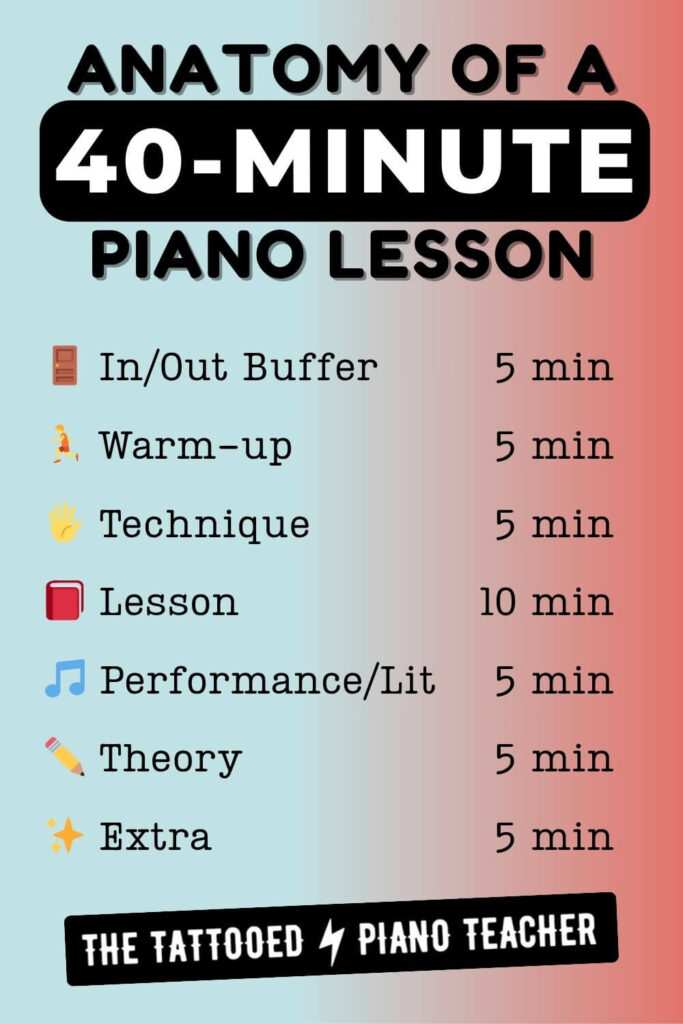
40-Minute Piano Lesson Plan
For a 40-minute private piano lesson with a student who does not have a special event coming up:
- 5 min: In/Out
- 5 min: Warm-up
- 5 min: Technique
- 10 min: Lesson
- 5 min: Performance/Literature
- 5 min: Theory
- 5 min: Extra
And for a student who has an event coming up that they are preparing for:
- 5 min: In/Out
- 5 min: Warm-up
- 5 min: Technique
- 5 min: Special piece
- 10 min: Lesson
- 5 min: Performance/Literature
- 5 min: Theory
Notice that with 40-minute lessons, although most activities are still only five minutes, we don’t have to rotate or eliminate any activities altogether, even if preparing for a recital or competition.

60-Minute Piano Lesson Plan
A student taking 60-minute lessons can really deep dive into each book and each category of the piano learning process.
For students who do not have a special event coming up, a 60 minute lesson could look something like this:
- 5 min: In/Out
- 5 min: Warm-up
- 5 min: Technique
- 15 min: Lesson
- 10 min: Theory
- 10 min: Performance/Literature
- 5 min: Fun piece
- 5 min: Extra
And for a student actively preparing for an upcoming event:
- 5 min: In/Out
- 5 min: Warm-up
- 5 min: Technique
- 10 min: Special piece
- 15 min: Lesson
- 5 min: Theory
- 5 min: Performance/Literature
- 5 min: Fun piece
- 5 min: Extra
30-Minute Piano Lesson Plan for Ages 3-5
If you have taught a young student in preschool or kindergarten, you know that you can’t sit at the piano and expect full attention for thirty minutes.
Although I’ve had a few 4- or 5-year-olds that had the ability to sit still, a lesson plan for the average 3-, 4-, or 5-year-old (or sometimes 6-year-old) piano student will look a little different:
- 5 min: In/Out
- 5 min: (Off-bench) Activity – movement, game, or manipulatives
- 5 min: (On-bench) Lesson Book
- 5 min: (Off-bench) Activity – listening, singing, or rhythm
- 5 min: (On-bench) Lesson or Supplementary Book
- 5 min: Go over assignment with student/parent

Free Lesson Plan Template for Teachers
So be sure to grab your free PDF template for piano teachers. Use this printable planning page to help you keep track of your students’ assignments from week to week as well as brainstorm creative activities and prepare for lessons with confidence!
New Piano Teacher?
If you’re a new or soon-to-be piano teacher, check out my 30-day free email challenge–“Start Your Studio.” It walks you through 12 tangible steps you can take to get your business all set up before you teach your first lesson. From business planning to finding your first student, these every-other-day emails will help you actually make this happen without too much overwhelm!
Let me know if you do decide to give the email challenge a try. I’d love to hear about your piano teaching dreams in the comments!